Activity
Mon
Wed
Fri
Sun
Aug
Sep
Oct
Nov
Dec
Jan
Feb
Mar
Apr
May
Jun
What is this?
Less
More
Memberships
Harmony
35.3k members • $27/month
Hekatean Healing & Herbalism
80 members • Free
6 Figure Tech Community
750 members • Free
7 contributions to Hekatean Healing & Herbalism
10d •
🌙 Wisdom Wednesday: Frangissa, The Sanctuary That Forgot Where It Was
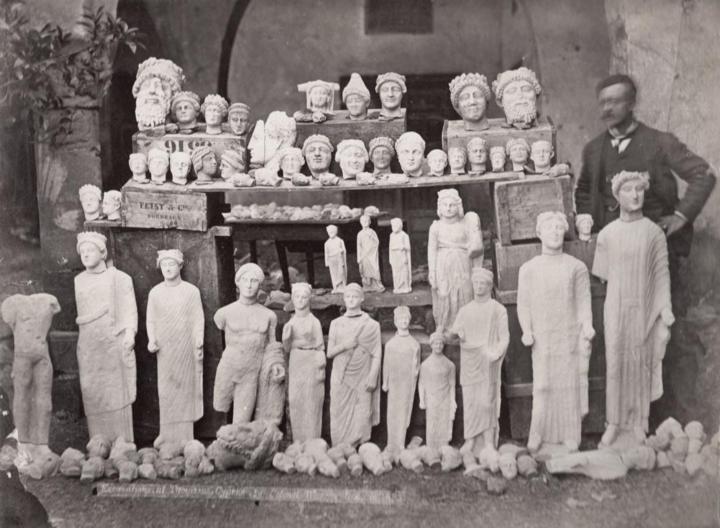
This last week Apollo came home to Delphi at the solstice. As a Hekatean witch, I honor this solar wheel. And, this week Apollo surfaces somewhere far stranger. Out of the ground itself, on Cyprus, after vanishing for 140 years. In 1885, a German archaeologist named Max Ohnefalsch-Richter stumbled onto fragments of statues in a narrow valley near the ancient royal city of Tamassos, in the area of modern Pera Oreinis. He dug. He found a rural sanctuary of Apollo packed with votive offerings — including dozens of stone bases that once held statues, left standing exactly where the ancients had placed them. Then he documented it only briefly, backfilled the site, and moved on. And the location was lost. Not metaphorically lost — actually lost. For over a century no one could say with certainty where Apollo's sanctuary at Frangissa physically was. So maddening. It took archive work across German, English, and Canadian collections, plus drone surveys and a 3D model of the valley, to relocate it around 2020. Since then, teams have been excavating. And the fifth season — reported this spring — produced what they're calling possibly the most spectacular results yet: more than 20 votive statue bases still standing in their original positions, untouched since antiquity. Here is the part that stops me. Several of those limestone bases still hold the feet of the statues that once stood on them. Stone feet. Terracotta feet. Fragments of clay figurines. The worshippers are gone, the gods' images are mostly gone — but the place where they stood to be seen by Apollo is still there, foot by foot, base by base. The dig also turned up the first undisturbed Archaic pottery from the site, finally giving hard proof of how early the worship began (7th–6th century BCE, the Archaic period). And the offerings tell a story about accumulation — about a sanctuary running out of room for devotion. In places the bases were stacked so tightly that older ones were deliberately buried under leveling fill, a flat new floor laid down, and a fresh layer of offerings installed on top. Centuries of people saying here, take this, remember me until the holy ground had to be re-floored to hold more.
2 likes • 10d
@Ra Ven what kind of music do you make?
1 like • 10d
@Ra Ven badass 🤘
Apr 19 •
🗝️ The Coven Ledger — Write Your Name 🗝️
Copy, paste, and fill in your entry! 🕯️ Name/Pronouns 🔮 Sun/Moon/Rising 🌑 Favorite Moon Phase 🌊 Favorite Element 🗝️ How’d Hekate Find You? ⚡ A song that feels like your magic: We're glad you're here. Now let us get to know you. 🖤

2 likes • Jun 3
@Tiffany Thys yeah I love that song! Their other songs are good too but they don’t speak to me as much.
2 likes • Jun 3
@Heather Hale Leo, Aries, Scorpio?! What a banger 🤩 . I am Scorpio Rising too. Great song ✨
May 26 •
🔥Tarot (Oracle) Tuesday🔥Big Pluto Day
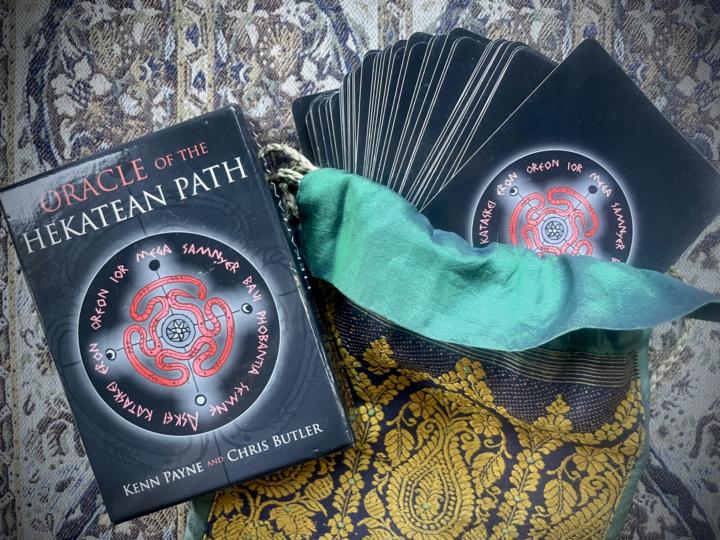
Good morning, loves! Mars square Pluto hit overnight — the first major activation since Pluto went retrograde on May 6th. Mars in Taurus pushing against Pluto in Aquarius. Comfort versus transformation. What you're holding onto versus what's trying to break through. If something felt like pressure this morning, that's why. The Week 3 prompt for Pluto Retrograde lands here: "What does my anger know that I don't?” So, let’s pull into it! Hekate Kleidoukhos — She Who Holds the Keys — has 60 doors in the Oracle of the Hekatean Path. One of them has your name on it. And on a day like today, the door She opens might not be the one you wanted. It'll be the one you need. 🗝️ Drop a number from 1–60 in the comments. I'll shuffle and count to find the message She left at the crossroads for you. Then I'll pull a supporting card from the Witches Tarot to light the way forward — because She doesn't just show you the door. She hands you the torch. Readings might roll in slow — but Pluto is retrograde and neither of us is rushing. Every single reading will come. 🕯️ 🕯️ Torchlight For Today “Pluto compels, empowers, overwhelms, transforms; it destroys and resurrects." — Richard Tarnas, Cosmos and Psyche 👇 Drop your number. Let the Keeper of Keys show you what this square is cracking open. En Erebos, Phos. In darkness, light. Blessings, Tirza 🌿🗝️🌙 #OracleTuesday #HekateanHealing #Crossroads #Kleidoukhos #PlutoRetrograde #MarsSquarePluto #OracleOfTheHekateanPath
3 likes • May 26
@Tiffany Thys 39 for me as well! This number popped into my head before I scrolled to the comments.
4 likes • May 26
@Tirza Cook thank you for this 🙏 feels spot on again.
May 24 •
🎶 Sunday Bonus: Should I Make a Hekatean Music Playlist?
Okay this has been rattling around in my head for a while. Should I put together a Hekatean Music Playlist for the community? Something you can put on during ritual, meditation, journaling, spellwork, or just when you need to feel like you're walking through a torchlit procession at 2am on a Tuesday. I'm thinking heavy on the lyre. Obviously. Ancient instruments. Dark ambient. Devotional. Maybe some folk. Maybe some things that just feel like standing at a crossroads at midnight even though technically it's a cello. I already have ideas. I have too many ideas. That's why I'm asking. 👇 Two questions: 1. Yes or no — do you want this? 2. Drop a song, artist, or vibe that feels Hekatean to you. No wrong answers. If it sounds like torchlight, I wantto hear it. En Erebos, Phos. In darkness, light. Blessings, Tirza 🌿🗝️🌙 #HekateanHealing #HekateanPlaylist #Crossroads #RitualMusic #LyreCore

3 likes • May 24
Sevdaliza gives me Hekate vibes. https://open.spotify.com/track/2g2Sy0FDOM6B5O8qcGeVnU?si=eRR2Jgp8SL24MEXMH9KEzg
May 22 •
🔥 Freewill Friday
Happy Friday, torchbearers. This is the day you speak your choice out loud. Freewill isn't about big moves. It's about conscious ones. The moment you stop running on autopilot and say — out loud, in writing, in front of witnesses — this is what I'm choosing today. Maybe it's choosing rest when everything in you says push harder. Maybe it's the conversation you've been avoiding. Maybe it's garlic on the stove tonight because yesterday's Thicket Thursday reminded you that protection starts in the kitchen. Whatever it is — name it. 👇 Drop your conscious choice of the day in the comments. Tag it #Freewill. Most likes and comments by Sunday wins a full Triple Crossroads Spread with the Oracle of the Hekatean Path — completely free. 🗝️ No judgment. Just your will, witnessed. En Erebos, Phos. In darkness, light. Blessings, Tirza 🌿🗝️🌙

8 likes • May 22
I am choosing to let go of what no longer serves me and being honest with myself about what that is.
4 likes • May 22
@Ra Ven rest without guilt!
1-7 of 7
Active 23h ago
Joined May 9, 2026