Activity
Mon
Wed
Fri
Sun
Jul
Aug
Sep
Oct
Nov
Dec
Jan
Feb
Mar
Apr
May
What is this?
Less
More
Memberships
The Peptide Daily Brief
640 members • Free
Aminos Academy
1.9k members • Free
Grey Matters Research LLC
684 members • Free
RNS-Ravens Nest
6.6k members • Free
OfficialShelbyPepTalk
1.1k members • Free
Research Peptide Community
1.7k members • Free
Biohackers Buyers Club
202 members • Free
Biohacking Peptide Playground
5k members • Free
Hacksmith's Free Peptalk Group
1k members • Free
2 contributions to Orion Peptides

6d •
GHK-Cu “Copper Peptides”: Why Skin Results Can Vary So Dramatically (and What Actually Matters Biochemically)
GHK-Cu has become one of the most discussed peptides in skin and regenerative research circles because of its unusual dual role in tissue remodeling. Some research subjects report: - improved skin texture - increased firmness - better overall tone While others report: - temporary worsening of fine lines - increased dryness or laxity - or a “worse before better” phase This inconsistency often leads to confusion, but mechanistically it’s not random. It comes down to how tissue remodeling biology actually works. GHK-Cu Is a Remodeling Signal, Not Just a “Collagen Builder” One of the biggest misconceptions is that GHK-Cu simply increases collagen. In reality, research suggests it influences both sides of tissue turnover: - collagen synthesis pathways - extracellular matrix remodeling - enzymatic breakdown of older collagen structures - wound-healing signaling cascades - and angiogenic support processes A key group of enzymes involved here are matrix metalloproteinases (MMPs), which are responsible for breaking down old or damaged collagen before new tissue can be organized. So instead of “building skin,” a more accurate description is: GHK-Cu helps regulate the remodeling cycle of skin tissue That cycle includes both breakdown and reconstruction. Why Some People Experience “Worse Before Better” Skin is not rebuilt instantly. It follows a staged process: 1. Old or disorganized collagen structures are broken down 2. The extracellular matrix is reorganized 3. New collagen is synthesized and aligned 4. Tissue gradually stabilizes and strengthens If the breakdown phase temporarily outpaces reconstruction, the visible result may include: - reduced firmness - temporary texture irregularities - or increased appearance of lines This is often interpreted as “worsening,” but in biochemical terms it may simply be an accelerated remodeling phase without immediate structural replacement. The Copper–Zinc Balance: The Overlooked Variable

0 likes • 5d
Love this peptide.
19d •
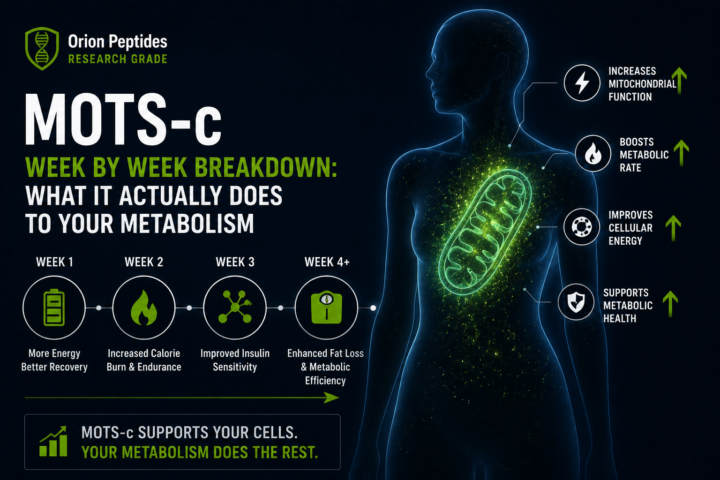
MOTS-c Week By Week Breakdown: What It Actually Does To Your Metabolism
Most people hear “fat loss” and think calories, cardio, or appetite suppression. MOTS-c doesn’t really fit that category. It’s better understood as a mitochondrial signal — one that influences how your cells communicate energy demand, stress, and adaptation. This isn’t about forcing change. It’s about shifting how your body responds to change. WEEK 1: SOMETHING FEELS DIFFERENT You may notice: - slightly more stable energy - fewer post-meal crashes - reduced cravings What’s happening: MOTS-c is associated with activation of AMPK pathways, which are central to cellular energy sensing. Your body starts becoming more efficient at recognizing energy availability and glucose handling begins to improve. WEEK 2: YOUR BODY STARTS SWITCHING FUEL You may notice: - more consistent energy through the day - less reliance on sugar - feeling lighter after eating What’s happening: Insulin sensitivity begins improving and glucose spikes may reduce. At this stage, the body starts shifting toward more flexible fuel utilization — including increased fat oxidation signaling. WEEK 3: FAT LOSS STARTS FEELING “AUTOMATIC” You may notice: - reduced appetite - less bloating - a “leaner” feeling without trying What’s happening: Mitochondrial efficiency improves and fat oxidation pathways become more active. Low-grade inflammation signaling may also begin to reduce, improving overall metabolic output. WEEK 4: YOUR METABOLISM STOPS FIGHTING YOU You may notice: - steady energy without crashes - improved training output or easier movement - clearer mental focus What’s happening: Mitochondrial function becomes more efficient at producing ATP (cellular energy), improving energy output per unit of fuel. Muscle tissue begins using energy more effectively. WEEK 5: BODY RECOMPOSITION SIGNALS You may notice: - gradual leanness without major effort - faster recovery - better physical definition What’s happening: Metabolic flexibility improves — meaning your body becomes better at switching between fuel sources (fat and glucose).
0 likes • 19d
Thank you for this information. I am currently researching about Mots-C for a cycle.
1-2 of 2

Active 1h ago
Joined May 7, 2026