Activity
Mon
Wed
Fri
Sun
Nov
Dec
Jan
Feb
Mar
Apr
May
Jun
Jul
Aug
Sep
Oct
What is this?
Less
More
Money Broker Society
23.5k
Free
Peptides for Newbies
8.2k
Free
The Daily Pep-Talk (Peptides)
221
5.0
$25/m
Orion Peptides
407
Free
Peptide of The Week Community
17.2k
5.0
Free
Teacher Reset Room
153
Free
Peptides 101
4k
5.0
$5/m
Mikes PEP-Talk
1.9k
$5/m
Exploring Peptides Community
23.2k
5.0
Free
1 contribution to Orion Peptides

Jul 7 •
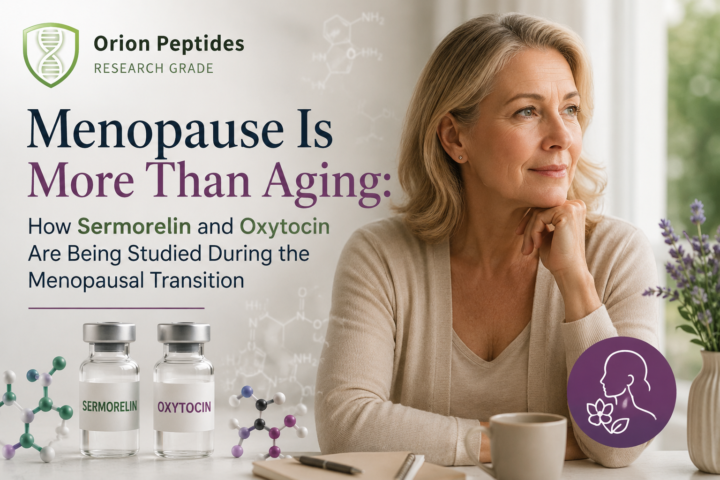
Menopause Is More Than Aging: How Sermorelin and Oxytocin Are Being Studied During the Menopausal Transition
For many years, menopause was viewed as little more than the inevitable consequence of getting older. Today, researchers understand that menopause represents something far more complex—a dramatic shift in the body's signaling networks. Hormones don't simply disappear. They alter the way nearly every organ communicates with every other organ. Sleep changes. Recovery changes. Mood changes. Body composition changes. Stress responses change. Even social bonding and emotional regulation can feel different. Rather than viewing menopause as a single hormone deficiency, scientists increasingly see it as a large-scale communication problem inside the body. That perspective has led researchers to investigate peptides that influence natural signaling pathways rather than simply replacing hormones. Two of the most discussed peptides in this area are Sermorelin and Oxytocin. While they work through completely different biological systems, both are being studied for how they may influence the body's adaptation to menopause. Menopause Is a Whole-Body Signaling Shift The transition into menopause is driven primarily by declining ovarian hormone production, particularly estrogen and progesterone. However, the downstream effects extend much further. Researchers have identified changes involving: - Growth hormone signaling - Sleep architecture - Body composition - Bone metabolism - Stress response - Immune function - Cardiovascular health - Brain function - Emotional regulation Instead of thinking of menopause as simply "low estrogen," it's more accurate to think of it as a large-scale recalibration of multiple endocrine systems. That is why peptide research has become increasingly interesting. Sermorelin: Supporting the Body's Natural Growth Hormone Signaling Unlike growth hormone itself, Sermorelin is a synthetic version of growth hormone-releasing hormone (GHRH). Instead of supplying growth hormone directly, Sermorelin stimulates the pituitary gland to release more of the body's own growth hormone.

0 likes • Jul 7
Great article Now if I could only get my subject to take “charge”of her body to step into the RUO office 🤔🤔
1-1 of 1

@tim-renner-4850
Enjoying the journey of peptides and wanting to learn as much as possible
Active 2h ago
Joined Jun 18, 2026