Activity
Mon
Wed
Fri
Sun
Jul
Aug
Sep
Oct
Nov
Dec
Jan
Feb
Mar
Apr
May
Jun
What is this?
Less
More
Memberships
High Vibe Tribe
80.6k members • Free
The AI Advantage
125.5k members • Free
22 contributions to The AI Advantage

May 15 •
Oh WOW!!!!!
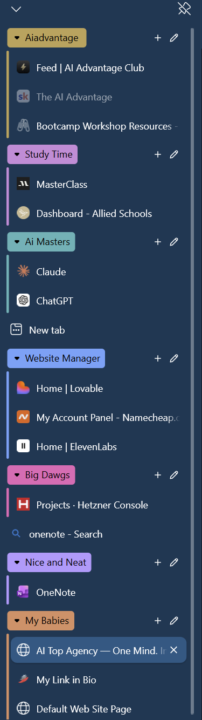
Happy Friday team!!!!! How is everyone feeling today?? I am beyond excited about what I have been working on lately. Who wants to see a sneak peek? If you’ve been following my post you know that I used Chat GPT to research a laptop for me and it found me the laptop of my dreams and the best part, It was on SALE!!!! 🥳 It’s a Dell 2 in 1 laptop with a 16” screen. 32gb RAM and 1TB of storage. This baby is a power house just like it owner 😎🥰 The icing on the cake is that it has a tab feature that I’ve been waiting for my WHOLE LIFE!!!! Don’t believe me take a look for yourself.✨ Wowwww this is just the beginning, who’s ready to build together 💻💻💻💻💻💻💻💻💻 Also, if you don’t have a laptop that’s ok I’ve built the foundation of my empire with chrome books and HP notebooks it can be done and YOU CAN DO IT!!!!!! 😎😎😎😎😎😎😎😎😎😎😎😎😎
0 likes • May 15
@AI Advantage Team Yessss and not to mention the Remote Desktop Feature 🥳 I am ready to take flight!!!!! To infinity and beyond with this setup!!! 🥰💻
May 14 •
Good morning AI Advantage Family 😎💻
It is another beautiful day in paradise and I am excited to use a new prompt!!! Has anyone tried any? Any favorites out there that we can use this message to share 💚💚💚
1 like • May 14
@AI Advantage Team Reading all of the teams replies to other members has really accelerated my learning even more!!! Thank you and the Team for guiding us through this massive transition with ease and clarity 👏🏼🫶🏻🙌🏼
1 like • May 14
@AI Advantage Team Omg that last like got me to level 5 🥳🥳🥳🥳🥳 thank you so much team you’re really the best!!!!

0 likes • May 14
Hi Nancy, select the three dots in the top right corner (when in the main feed section) select group settings- select Membership at the top- select Leave group 💚 hope this helps 💻
May 12 •
Week 2 of Bootcamp is today 🥳
I am beyond excited about my experience so far, I’ve been using AI for 3 years now and I love it. It makes even the smallest decision super easy, not sure how much accessibility to give your programs? A simple screen shot to one of my LLM’s takes care if that in no time. Not sure what computer to buy for your needs? AI researched endlessly with me while constantly getting price updates till I found a super great deal $500 off. I may be a little advanced with my usage since I am at the point of having Hetzner linked and operating on a remote server however this class is creating the boundaries that I get to shoot for the stars ✨ just this 1st week alone I registered my LLC, purchased a powerhouse of a laptop, extended my domain another 7 years and now have a little baby clone of myself helping me where I needed it the most. I was told so many different things when I wanted to join this class, at the end of the day it’s you and your decisions. Think of AI as your life map GPS, where would you want to go if you didn’t have back seat drivers in your ear? See you at the top 🥳
0 likes • May 13
@Katina Cobb Hi Katina, yes. Were you able to locate the first recording? Have you used Chat GPT or Claude before? ☺️

🔥
May 12 •
📰 AI News: OpenAI Just Launched Daybreak, Its Big Push Into AI-Powered Cyber Defense 📰
📝 TL;DR 📝 OpenAI has launched Daybreak, a new cybersecurity initiative built to help defenders find, validate, and fix vulnerabilities faster with frontier AI. This is not a consumer feature. It is a clear signal that OpenAI wants its best models doing real defensive security work inside enterprise workflows. 🧠 Overview 🧠 Daybreak is OpenAI’s umbrella effort for what Greg Brockman called “defensive acceleration.” It combines OpenAI’s most capable models, Codex as the agentic execution layer, and security partners to help software teams move from vulnerability discovery to remediation much faster. The bigger story is that AI labs are no longer just shipping chat products, they are building full security stacks for enterprises. 📜 The Announcement 📜 OpenAI’s Daybreak page says the initiative is focused on helping organizations continuously secure software by bringing secure code review, threat modeling, patch validation, dependency risk analysis, detection, and remediation guidance into everyday development workflows. OpenAI also says it is working with industry and government partners and preparing to deploy increasingly more cyber-capable models in the coming weeks. ⚙️ How It Works ⚙️ • Frontier models plus Codex - Daybreak combines OpenAI models with Codex as an agentic harness for security workflows. • Threat prioritization - OpenAI says it helps teams focus on high-impact issues and cut hours of analysis down to minutes. • Patch generation and testing - The platform can generate and test patches directly in repositories with scoped access, monitoring, and review. • Verification built in - OpenAI says Daybreak sends back audit-ready evidence so teams can track and verify remediation. • Tiered cyber access - OpenAI offers standard GPT-5.5, GPT-5.5 with Trusted Access for Cyber, and GPT-5.5-Cyber for increasingly specialized authorized workflows. • Security-team focused - This is aimed at defensive security workflows like secure code review, vulnerability triage, malware analysis, detection engineering, patch validation, and controlled red teaming.
1 like • May 12
Safety and Security are the pillars in everything we do in our daily lives, seeing them address and execute their ideas to protect people and data while anticipating threats and potential harm although we have a journey to go still we have to also remember it is our duty to keep our data safe, don’t x out of dialog boxes asking your cookie preference. Don’t think of it as a 🍪 instead think of 🗄️🗃️🗂️ they gave it a funny name but you are the recipe and all the ingredients. Please protect it 😎
1-10 of 22

@tanya-p-8202
As founder of AI Top Agency I look forward to the future of tech advancing and integrating itself into our daily lives
Active 10d ago
Joined Apr 4, 2026
Powered by