Activity
Mon
Wed
Fri
Sun
Jun
Jul
Aug
Sep
Oct
Nov
Dec
Jan
Feb
Mar
Apr
May
What is this?
Less
More
Owned by Stacey
For established service providers ready to turn content into a clear, connected marketing system that drives results.
Memberships
AuthorityCam
278 members • Free
Skool Launch Lab
346 members • Free
Skool Extensions 🧩
437 members • Free
The Great AI Shift
3.4k members • Free
Social Media College
1.4k members • Free
GOOSIFY 🍎🐛🦋🌈⭐️🩷
12.9k members • Free
Studio SHIM Sanctuary
14 members • Free
Thrive Rise & Empower
24 members • Free
KDP Publishing
1k members • Free
24 contributions to KDP Publishing
🔥
1d •
What Books Did You Read in Childhood?
📚 Throwback Question: What Did You Read as a Kid? I was thinking back to my childhood reading habits, and it hit me how different they were compared to what I read now. Back then, I was all about fun, fictional books—anything that kept me entertained and pulled me into a story. One of my favorites was the Goosebumps series. I used to fly through those books as a pre-teen. And then when the Goosebumps show came out, it was such a cool experience seeing those stories come to life. I remember noticing how some parts were different from what I had imagined while reading—which made it even more fun. It really made me realize how powerful storytelling is… especially when it sticks with you years later. Now I’m curious—what about YOU? - What books or series did you love growing up? - Were you into fiction, or something totally different? - Did any of those stories stick with you into adulthood? Drop your favorites below 👇 Let’s take a little trip down memory lane.

4 likes • 1d
I read the entire Sweet Valley High series, the Bobbsey Twins and eventually landed on Lois Duncan, Christopher Pike and RL Stine books.
2 likes • 24h
@Jessica White uh no, BUT now I have to!!!! New Summer reading unlocked!
🔥
26d •
Finally It's FEATURE FRIDAY - SHARE YOUR STUFF!
It’s time to put yourself out there. Share whatever you’re working on or proud of right now. This community is full of creators, authors, and entrepreneurs, and sometimes the best thing we can do is help each other get a little more visibility. 💡 IDEAS ON WHAT YOU COULD SHARE: • Yourself and what you do • Your Skool community • A book you're writing or recently published • A project you're building • A shoutout to another member • A video, post, or resource • Affiliate links (yes, those are allowed) The goal is simple: help our members get seen. Just one request so this stays valuable for everyone. 👉 1 RULE: If you share something, please also leave a thoughtful or helpful comment on someone else’s post. Support goes both ways, and when we all participate, the whole community benefits. Now let’s see what everyone is building 👇

1 like • 17d
@Liisa Reimann I missed this 😭 . Thank you so much, I'm so glad you got so much out of it. Would love to do more like it, it was so fun. Love an engaged audience on Zoom
26d •
Is this brilliant or what?
I came across this video on Instagram. As someone whose business is social media marketing I rarely have a business card. I use the Blinq app with a QR code to connect but once I've finished my book I think I may just get some bookmark business cards.

0 likes • 19d
@Nick Nebelsky this made my day! A little mayo too? Or mustard?
1 like • 19d
@Nick Nebelsky
🔥
25d •
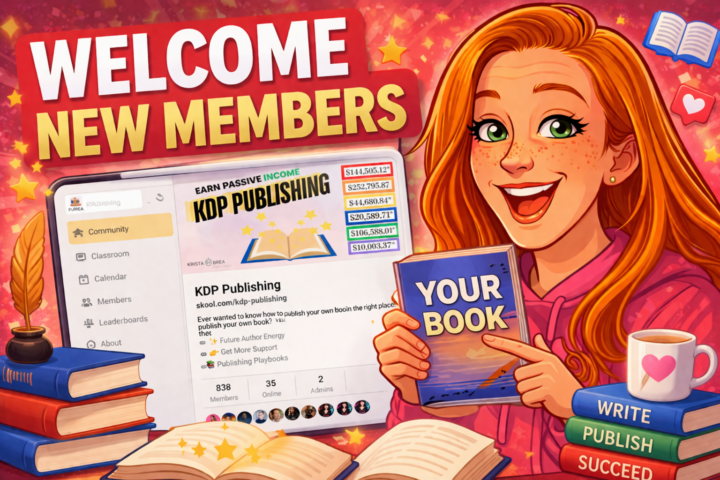
Welcome New Authors & Future Authors
Hello and Happy Friday 🙌 We have had a ton of new members coming in here, so let's give them a warm welcome 💖 @Alice Rienzo Alexander - I have 5 adult boys and 4 grandchildren. I currently live in New York. (Referred by @Gale Bates ) @Kelly-Ann Bam - Hi my name is Kelly, I recently started my own business and just finished my own book. @Michelle Farris - I'm a therapist helping people create relationships that work! @Helen Lawrence - Professional Declutterer and Organiser helping people to free their space and time for the things that matter in life (Referred by @Janet Wilson ) @Michella Nielsen - 🎉 60 isn’t too late 💻 Learning digital marketing @Tatiana Di Maio - Obsessed with making videos with AI (Referred by @Nick Nebelsky ) @Lolly Writes - Children's book📚 author... @Emma Wratten - As a lawyer, I relax by sketching, capturing thoughts and emotions on paper. I’m eager to grow my skills in architecture, parametric design, and AI. @Kristina Brown - Dental Business Analyst, FL, WFHM. Looking to network and change my life for me. @Ikram Daf - “Creative and driven, focused on positivity and motivation. Here to connect, support, and grow with like-minded people!” @Wendy Lopez - Hi all! My name is Wendy! Im a mom, wife, nurse, and hustler. Looking forward to building and growing! @Tallahase Veronah - (Referred by @Larvida Noble ) @Sarah L Lane - (Referred by @Lesley Christine )
5 likes • 25d
[attachment]
29d •
Choosing a writer’s alias?
Hey there! I’m curious about how one chooses an author’s name. I don’t want to publish all the books I write under my name, only one! lol So how does one choose a self-publishing name? All those who use an alias, do you have a different one for each book genre? Also, feel free to let me know if I'm overthinking this lol… I tend to do that!
10 likes • 28d
For me, for my book on showing up on social media for business I am using my own name. When the time comes and I write my murder/mystery book it'll be under my first two initials and last name. So S.J. Watts, it's a little more mysterious that way.
1 like • 26d
@Victoria Moser that would be a great pseudonym. V.M. (Smith) or whatever it is, for one genre and your regular name for another. The J in mine is one of my middle names, which I rarely use.
1-10 of 24
@stacey-watts-2292
I help you stop creating more content and start using what you already have to build a business that doesn’t rely on showing up 24/7
Active 3h ago
Joined Jan 30, 2026
Airdrie, Alberta
Powered by