Activity
Mon
Wed
Fri
Sun
Nov
Dec
Jan
Feb
Mar
Apr
May
Jun
Jul
Aug
Sep
Oct
What is this?
Less
More
25 contributions to School of AI

May 10 •
Today We Kick Off 2 FREE AI Certifications from School of AI!
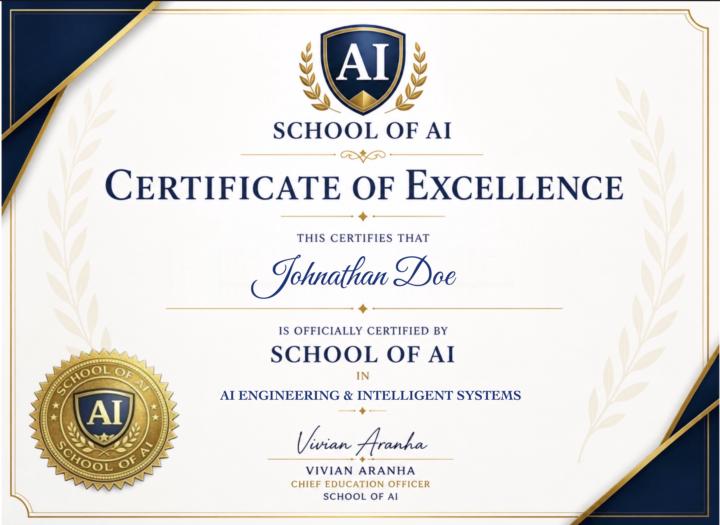
Today is the official start of our first two FREE project-based AI certification programs. These certifications are designed for learners who want more than theory. You will learn through video lectures, hands-on labs, real projects, and GitHub submissions. No tests. No exams. No passive certificates. You build. You submit. You earn a Certificate of Excellence. ------------------------------------ 1. 12 Week AI Engineering and Intelligent Systems Certification This is our flagship AI engineering certification for anyone who wants to go from the foundations of AI to building real intelligent systems. You will explore: AI fundamentals, Python, data, machine learning, generative AI, AI agents, intelligent workflows, deployment, and real-world AI system design. This is ideal for learners who want a complete, structured path into AI engineering. 2. 3 Week Generative AI Foundations Certification Generative AI is one of the most important skills for modern professionals. This certification focuses on: Large language models, prompting, content generation, AI assistants, reasoning patterns, and practical GenAI workflows. You will learn how Generative AI works and how to apply it in real business, productivity, and creative scenarios. ------------------------------------ Why Join? Both certifications are completely FREE and include: ✅ Video lectures ✅ Hands-on labs ✅ Real-world projects ✅ GitHub project submission ✅ Certificate of Excellence after successful project completion This is not a certificate of completion. This is a Certificate of Excellence — proof that you learned, built, and earned it. Let’s begin the journey. Learn AI. Build projects. Earn excellence.

1 like • May 10
Thank you @Vivian Aranha
May 3 •
Free 12-Week AI Certification Program
Starting May 11th 2026. Free for all our members. Will be available in Classroom. How to enroll: There is no enrollment process. Videos will be available daily - complete the tasks at the end of the week. Once all 12-weeks are completed. Submit the tasks to us and we will send you the certificate. We are offering this and other certificates as a more hands-on approach instead of exams. Announcing our 12-Week AI Certification Program—your complete path from beginner to building production-ready AI systems. In 60 focused sessions, you’ll master Python, machine learning, deep learning, LLMs, and AI agents, while gaining hands-on experience deploying real-world solutions. Designed for ambitious builders, this program transforms you into a confident AI practitioner ready for modern industry challenges. Week 1: Foundations of AI & Computing 1. Introduction to Artificial Intelligence: Scope & Impact 2. Understanding Software Evolution: From Rules to Learning Systems 3. Basics of Computing, Data, and Algorithms 4. Setting Up Your AI Development Environment 5. First AI Demo: Building a Simple Intelligent System Week 2: Python for AI 6. Python Essentials for AI Development 7. Working with Data Structures in Python 8. Functions, Modules, and Code Organization 9. Introduction to NumPy for Numerical Computing 10. Data Handling with Pandas Week 3: Data Fundamentals 11. What is Data? Types, Sources, and Pipelines 12. Data Cleaning and Preprocessing Techniques 13. Exploratory Data Analysis (EDA) 14. Data Visualization for Insights 15. Building Your First Data Pipeline Week 4: Machine Learning Basics 16. Introduction to Machine Learning Concepts 17. Supervised Learning: Regression Models 18. Supervised Learning: Classification Models 19. Model Evaluation and Metrics 20. Hands-on: Build Your First ML Model Week 5: Advanced Machine Learning 21. Feature Engineering Techniques 22. Unsupervised Learning: Clustering 23. Dimensionality Reduction Methods 24. Model Optimization and Hyperparameter Tuning 25. ML Project: End-to-End Pipeline
1 like • May 3
Thank you @Vivian Aranha
Feb 24 •
Agentic AI Mastery: Claude Code, Clawdbot & Beyond
The era of prompts is over. The era of Agentic AI systems has begun. I’m excited to introduce Agentic AI Mastery: Claude Code, Clawdbot & Beyond — a hands-on course designed for engineers and builders who want to move beyond chatbots and build real multi-agent, production-ready architectures. In this course, you’ll design event-driven systems, implement guardrails, build personal and enterprise agents, and ship a complete capstone project ready for your portfolio. If you want to think like an AI systems architect and build autonomous workflows that actually scale — this course is for you. The future is agentic. Let’s build it.

0 likes • Feb 24
Thanks @Vivian Aranha for creating this course
Jan 20 •
Looking for a new role within the UK - Technology Transformation Lead - IT infra, Cyber Security & Generative AI
Hi everyone - I’m Srinivas (https://www.linkedin.com/in/sraddepalli). I’m based in the UK and come from an IT infrastructure and cyber security background, with experience in SOC operations and cloud security across major industries. I’m now exploring Generative AI to see how it can enhance IT operations and security workflows. I’m available now and actively looking for a new role within the UK, so please do let me know if you hear of any opportunities where my skills could add value.
0 likes • Jan 23
Yeah. Thank you @Mucha Murapa
Jan 23 •
FREE COURSE COUPONS FOR UDEMY
100 AI Agents in 100 Days 2026 https://www.udemy.com/course/100-ai-agents/?couponCode=JAN_FREE_03 AI Enginner 2026 Complete Course, GEN AI, Deep, Machine, LLM https://www.udemy.com/course/ai-enginner-2026-complete-course-gen-ai-deep-machine-llm/?couponCode=JAN_FREE_03 Modern NLP for AI Engineers & Data Scientists https://www.udemy.com/course/modern-nlp-for-ai-engineers-data-scientists/?couponCode=JAN_FREE_03 Full Stack AI Engineer 2026 - Generative AI & LLMs III https://www.udemy.com/course/full-stack-ai-engineer-2026-generative-ai-llms-iii/?couponCode=JAN_FREE_03 Full Stack AI Engineer 2026 - Deep Learning - II https://www.udemy.com/course/full-stack-ai-engineer-deep-learning-ii/?couponCode=C259F7949939395FB359 The Ultimate AI Engineer Job Preparation Course (2026) https://www.udemy.com/course/the-ultimate-ai-engineer-job-preparation-course-2026/?couponCode=JAN_FREE_03 Full-Stack AI Engineer 2026–Machine Learning Foundations - I https://www.udemy.com/course/full-stack-ai-engineer-machine-learning-foundations/?couponCode=34CAEF66D217DD6C5E37 AI Product Management: Build What Actually Works https://www.udemy.com/course/ai-product-management-build-what-actually-works/?couponCode=JAN_FREE_03
2 likes • Jan 23
Thanks for sharing @Vivian Aranha
1-10 of 25

@srinivas-a-6100
Platform Engineering, IT Infrastructure Services, Cyber Security, Prompt Engineering, Generative AI
Active 11d ago
Joined Dec 28, 2025
United Kingdom
Powered by