Activity
Mon
Wed
Fri
Sun
Nov
Dec
Jan
Feb
Mar
Apr
May
Jun
Jul
Aug
Sep
Oct
What is this?
Less
More
4 contributions to Redirect K9s
Aug 15 •
Norwegian Lundehund
This week we are going to talk about one of the rarest, but apparently least popular on the AKC list of official breeds, the Norwegian Lundehund. This Norway native is also considered one the oldest and most primitive of the dog breeds in the world. There are various statements on how old the Norwegian Lundehund is as one source says there is archaeological evidence of skeletal remains that go back to the Viking Age and a lineage that goes back thousands. Another source states that the furthest back is mentions of a dog with such skill being written down as far back as the 1400s or the year 1591. Regardless of which one is correct it is clear that this dog has been around for a while. These dogs have quite the fun and unique job which caused them to evolve to have some fun and unique physical features. The Norwegian Lundehund can literally be translated to “Puffin Dog” as their job was to hunt puffins in Norway all along the steep cliffs. In order to adapt well to their job they were selectively bred to have 6 functioning toes on EACH paw, be able to have their legs fan out at 90º like an airplane, fold their ears shut forward or backward to protect against water and debris and be able to flex their head back onto their spine for quick about face maneuvers in small caves. They not only were responsible for finding and retrieving puffins but also they were watchdogs and helped herd small livestock where their unique capable stability comes into play again on the rocky terrain. Much like with other types of jobs the Norwegian Lundehund became obsolete once nets and other methods were introduced plus the Norwegian authorities had a dog tax which made having a dog made life more expensive and families often had multiple Norwegian Lundehund at this time. In the 1960s the Norwegian Lundehund had barely survived a wave of distemper only for another wave of distemper to come through and almost wipe out the breed again. This left the Norwegian Lundehund with 6 that were purebred where only 4 were used to repopulate the breed and those 4 were related. This “genetic bottleneck” as it is called in the sources was and is a concern for Norwegian Lundehund enthusiasts. This level of inbreeding has caused some health issues as one might imagine and this includes low fertility and something called intestinal lymphangiectasia which basically is a digestive disorder that does not allow your body to absorb the nutrients one needs from food. Essentially a dog with this disorder can starve to death no matter how much they eat.

1 like • Aug 16
Wow. This breed is super interesting and I learned something new today! Great post!
Aug 5 •
Pet Insurance
This week I wanted to talk about pet insurance. While I am not an insurance expert I can say with confidence that animal insurance is much easier to understand than human insurance. This week’s topic was inspired by my animals and encouraged to talk about by @Katie Schobel . For those who don’t know I have 3 dogs, 3 cats and a snake and they range from the age of 2.5 years old to 12.5 years old. Dogs: - Lucas McCain – American Pit Bull Terrier – 12.5 years - Káosz – Vizsla – 2.5 years - Csili – Vizsla – 5 years Cats - Artemis – DSH – 12 years old - Aries – DSH – 11 years old - Minka – 3 years old Snake - Havoc – Thorn Scrub Rat Snake – 5 years (?) I have had Lucas on insurance since he was about 4 years old and I am so glad that I have due to him getting sick at a month short of 9 years old with a chronic auto immune disease that he still has. That first year I spent about $10,000 between food, diagnostics, medications, supplements and insurance payments. Thanks to insurance though I was reimbursed about $7000-8000. So, when I bought Káosz I immediately put him on insurance and when I adopted Csili she was covered as well. In November of 2025 I switched the vizslas to a different insurance company which I am happy with but kept Lucas on the one he has always been on due to coverage issues with his history. I will admit that I only have my dogs covered as thankfully my cats are for the most part medically boring although Minka is no longer medically boring. The blood test is pending but she is suspected to have histoplasmosis which is a fungal infection endemic to the Americas that is found in the soil that if left untreated is fatal. She is currently blind and her sight may not possibly return. I will know more about her prognosis once I get the test result hopefully later this week. In hindsight having her covered would have been beneficial as well but it won’t stop me from caring for her. Given my experience some things to note when considering insurance:
1 like • Aug 5
I too have been so thankful I purchased insurance for my dog. Last year included a TPLO surgery and a root canal for a broken molar totaling over $10,000, which I wouldn’t have been able to handle out of pocket. One of the things that surprised me when shopping for insurance was that I was quoted a lower premium if I reported my dog as a mix as opposed to a pure breed. Lastly, if I had to do it again, I would have purchased insurance within the first few days instead of a year later. By then my dog had a “pre-existing condition” of allergies or itchy skin. It would have been nice to have those treatments covered as well. I have Embrace insurance and overall I have been happy with them.
Jan 15 •
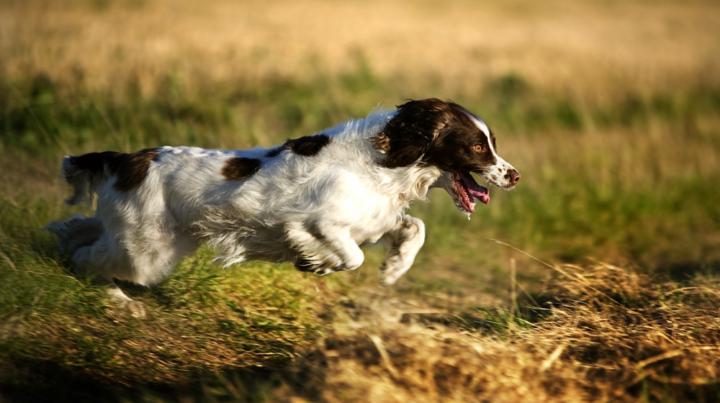
English Springer Spaniel
A Hurricane in a Teacup One of the earliest mention of spaniels in England was in 1576 by English physician John Caius in his book Treatise of Englishe Dogs. In his book spaniels were described and separated by function then later in 1801 Sydenham Edwards suggested that they be divided into Springing, Hawking Spaniel, or Starter; and the Cocking or Cocker Spaniel. The English Springer, alongside other spaniels, primarily grew in the counties of Norfolk and Shropshire. They were originally separated by size: less than 25lbs would be a cocker spaniel and those over 25lbs would be called springers. During this time both types of spaniels were born in the same litters, and both had a function: to serve as a hunting dog. The smaller spaniels, cockers, were used to hunt woodcock, hence the breed’s name, and the larger spaniels, springers, would “spring” or flush the gamebirds into the air. In the 1600s these spaniels were further categorized as land spaniels and were used to not only flush out birds but also rabbits. In 1902 the English Springer Spaniel was officially recognized by the English Kennel Club and recognized by the American Kennel Club in 1910. In 1914 the first English Field Champion was crowned, FTC Rivington Sam, and is considered one of the foundation sires for modern field lines. The Springers job back then is similar to what the field line is bred for in modern day: bird hunting and retrieve game. Whether the hunters used nets, bows, birds of prey or rifles to hunt down the flushed birds the Springer Spaniel remained very important and became known as a gun dog. . Sources: https://en.wikipedia.org/wiki/English_Springer_Spaniel, https://moderndogmagazine.com/articles/breeds/the-english-springer-spaniel/
1 like • Jan 15
Thank you Christina. I love reading your dog breed history posts as I always learn something new and fascinating. 💜
1 like • Jan 8
This is great! Love the message and I could listen to Alan Watts voice all day. I had no idea he had ever done a talk about dogs.
1-4 of 4
@sonja-streater-4910
Drifter - 4 year old Field Lab - Search and Rescue HRD. We live in Durango, Colorado
Active 5d ago
Joined Dec 22, 2025
Durango, Colorado, USA