Activity
Mon
Wed
Fri
Sun
Apr
May
Jun
Jul
Aug
Sep
Oct
Nov
Dec
Jan
Feb
Mar
What is this?
Less
More
Owned by Jack
Learn how to make money on Skool without social media, paid ads or cold DMs. Use Skool, AI clones and the Yard Party Method ⭐️
we go wee
Memberships
5 contributions to What Is Skool?

🔥
5d •
The Skool Morning Show ☀️ Watch Us LIVE | Skool Quick Win
Good Monday Morning! 🌇 We are going LIVE for The Skool Morning Show now to talk about one of the most important things each Skool should have... A Quick Win! 🏆 👇 To Chat with us LIVE comment on this post and we'll pull up some of the comments.

🔥
3 likes • 5d
nice I love the vibe in here very intentional
🔥
12d •
The Online Community Show Episode 1 Is Out Now! 🎙️
The first episode of The Online Community Show is officially live. This podcast is focused on real conversations about online communities, community building, trust, traffic, and connection. Not just the biggest success stories, but the full range of experiences from people who are actively building communities right now. In this first episode, @Eric Howell and I introduce the show, share how we met through Skool, and talk about why online communities are becoming one of the most important places on the internet in 2026. Here are a few of the things we get into: • Why social media often feels less social today and why communities are filling that gap • How online communities create real human connection in a world full of AI generated content • The difference between traffic tools and nurturing tools when you are growing a community • Why podcasting can become a long term trust builder for your future members • How overthinking and perfectionism stop people from starting communities or creating content • Why testing, experimenting, and learning together is one of the biggest advantages of communities One of the biggest ideas we talk about in this episode is that people are looking for something real again. When most social media feeds are filled with algorithms, ads, and content from strangers, communities create a place where people can actually talk to each other, build relationships, and learn together. We also talk about something that many creators misunderstand about podcasting. A podcast is not mainly a traffic tool. It is a trust builder. Someone might scroll past dozens of short videos and forget them instantly. But when someone spends thirty to sixty minutes listening to you talk, they begin to understand how you think, what you value, and whether they trust you. That is where communities grow. We already have 3 more episodes recorded with upcoming conversations featuring @Matthew Burns, @Victoria Gallagher, @Artin Asghari, & @Ethan Brits, each bringing a different perspective on building, growing, & running online communities.
🔥
3 likes • 12d
[attachment]
🔥
Jan 30 •
Welcome to What is Skool? A Free Public Community
This community helps you understand what Skool is, how the platform works, and stay up to date with platform changes that affect how people use it. Sometimes I will highlight Skool communities that are worth checking out. These are shared as real examples of how people are using the platform and what different types of communities can look like in practice. So What is Skool? Skool is a community platform where people can discover or create communities. People use Skool to run communities that include content, discussions, events, and memberships in one place. Inside the Classroom, you will find three main resources: Skool Basics This walks through what Skool is, what Skoolers is, and how the Skool Games work. Skool Build Template This is a practical starter kit you get free access to just by joining the community. The build template includes a checklist, a questionnaire to help you think through your idea, and Canva templates you can use to set things up visually. Skool Clarity Call Feedback Real responses from community members about their ideas and the clarity they gained from clarity calls. This is something I recommend community owners do for their own members when starting out, no matter what their community is about. You can see what others have to say by joining the community for free. What will the content in here look like? You will see: - Resources and templates you can use. - Our latest Skool videos and podcast episodes. - Highlighted communities that are worth checking out. - Posts about new Skool features and platform changes. - Breakdowns of how different Skool communities are structured and what is working.
🔥
2 likes • Jan 31
@Daniella Groves
🔥
1 like • Feb 14
@April Brumm Morning back to ya. I think your community is great, it's really cool
🔥
Feb 9 •
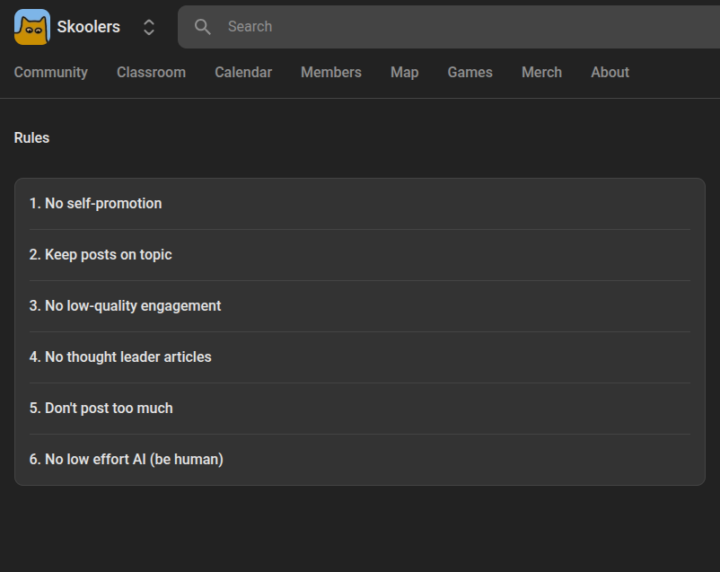
Why the Skoolers Community Uses Vague Rules on Purpose
I’ve been asked this directly and I’ve also seen a lot of people asking it publicly. Why are the Skoolers community rules vague? Some people are totally fine with it. Others really dislike it. Both reactions are okay. Some people prefer things extremely clear with exact limits. Some are used to platforms where everything is spelled out. Others have been part of large communities before and already understand why vague rules exist in the first place. Here’s the part that matters and why I now strongly recommend vague rules… even for smaller communities. Hard rules create loopholes. Vague rules create better communities. The moment you introduce hard limits, people naturally want to reach those limits. Instead of looking at the intention of a post, it turns into “does this technically fit in the guidelines?” It even takes away from something that makes a community really wonderful. If a community like Skoolers spelled out exactly what a good post is and what a bad post is, we might never see some of the creativity that comes from someone trying something out. From experimenting. From sharing something that wasn’t done before that ends up being genuinely good. Vague rules leave room for that. They also mean that as moderators and admins, we end up having a lot of conversations. We look at patterns. We make decisions based on context instead of black and white rules. Sometimes there is a new person who is just trying to fit in. A post might technically be questionable, but the right response is to welcome them and guide them. Other times someone is new and blatantly self promoting, which clearly is not allowed. In that case, we can redirect and still welcome them without letting the behavior continue. Those situations look similar on paper but they are very different in reality. Vague rules allow for that distinction. They also protect against bad actors. An example that Andrew Kirby shared explains this well. If people were told they would not be prosecuted for stealing things under $50, you would immediately see people stealing things up to $49. The clear rule creates the behavior.
Poll
48 members have voted
🔥
1 like • Feb 10
Wow I feel like this post got sent from the gods. I had no idea that's the reason for vague rules. Honestly couldn't figure it out on my own end and would have in the past preferred specific rules but I didn't even think about the angle of pushing up against the limits. Thank you for sharing. This is gonna make me ponder about what type of rules I should enforce in my own group. You're right vagueness allows for creativity but it also doesn't permit people pushing the limits. Awesome post, holy crap what a gem!
🔥
Feb 7 •
ProveWorth Setup and How to Use It With Skool Communities (Replay)
We built the ProveWorth profile live, talked through what to put in each section, and walked through how reviews actually work so it’s usable, not confusing. Most of the time was spent on the ProveWorth build itself and how to use it inside a Skool community, especially if you’re running or planning a free public community. We will have a call this upcoming Friday to go more in-depth about what @Matthew Burns has learned about the AI Discoverability, since having his website up and running. (Calendar link to be added soon) What we covered on this call: - How ProveWorth works as a third party proof layer for communities - Why outside proof matters when someone is deciding whether your community is worth joining - How to claim and build your ProveWorth community profile - What to write when you are staring at a blank page - How reviews work, including approvals, edits, and replies - Where and how to use your ProveWorth link inside Skool We also talked a bit about SEO and AI discoverability and why ProveWorth plays a role there. Things like how public Skool communities get indexed, why links matter, and how ProveWorth supports trust and visibility came up throughout the call, but the focus stayed on getting the setup right first. 🎥 Watch the replay when you can and let us know if you have any questions: https://youtu.be/7QgnYKv9qEo?views Also check out the ProveWorth profile and feel free to leave a review: https://proveworth.com/communityprofile?slug=what-is-skool I’ll make a separate post showing exactly how to ask for reviews inside your own community so you can use it as an example. As the young generation says: Very meta. (or something like that) 👉 Here is the ProveWorth community, if you want to check it out. Shout out and huge thank you to @Matthew Burns for being on the live and also creating ProveWorth! 🙌
🔥
1 like • Feb 7
nice!
🔥
2 likes • Feb 7
@Tina Saxena Skoot from @garrettF
1-5 of 5

🔥
@skooljack
I build the best Skools in the world.
Doer by day. Hormozi padawan by night. 🧃
Active 12m ago
Joined Nov 20, 2025
Montréal
Powered by