Activity
Mon
Wed
Fri
Sun
May
Jun
Jul
Aug
Sep
Oct
Nov
Dec
Jan
Feb
Mar
Apr
What is this?
Less
More
Owned by Sean
For everyday people using AI (LLM’s) for real work and life tasks; writing your CV, thinking, organising. No hype, no agents. Just useful outcomes.
Memberships
Synthesizer: Free Skool Growth
41k members • Free
30-Day Skool Hackathon
449 members • Free
AI Without The Hype
58 members • Free
Skoolers
193.7k members • Free
11 contributions to Learn to talk to machines (AI)

13h •
My Introduction!
Hi Everyone! I am completely new to AI and i want to know how i must start my learning journey in it so that i can have a profitable and a successful career in it. @Sean McLoughlin Would love to take your guidance on is it better to take a job as an AI engineer or is it best to work with clients. I have my background in computer science and I want to know how i can start my career in AI. @Sean McLoughlin Thank you so much for having me in your amazing community. Looking forward to the guidance💯

0 likes • 11h
Hi Tufail, hello and welcome! I’m not that well placed to advise you on which option would be a better career route but I certainly can help start you on your journey of what AI is and what it isn’t! First thing to get straight: most of what you see online about AI careers is… let’s call it optimistic. You don’t need to rush into becoming an “AI engineer” unless you genuinely want to go deep into maths, models, and building systems from scratch. With your computer science background, you’ve actually got a strong advantage. The question is how you use it. If I were you, I’d do three things: 1. Learn how these tools actually behave (not just what they can do). Spend time using tools like ChatGPT, Claude, Copilot properly. Not one-line prompts, structured thinking. Understand things like: * Why they get things wrong (hallucinations) * How context changes output * Where they’re useful vs where they fall apart That alone will put you ahead of most people. 2. Pick a lane… temporarily. Instead of “AI engineer vs clients”, try this: * Build something small (automation, tool, workflow), or * Solve real problems for people using AI (CVs, research, reporting, etc.) You’ll learn faster doing than deciding. 3. Focus on usefulness, not hype. The people winning right now aren’t the ones shouting about AI. They’re the ones that are quietly: * Saving time * Improving outputs * Making messy work clearer That’s where the real value is. If later you find yourself enjoying the technical side, go deeper into engineering. If you enjoy applying it to real-world problems, lean into client work or products. But right now? Don’t overthink it. Start using it properly, every day, on real tasks. That’s the bit most people skip, and it’s the bit that will make you valuable.
5d •
Heard of Claude Skills?
Lot of noise about Claude Skills right now. Most people posting about them couldn’t tell you what they actually are. We’ve seen this before. Early days of ‘prompting’, everyone suddenly had a course, a carousel, a top 10 list, most of it copy-pasted from someone else who also didn’t really know. Confident packaging, hollow centre. This page exists because that pattern is worth calling out. So here’s the unflashy version. A Skill is an instruction manual Claude reads before starting a specific type of task. Instead of you re-explaining your preferences every session, the skill carries them forward. That’s the whole thing. Built-in ones already exist for Word docs, spreadsheets, PDFs, PowerPoint. Useful, but not the interesting part. The interesting part is building your own, for the tasks you repeat, in your way. Ask yourself: what do you keep explaining to Claude every time? Your tone. Your format. Your structure. Your rules. That repetition is the signal. Build a skill, stop repeating yourself. Ask Claude it’ll direct you. It’s not complicated. It’s not a trend worth performing. It’s just a practical feature that rewards people who actually know how they work, and doesn’t do much for people who are still winging every prompt. 👇 Drop a task you keep repeating and let’s work out if it’s skill-worthy.
0
0
6d •
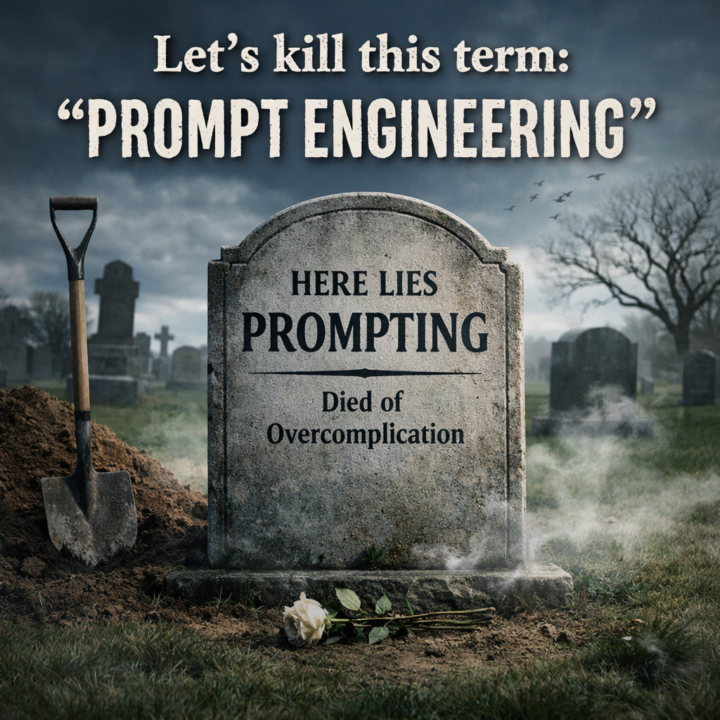
Let’s kill this term…
Let's kill this term: 𝗣𝗿𝗼𝗺𝗽𝘁 𝗘𝗻𝗴𝗶𝗻𝗲𝗲𝗿𝗶𝗻𝗴. It makes this sound like a technical skill. Like you need to be a specialist or learn some arcane discipline. You don't. It is just communication. Clear, structured communication.
0
0
11d •
He Avoided AI for Years. Then This Happened in One Hour.
Here’s what happens when people start using AI properly. Yesterday I helped a good friend use AI for the first time. He runs a successful IT recruitment consultancy, is sharp as they come… and is also gloriously tech-phobic, which makes this story even better 🤣 He’s doing voluntary work with a local prison, helping offenders nearing release learn how to write CVs. Because they can’t access computers directly, he needed to create a paper-based form to use as a teaching tool. Ordinarily, that would have meant an afternoon lost wrestling with layout, wording, structure, and endless rewrites. Instead, we spent about 30 minutes together going through a few basics: how to frame a clear prompt, how to give context, and how to refine outputs instead of accepting the first draft blindly. Then I left him to it. An hour later he sent me the finished document, polished, practical, and ready to use. That’s the bit people miss when they talk about AI. It’s not magic. It’s not replacing expertise. It’s giving capable people a faster route from idea to outcome. Same person. Same brain. Just less time spent fighting the blank page.
1
0

13d •
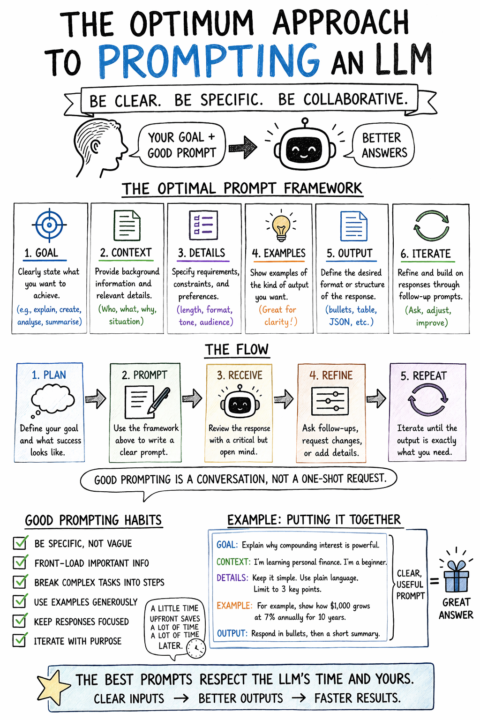
Prompting tips to try this week….
Here’s something useful to try this week: Pay attention to the prompts you’re giving AI. AI doesn’t produce “bad” results out of nowhere, it gives the result your prompt invited. When you use one-line prompts or simply paste back the model’s suggested prompt, the output may look polished, but it’s often hollow: no context, no specifics, no personality. That’s where mistakes creep in. If your prompt is vague, the model fills in the gaps with guesses, very confidently. And if nobody checks it, those guesses go out under your name, not the AI’s. What feels like time saved often just creates more work later: correcting errors, rewriting bland copy, fixing things that missed the mark. Good prompting isn’t about clever tricks. It’s about giving enough context upfront so the output is genuinely useful. That’s exactly what this sketch breaks down (with a little help from AI, naturally 🤣), have a look and let me know how you get on👇
0
0
1-10 of 11

@sean-mcloughlin-7300
20+ years in Ops. Now exploring AI in the real world, no hype, just practical ways to think better, work smarter, and get more from it.
Active 9h ago
Joined Jan 10, 2026