Activity
Mon
Wed
Fri
Sun
Oct
Nov
Dec
Jan
Feb
Mar
Apr
May
Jun
Jul
Aug
What is this?
Less
More
Unshakable
41 members • Free
13 contributions to Unshakable

29d •
Day 3 activity
If I continue to track some of the story patterns I've used over the years, one of the things that had made it hard to break the coherent story was social anxiety. I've had my feelings hurt more than once about how I looked, how I didn't fit in, etc., and I would cling to this negative self-image in an attempt to not be hurt by others. My stories would come out awkwardly. There would be a mix of self-depricating humor (so no one could say anything worse about me than I already was) and an inflated ego to try and offset the pain I was now causing myself. This would sound often like I was the victim of someone or something, in a way that would put me down and then I would counter it by either minimizing how it impacted me or turn it around to make myself out be the underdog hero of the story. I wouldn't necessarily lie, but I had a very biased view, a bit of exaggeration, a bit of minimizing, but for so long the same repetitive schematic of: "can you believe this horrible thing or person.... but whatever, I did this and then I got it to work out." In the end, I kept trying to convince other people of my own worth in an attempt to feel safe and validated. It wasn't until later in life that I learned that I'm the only one I need to prove my worth to. If I don't see it, then it doesn't really matter... But I mean really, really see it. I'm still socially anxious, but I've learned to connect to those nerves and fears and just let them be for the moment instead of reacting to them.

1 like • 27d
Reading this, I see so much of my own story in what you are saying. I do think that a lot of what we experienced growing up is very much the same. I find myself doing all of the same things.
Aug 2 •
Day 1 Activity
For me, my main struggles with my own story have come from a deep-rooted negative self-image and a need to not be wrong. These feel so big for me, almost as if it's impossible to let them go. I felt these both very young and spent a good portion of my life holding onto them and reinforcing them (as this was what was modeled for me). Trying to let go of them feels extremely difficult and sometimes "fake." In order to try and break these patterned story lines, I have started to acknowledge what I'm feeling inside when they get activated and instead of clinging to the facade they create, I try to talk more honestly about what is actually going on inside.
2 likes • Aug 3
Yes!!!! All of this all the time!
Aug 2 •
What and How
William James famously said, "What we attend to becomes our life." But it isn’t just what we pay attention to—it’s how we pay attention. What enters your conscious mind primes your subconscious to look for more of the same. If work is your sole focus, your brain becomes a 24/7 work scanner. You’ll process every event, conversation, and moment through a job-centric lens. The catch? The mood you bring matters just as much as the focus itself. If you approach work with stress, hypervigilance, or a victim mindset, your subconscious accepts that as the default filter. Suddenly, you aren't just seeing more work—you're seeing more unfairness, feeling more underappreciated, and staying constantly on edge. It’s not enough to manage your attention—you have to manage the attitude behind it. What’s one thought pattern or lens you’re trying to shift in your own life right now? Drop it in the comments below.
2 likes • Aug 3
I am realizing that I see everything so negatively. Its like everyone is out to get me and hurt those I love. I am working through seeing what is true and focus on the blessings around me and trying to see things for what they truly are or if I am letting go my past experiences cloud what is real.
May 11 •
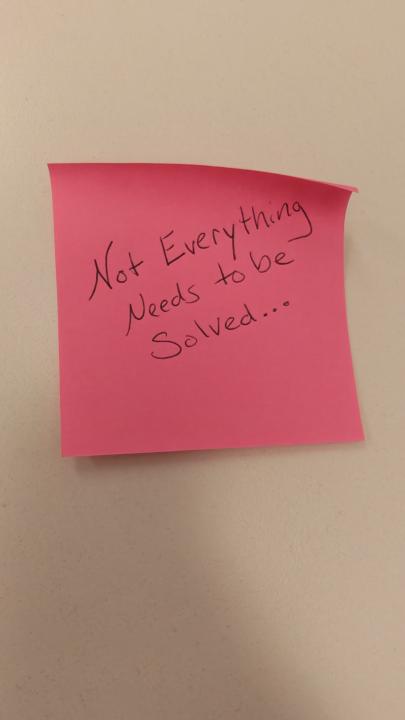
Let it be
Sometimes, we don't have to do anything. We can just let the feeling be there and let it run its course. Sometimes, doing nothing but observing allows us to be fully present in a moment without needing to fix, solve or escape it. Sitting with a feeling, with an emotion opens an opportunity to meet ourselves exactly where we are, as we are...
1 like • Jun 23
This is so hard for someone who feels the need to "FIX" everything!
1 like • Jun 24
@Jeromy Hrabovecky yes, that makes sense. I tend to have all the feels all the time. It gets t9 be overwhelming.
Mar 20 •
Hope vs. Expectation: The Subtle Difference That Saves Your Peace
We often use these two words interchangeably, but mixing them up is a recipe for internal chaos. Here’s the breakdown of why one sets you free while the other keeps you bound. The Anatomy of Hope Hope is a "felt sense" of something that is lacking mixed with the desire to fill it. It’s an interesting emotional cocktail because it requires acquiescence. - The Drive: You want something better. - The Peace: You accept the state of affairs exactly as they are right now. - The Magic: Hope leaves space for a better future while fully embracing the present—even if things never change. The Rigidity of Expectation Expectation is hope’s more demanding cousin. It is rigid, unwavering, and—honestly—a bit of a bully. - The Trap: Expectation refuses to accept the current reality. - The Result: It leaves no room for pivot or peace; it only leaves room for disappointment when the world doesn't align with your blueprint. The "Havoc" Check Have you ever let these two become synonyms in your mind? When we turn a hope into an expectation, we stop being present and start being entitled to a specific outcome. That’s usually when the havoc starts. How to keep them separate: 1. Audit your "Musts": If you feel like a specific outcome must happen for you to be okay, you’ve drifted into expectation. 2. Practice Presence: Hope says, "I'd love for this to happen." Expectation says, "This has to happen." 3. The Pivot: If you see them overlapping, take a breath and "release the grip." Return to the state of being okay with the now, regardless of the next. The takeaway: Hope is an open hand; expectation is a clenched fist. Have you experienced this? How did it play out? What did you learn about your own hopes and expectations? How has this influenced you in your current life?
1 like • Jun 23
I just had a whole conversation about expectations and how really I set myself up when I set expectations on others and different situations.
1-10 of 13

@sarah-molli-5995
Daughter, sister, wife, mother, teacher, follower of Christ.
Active 23d ago
Joined Jan 10, 2026