Activity
Mon
Wed
Fri
Sun
Nov
Dec
Jan
Feb
Mar
Apr
May
Jun
Jul
Aug
Sep
Oct
What is this?
Less
More
The Sensory Ladders™️ Project
252
Free
5 contributions to The Sensory Ladders™️ Project

Apr 13 •
Any comments on how to improve this...thoughts?
What Sets Sensory Ladders® Apart from Other Self-Regulation Approaches There is growing interest in tools and approaches that help children, young people and adults understand their feelings, manage distress, and find ways to move through difficult moments. That is a positive shift. It reflects a wider recognition that regulation matters, that lived experience matters, and that support needs to be more thoughtful, more relational, and more respectful. At the same time, not all self-regulation approaches are built in the same way. Some tools are designed around broad categories or stages. They may group experience into colour zones, emotional levels, or expected states, then suggest a matching strategy. These approaches can offer helpful structure, especially when someone is first beginning to notice patterns in their day. They can give adults and teams a shared language. They can also support consistency across home, school, and care settings. But many of these approaches remain adult-defined. They often begin with an external framework and ask the person to fit themselves into it. Sensory Ladders® were developed differently. Sensory Ladders® are not simply a regulation chart, a behaviour support tool, or a list of calming activities. They are a co-produced, person-led way of exploring how sensory experience, arousal, emotion, action, meaning, and participation connect in daily life. They begin not with a category, but with the person. That distinction matters. Starting with the person, not the framework What sets Sensory Ladders® apart most clearly is that they do not ask, “Which box are you in?” They ask, “What is this like for you?” That change in starting point opens up a very different kind of conversation. Rather than reducing experience to fixed labels such as calm, over alert, or dysregulated, Sensory Ladders® make space for the person to describe their own internal world in their own way. For one person, early signs of overload may feel like buzzing skin, muddled thoughts, or needing to move. For another, it may feel like going quiet, losing words, or suddenly needing to leave. For someone else, it may not feel distressing at first at all. It may feel exciting, fast, funny, intense, or confusing.

0 likes • Apr 14
As Rebecca says, knowing who this is intended for would help your audience reflect on how to improve it. When I started reading I kind of missed the "how to improve" question and was drawn in to the article by my own need to learn and understand. I felt this was a great description/reflection on sensory ladders and would use this to help staff I work with understand the aim and merits of using sensory ladders with our service users.
Feb 16 •
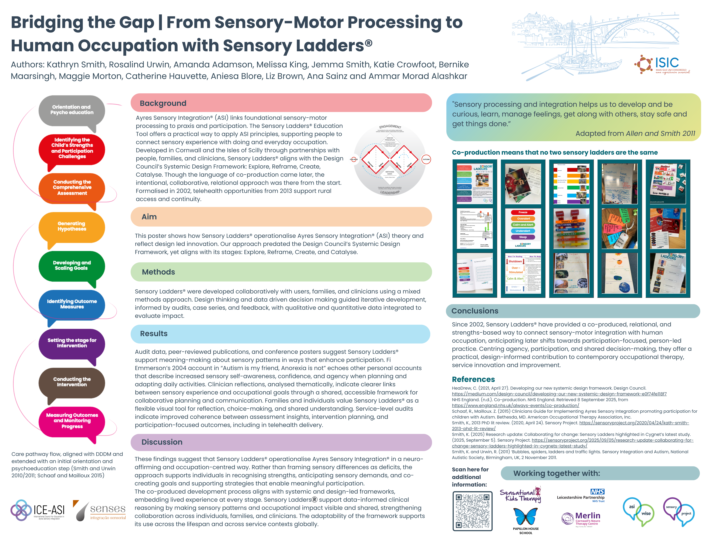
Innovation, Iteration and Co-production - ISIC Poster
We are sharing our ISIC poster alongside this reflection, because it captures something central to Sensory Ladders®: co production is not a slogan. It is how the work was built, and how it continues to grow. Bridging the Gap | From Sensory Motor Processing to Human Occupation with Sensory Ladders® This is one of the posters presented at ISIC: What we mean by co production There are three living layers to this. 1. The concept itself was co produced. Sensory Ladders®️ did not arrive fully formed. They grew organically in collaboration with people using services, families, and clinicians. In learning disability and mental health services, we needed a way to make sensory experience visible in a way that protected dignity and supported participation. People described what overwhelmed felt like. What underpowered felt like. What helped. What made things worse. We trialled versions together. We changed language when it felt reducing. We refined structure when it felt confusing. The framework evolved through feedback, reflection, and active participation. Lived experience shaped the structure as much as theory did. 2. Every individual ladder is co produced. No two Sensory Ladders®️ are the same. Each ladder is created with a person, not for them. The steps are named together. The wording reflects the person’s own language. The levels link directly to real occupations, roles, and environments. The making of the ladder builds shared understanding. It supports agency, reduces misinterpretation, and strengthens relational response. It is not about placing someone into a type. It is about recognising unique patterns and building a shared map that supports meaningful doing. 3. Translation is also co produced. As Sensory Ladders®️ are translated internationally, this is done in collaboration with therapists within each cultural and linguistic context. Translation is not simply about swapping words. It involves: • ensuring metaphors make sense locally
2 likes • Mar 16
Hi Kathy, I love this poster to. It has made me reflect on the use of Sensory ladders in my work place, working with adults with LD's. Due to cognitive difficulties and significant language barriers, co-production is taking place with the individuals main carers rather than the individual themselves. I would love to discuss this with you and get your thoughts on this.
Feb 28 •
Sensory Ladders®️ USA
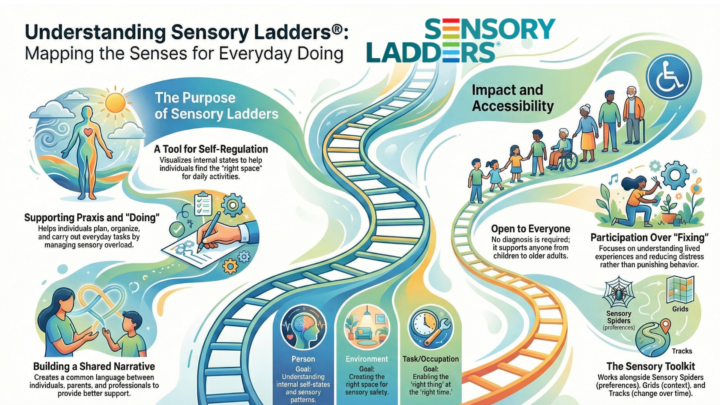
Today in the USA Mel Homan ran a launch of Sensory Ladders in her home state. Mel has been involved with Sensory Ladders, since co-lecturing about them here in the UK with Kath Smith, before she moved to the USA. Coming soon, some pictures of today's event. Thank you Mel for hosting this event.
1 like • Mar 6
It is good to see Sensory Ladders spreading over the globe
Mar 6 •
Sandra Napper
Hi I am a Professional Lead OT working in Wales. I am privileged to work in adult learning disability services.
Feb 16 •
Please join in and upload your Sensory Ladder examples here
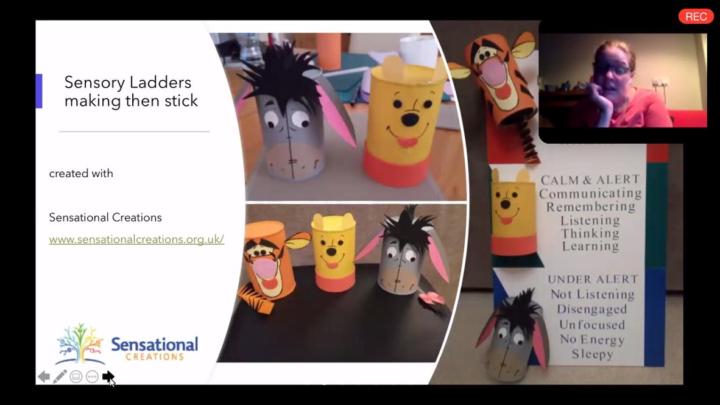
When you upload a Sensory Ladder example, you are doing something quietly powerful. You are showing what co-production looks like in real life, not in theory, but in the everyday moments where participation either opens up or closes down. Sharing matters because it helps us learn together. We start to notice patterns across settings. We gather ideas that are adaptable rather than prescriptive, so each person can shape what fits their own sensory world. Sharing matters because it builds a community of practice.A place where people can borrow courage, borrow words, and borrow a starting point, then co-create something uniquely theirs. If you have one to share, please upload it. A photo, a sketch, a template, a story. It does not need to be perfect. It just needs to be real.
2 likes • Mar 6
@Claire Kampa This young person is really talented. I would love to hear how they found the process of developing the ladder.
2 likes • Mar 6
to je čudovito
1-5 of 5
@sandra-napper-7566
Occupational Therapist working in learning disability services.
Active 204d ago
Joined Mar 2, 2026
Powered by