Activity
Mon
Wed
Fri
Sun
Nov
Dec
Jan
Feb
Mar
Apr
May
Jun
Jul
Aug
Sep
Oct
What is this?
Less
More
Hacksmith's Free Peptalk Group
2.6k
Free
BC
Bio Collective
247
Free
Peptide of The Week Community
17.2k
5.0
Free
Research Peptide Community
1.9k
Free
Orion Peptides
407
Free
Food Freedom GLP-1 LAB
690
Free
Cale's Peptide Guide
3.4k
Free
RealTalkByNewMe
713
5.0
$7/m
Mildly Thriving Peptide Hub
2.7k
Free
7 contributions to Orion Peptides

Jul 6 •
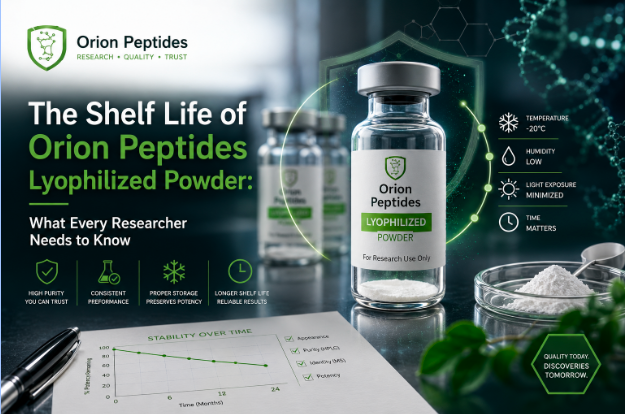
The Shelf Life of Orion Peptides Lyophilized Powder: What Every Researcher Needs to Know
Alright everyone, let’s talk about something that doesn’t get nearly enough attention in the peptide community: shelf life. I see questions about this constantly, especially with people starting to stock up or wanting to keep a backup supply. You’ve got your lyophilized powder from a source like Orion Peptides, and you’re wondering—how long is this stuff actually good for? Can I keep it for a year? Two years? Does it go bad like milk? I’ve been down this rabbit hole myself, and the short answer is: a properly stored lyophilized peptide can remain stable for years, potentially even a decade or more. But there’s a lot more to it than just tossing it in the freezer. The long answer involves understanding the science of peptide degradation, the difference between storage and reconstitution, and a few hard-learned lessons about best practices. Let’s break it down properly. Disclaimer: The Product must be for Research purposes only, and not used for human direct consumption. This information is for educational and laboratory research purposes only. The Core Answer: Years, Not Months So, what’s the actual shelf life? For lyophilized (freeze-dried) peptides stored correctly, the consensus from scientific literature and major manufacturers is that they can be stable for several years, often up to 2 to 5 years or more at -20°C . I’ve even seen some sources suggest that if kept at -80°C, they can last even longer. The key is that we are talking about the powder form. Think of it like this: your lyophilized peptide is in a state of suspended animation. The water has been removed, which eliminates the primary environment where degradation reactions happen. It’s like putting a seed in a dry, cold place—it’s not growing, it’s just waiting. That’s the beauty of lyophilization. It gives you a massive window of opportunity to store your research materials. Now, this doesn’t mean you can leave it out on the counter. The shelf life is heavily dependent on storage conditions. If you’re ordering from a reputable source like Orion Peptides, the peptide typically arrives in a stable, lyophilized form that can even survive a few days at room temperature during shipping . But for long-term storage, the environment is everything.

1 like • Jul 6
How long can they last in a dark fridge?
Jun 22 •
5 Eye-Opening Stats From the Latest Retatrutide Studies
Orion Peptides Code: Parker15 (15% Off) I genuinely couldn't do what I do without the support of Orion Peptides. Their support allows me to continue producing educational content that breaks down peptide and metabolic research into language that everyday people can actually understand. Is Retatrutide Becoming More Than a Weight-Loss Compound? The newest Retatrutide data presented by Eli Lilly at the American Diabetes Association's 86th Scientific Sessions in June 2026 may end up being remembered as a turning point in how we think about obesity treatment. For years, obesity medications have largely been evaluated through a single lens: How much weight do people lose? That's still important. But the latest Phase 3 data suggests we may need to start asking a much bigger question: What happens when improving metabolism starts improving everything else? The newest findings touched on sleep, joint pain, blood sugar control, obesity status, and overall metabolic health. If these results continue to hold up in long-term follow-up, Retatrutide may represent something far more significant than simply another weight-management therapy. Let's look at the five findings that stood out most. 1. Sleep Apnea Severity Improved By About 60% Sleep apnea affects millions of people worldwide. Many individuals spend years struggling with: - Poor sleep quality - Daytime fatigue - Reduced recovery - Increased cardiovascular risk - Difficulty controlling body weight According to the latest data, subjects with moderate to severe obstructive sleep apnea experienced approximately a 60% reduction in sleep apnea severity. That's a remarkable finding. Sleep apnea isn't simply snoring. It's a condition associated with increased risks for cardiovascular disease, metabolic dysfunction, and reduced quality of life. If future research continues to confirm these findings, this could become one of the most important secondary benefits being studied.
0 likes • Jun 22
Compared to Tirz- for inflammation and or joint pain etc - is it miles ahead? I love the added benefit of this - but if I could get more on Reta???
May 22 •
Peptide Dosing Explained: Why “Just Pull 20 Units” Is Misleading and What You Actually Need to Understand
One of the most common points of confusion in peptide research discussions is dosing. People often get handed a mix of: - milligrams (mg) - milliliters (mL) - “units” on an insulin syringe - and concentration values (mg/mL) And it immediately becomes overwhelming. But the confusion usually doesn’t come from complexity — it comes from missing context. The Core Concept Most People Miss There are only two separate ideas you need to understand: 1. Volume (Units / mL) This is simply: how much liquid you are drawing On an insulin syringe: - 100 units = 1 mL - 50 units = 0.5 mL - 10 units = 0.1 mL So “units” are just a measurement of liquid volume, not potency. 2. Concentration (mg/mL) This is where everything actually changes. Concentration tells you: how much active compound is dissolved in each mL of liquid For example: - 2 mg in 1 mL = 2 mg/mL - 5 mg in 1 mL = 5 mg/mL - 10 mg in 1 mL = 10 mg/mL This is the part that determines how strong each unit is. Why “Just Pull 20 Units” Is Incomplete Advice When someone says: “just take 20 units” That statement is missing the most important variable: what is actually dissolved in that liquid? Because 20 units could mean very different actual amounts depending on concentration. For example: - At 2 mg/mL → 20 units = 0.4 mg - At 5 mg/mL → 20 units = 1 mg - At 10 mg/mL → 20 units = 2 mg Same syringe volume. Completely different dose. This is why copying “unit advice” without concentration context leads to confusion. Why Beginners Think They’re Bad at Math (They’re Not) Most people assume: “I just don’t understand dosing math” But that’s not actually the issue. The real problem is: missing standardization of information No one tells you: - what concentration was used - how the solution was prepared - or what dilution ratio was applied So the brain tries to solve an incomplete equation. That’s why it feels confusing. A Simple Way to Think About It Think of it like coffee:
1 like • May 23
Thanks very informative. There are peptide calculators online that will do the math for you as well to double check.
May 15 •
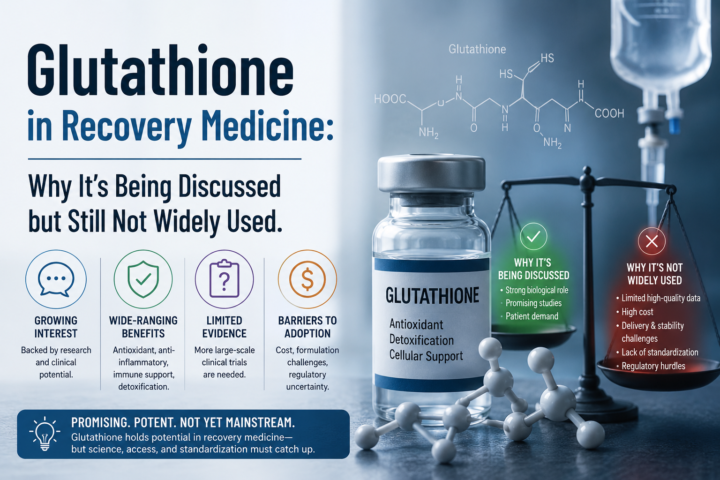
Glutathione in Recovery Medicine: Why It’s Being Discussed but Still Not Widely Used
Glutathione is often described in research and clinical discussions as one of the body’s primary endogenous antioxidant systems. Despite this, it is still not commonly used as a standard adjunct in many surgical recovery or post-anesthetic environments — even though some clinicians argue it has theoretical relevance in post-procedural oxidative stress management. This raises an interesting question in translational medicine: If glutathione is central to cellular detoxification and redox balance, why isn’t it more routinely integrated into recovery protocols? What Glutathione Actually Does in the Body Glutathione is a tripeptide composed of: - glutamine - cysteine - glycine It plays a major role in: - oxidative stress buffering - detoxification pathways (especially hepatic) - mitochondrial protection - immune modulation - cellular redox balance In simple terms, it helps regulate the internal “clean-up and repair” environment of cells. It is heavily involved in maintaining cellular resilience under physiological stress, including surgical stress, inflammation, and metabolic load. Why It Comes Up in Recovery Medicine In surgical and post-anesthesia settings, the body undergoes: - oxidative stress elevation - inflammatory signaling activation - metabolic demand shifts - transient immune modulation From a theoretical standpoint, glutathione is relevant because it participates in: - reactive oxygen species (ROS) neutralization - detoxification of metabolic byproducts - support of mitochondrial function This is why some clinicians view it as a potentially logical adjunct in recovery environments. The Concern: “Will It Interfere With Medications?” One of the key concerns often raised in clinical discussion is whether glutathione could: - alter antibiotic efficacy - interfere with anesthetic agents - or change pharmacokinetics of perioperative drugs However, most commonly used antibiotics in surgical contexts are:
1 like • May 15
I’ve been researching this for a bit. I’d like to take this long term if it helps me!!
Jan 5 •
Exclusive Member Discounts: Peptides, & Research
Hey team! To help you save on your research needs, I’ve compiled a master list of our partner vendors and exclusive discount codes. Whether you are looking for specific peptides or other research compounds, check the list below to get the best deal. 🧪 Peptides - Ascension Peptides: 20% OFF — Code: CAPRED20 - Tydes Peptides: 15% OFF — Code: REFROWANHOOPE - XL Peptides: 12.5% OFF — Code: CAPRED10 - Ameano Peptides: 10% OFF — Code: CAPRED10 - Prime Peptides: 10% OFF — Code: COMPOUND10 - Wolverine Peptides: 10% OFF — Code: CAPRED10 - Paramount Peptides: 5% OFF — Code: HOOPER5 - 🔬 Research Chems - PureRawz: 15% OFF — Code: CAPRED25 - Behemoth Labz: 15% OFF — Code: CAPRED25 - RCD.bio: 15% OFF — Code: CAPRED25 - Iron Mountain Labz: 15% OFF — Code: CAPRED25 - BC9: 15% OFF — Code: CAPRED25 - Freedom Research: 15% OFF — Code: CAPRED15 - Swiss Chems: 10% OFF — Code: CAPRED - Chemyo: 10% OFF — Code: CAPRED10 - MuscleChem: 5% OFF — Code: CAPRED5
0 likes • May 14
Do you know if any of the those companies, send internationally? Like Mexico?
1-7 of 7