Activity
Mon
Wed
Fri
Sun
Oct
Nov
Dec
Jan
Feb
Mar
Apr
May
Jun
Jul
Aug
Sep
What is this?
Less
More
Owned by Rosalinda
Italian early childhood practice, pedagogy and practical resources for educators worldwide. Real ideas from everyday nursery life in Italy.
Toddler & Kids Play &Learn Hub
66 members • Free
Preschool Director Network
33 members • Free
Launch Lab
178 members • $15/month
The Curiosity Approach®️
17 members • Free
Preschool & Pre-K Teacher Hub
1k members • Free
Skoolers
159.7k members • Free
5 contributions to Preschool & Pre-K Teacher Hub

🍀
🔥
Jul 16 •
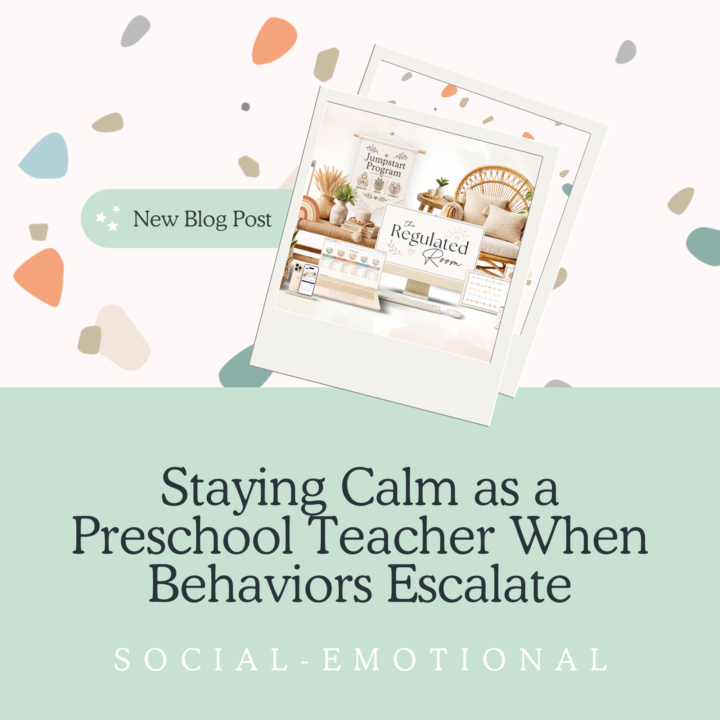
Staying Calm as a Preschool Teacher When Behaviors Escalate
Nobody tells the teacher what to do in that split second. When teachers ask me how to manage big feelings in a preschool classroom, what they usually describe is the children. The behaviors. The meltdowns. The child who will not come to the carpet. Almost never what it costs us to absorb it. I understand why. We are trained to look outward. So we have language for a child's hard moment and almost none for the thing happening in our own body at the same time. The shoulders. The voice we did not choose. The guilt at nap time that follows us all the way to the car. Here is what I have come to believe: You are not losing your patience. You are absorbing a room full of big feelings all day with nowhere to put your own. That is not a character flaw. That is a body doing what bodies do. Think of the last time a child swept the blocks off the shelf, or tore down your bulletin board. Your shoulders were probably up before you decided anything. That reaction was faster than thought. It was already underway before you had a chance to choose it. Which is exactly why "be more patient" has never once worked, for you or for anyone. You cannot decide your way out of something that already happened. There are a hundred resources out there for calming the children. There are almost none for the teacher standing in the middle of it. Jennifer said it better than I could: "I've been seeking this in so many places but it's always about regulating the kids. Everything says, the teacher will feel this way too. But they never tell the teacher what to do for yourself in that split second." So I made something that does. The Regulated Room is 90 minutes of audio, broken into five themes, built for the teacher and not the child. 90 minutes. That is one summer afternoon. Do it in a single sitting, or take one theme at a time over five mornings. Whatever way works for you. More than 117 teachers have already gone through it. I asked them for their honest feedback at the end, and I would rather they tell you than me.

3 likes • 4d
For me, transitions are often the most delicate moments. 🌱 In my experience in early childhood education in Italy, I’ve learned that what we call a “difficult behavior” is often a form of communication. Before reacting, I try to ask myself: What is this child trying to tell me right now? That small shift in perspective often changes the way we respond — and sometimes the whole atmosphere of the room. ❤️
🍀
🔥
Jun 27 •
Which curriculum are you going to be using?
Hey teachers!! 🍎 Would love to know which curriculum or approach you’re using this coming school year. This will help teachers find others using the same curriculum, for that extra support. 🫶🏼 If you don't see your curriculum, let us know in the comments which one you're using!
Poll
44 members have voted

1 like • 4d
I work in early childhood education in Italy, and our approach is not based on one fixed curriculum. 🇮🇹 We mainly start from observation, children's interests, relationships, play and everyday experiences. I find it really interesting to see how different approaches are used in other countries! 🌱
🍀
🔥
Jun 7 •
We need to know...
What's the #1 thing making your days feel harder than they should right now? The planning? The prep work? Never feeling caught up? Drop your answer below 👇 You might help another teacher who's feeling the exact same way. Once you've commented below... 🆓 Grab my free teacher planner to make this week a little easier

1 like • 4d
For me, one of the hardest parts is the invisible mental load behind our work. It’s not only planning activities, but constantly observing, adapting, documenting, supporting emotions, communicating with families and thinking about what each child truly needs. I’ve learned that good educational planning doesn’t mean filling every moment with an activity. Sometimes the most meaningful learning comes from slowing down, observing the children and letting their interests guide what happens next. 🌱
🍀
🔥
Jun 5 •
Do you have designated language colors?
If you work in a bilingual, dual language or multilingual setting, you probably have set colors for each language, like black for english and red for Spanish for example. And maybe you set up your classroom to match, then move to a new school with a whole new set of color rules. I've been there! 🫠 That's why I added a variety of color coded options to this freebie set of basket and bin labels. Honoring the language, staying consistent in how we display it, and including children in the process will help students organize it visually, and also be meaningful when they reference it. For example, you can also use a red marker to write down a child's dictation spoken in Spanish, and a black marker for a dictation in English. So when children (or anyone) see the web of ideas, language is clearly and immediately identified. Having worked in only bilingual and dual language settings, this was my default way of approaching language, so you'll see me offer various color options for that reason, I know how important it is and I also know, we don't always have time to do it. How are you using the labels, show us your setups! 📸

1 like • 5d
In our nursery in Italy, we use English naturally during everyday routines rather than as a separate lesson — greetings, colours, animals, simple requests and songs. I find that consistency and repetition work better than creating a completely separate “English moment”. I’m curious to see how others organise language cues in their settings.
🍀
🔥
Jul 3 •
🎉 Introduce Yourself to the Preschool & Pre-K Teacher Hub!
Welcome to the Teacher Hub! 🍎 I'm so glad you found your way here. This community is built by teachers, for teachers, and it truly gets better with every new voice in the room. So before you do anything else, let's get to know each other! Drop a comment and share: 🚸 Who you teach and their age group 🎯 One goal you're working toward this year, in your classroom or in your life ⚡ Something you love outside of teaching The best part of this Hub is the teachers in it, and that now includes you. 🎉

3 likes • 5d
Hi everyone! 👋 I’m Rosalinda, an early childhood pedagogist and educator from southern Italy 🇮🇹. I work in early childhood education and I’m especially interested in observation, relationships, play, learning environments and meaningful everyday experiences. I’m really happy to connect with educators from other countries and discover how early years practice looks in different settings. 🌿 Looking forward to learning from you all and sharing ideas together!
1-5 of 5

@rosalinda-laforgia-5210
Early Childhood Pedagogist & Educator | Founder of EDUPRASSI | Italian early years practice & practical resources for educators worldwide.
Active 24h ago
Joined Sep 8, 2026
Italy
Powered by