Activity
Mon
Wed
Fri
Sun
Nov
Dec
Jan
Feb
Mar
Apr
May
Jun
Jul
Aug
Sep
What is this?
Less
More
Owned by Ronald
UK‑based medical training built on national guidelines. Save lives through skill, speed, and knowledge.
Service Company Creator
3.6k
Free
AI Online Educators & Coaches
3.5k
5.0
Free
ADHD Masters
1.7k
$9/m
Skoolers
154.2k
Free
9 contributions to RapidMed Training
13d •
AED pads on a woman — the hesitation that costs lives
Same stigma as bystander CPR, same cost. The bra comes off, or gets cut. Pads must go on bare skin. A wire or padding under a pad is a burn risk and a poor contact. Pad placement doesn't change: below the right collarbone, and the left side below the armpit. Under breast tissue, not on it. Remove piercings and jewellery from the pad area. Wipe the chest dry. Nobody has ever been prosecuted for exposing a chest to save a life. People have died while bystanders debated it. Cover this in every session you teach. It changes what people do.
1
0

18d •
Free Download — 4 Mental Health Prompt Cards
Print them, carry them, and see if they earn their place next to the clinical set. Most of us have had the shift where the clinical bit was easy and the conversation wasn't. You can run an arrest. You've been trained for that. Then someone sits on a kerb and tells you they don't want to be here any more, and there's no algorithm for the next sentence. That's what these are for. One topic per card, written to be read in seconds rather than studied. Four of them are attached to this post, free, for everyone here. What you're getting 02 · Starting the Conversation — where and how to open it. The moment, the place, and the two questions that get past "I'm fine". Most people are waiting to be asked. 03 · Asking About Suicide — the exact words. Asking directly does not plant the idea; it is very often the first relief they've had. This card is the one I'd want in your pocket if you only took one. 21 · Meltdown, Shutdown or Panic? — they look alike and need opposite things, and getting it wrong makes it worse. Panic wants company. Overload wants quiet. 16 · Getting Help — UK Routes — England, Scotland, Wales and Northern Ireland. This one's in here because card 03 should never travel on its own. If you're going to ask the question, you need to know where you're sending them before you ask it. Both A5 and A6 are attached. A5 for the wall or the folder, A6 for your pocket. Print single-sided at 100% — don't let your printer "fit to page". 250gsm and a laminating pouch if you want them to survive a wet shift. 📋 There are 46 cards in the full set Recognising and responding · conditions · neurodiversity · crisis and conversation · law, ages and groups · grief and the responder. Three of them are pure crib sheet — actual sentences to say, for opening a conversation, keeping it going, and ending it safely. Not "listen and be supportive". The words. ADHD and autism are in there as neurodevelopmental differences, not illnesses, because we meet these people constantly and get it wrong. Capacity and detention law is set out plainly — England and Wales section by section, Scotland and Northern Ireland by statute.
0
0
22d •
Scene safety isn't a box you tick on arrival
Danger is the first step of the primary survey and the one most people treat as a single check at the door. It isn't. It's continuous. Conditions change — a crowd builds, a vehicle moves, someone who was calm isn't any more, weather turns, a second casualty appears. The scene you assessed ninety seconds ago is not the scene you're standing in now. Four priorities, on repeat: identify hazards · reduce risks · protect yourself with PPE · decide whether it's still safe to be there. And the uncomfortable one — if it isn't safe, you don't go in. Waiting for police or fire isn't hesitation. You cannot help anyone if you become the second casualty.
1
0

28d •
ACVPU, not AVPU — and the letter most people miss
If you learned AVPU, you're one letter behind. A — Alert C— Confusion, new or worsening V— responds to Voice P— responds to Pain U— Unresponsive The C was added because new confusion is an early, sensitive marker of deterioration — often the first thing to change and the easiest to dismiss as "they're just a bit muddled". It's also in NEWS2, so if you're scoring obs you're already using it whether you realised or not. P or U means the airway is at risk. Act, don't observe.
1
0

Aug 24 •
Cardiac Arrest in Women
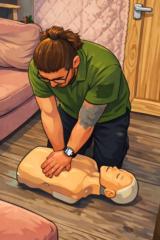
Research consistently finds women in cardiac arrest are less likely to receive bystander CPR than men. A major reason bystanders give is reluctance to touch or expose a woman's chest. If she is unresponsive and not breathing normally: - Start compressions. Hesitation costs survival — nothing else does - Hands go on the lower half of the sternum. The same landmark, regardless of sex - You will not be accused of anything for delivering CPR - Call 999 and get an AED Doing nothing is the only wrong answer. If you teach, cover this explicitly. People need permission before they'll act.
1
0

1-9 of 9

@ronald-carter-8856
Event medic who is passionate about sharing knowledge and strengthening communities through teaching first aid skills
Active 4h ago
Joined May 16, 2026
Suffolk, UK