Activity
Mon
Wed
Fri
Sun
Jul
Aug
Sep
Oct
Nov
Dec
Jan
Feb
Mar
Apr
May
What is this?
Less
More
Memberships
Boss Writer Academy
40 members • Free
Publish. Promote. Profit.
4.2k members • Free
Lifescil — The Reclaimers
5 members • Free
The Argovale Lore Guild
358 members • Free
2 contributions to Boss Writer Academy

18d •
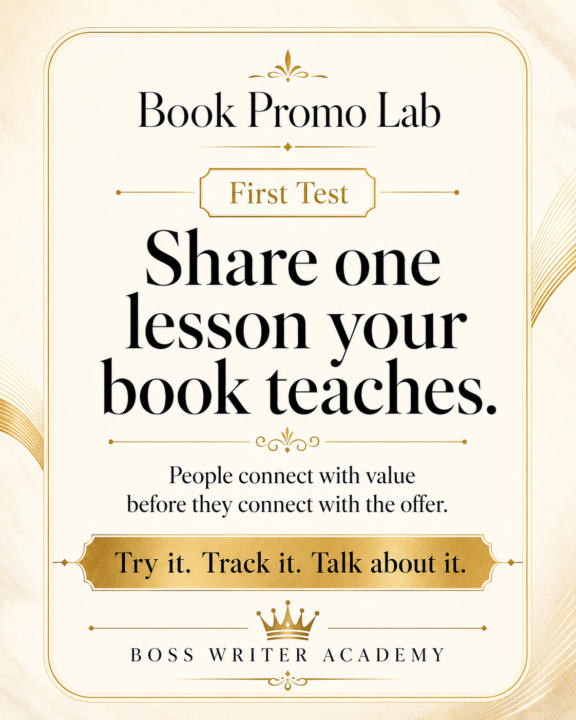
BOOK PROMO LAB - TEST ONE!
Let’s test a simple book promotion move. Instead of only saying, “Buy my book,” share one lesson your book teaches. People often connect with the value before they connect with the offer. Try one of these: My book teaches readers how to…One lesson from my book is…If you are struggling with ___, this part of my book will help you… This works because it gives people a reason to care before you ask them to buy. Your book is not just a product. It carries a message, a solution, a story, or a shift. Use this to build a social media graphic or a website post. Your task: Create one post this week sharing a lesson from your book. Comment : What is one lesson your book teaches? Or have you tried this before? Did it work? Post the social media or website link of where you have posted it in the chat so we can take a look. I am looking forward to this!!

2 likes • 12d
This is a great strategy because readers usually connect with transformation and value before making a purchase decision. Focusing on what the reader will learn or experience makes the promotion feel more authentic and engaging rather than just sales-focused. One lesson my book teaches is the importance of consistency and visibility when building long-term success, especially in publishing and personal growth. I’ve noticed that value-driven posts tend to create stronger engagement because people relate to the message first.
0 likes • 11d
@Latoya Belfon You are welcome. I would love to connect more and hear how you’re approaching things as well.
12d •
Learn from Dr. Cheyenne’s Failure
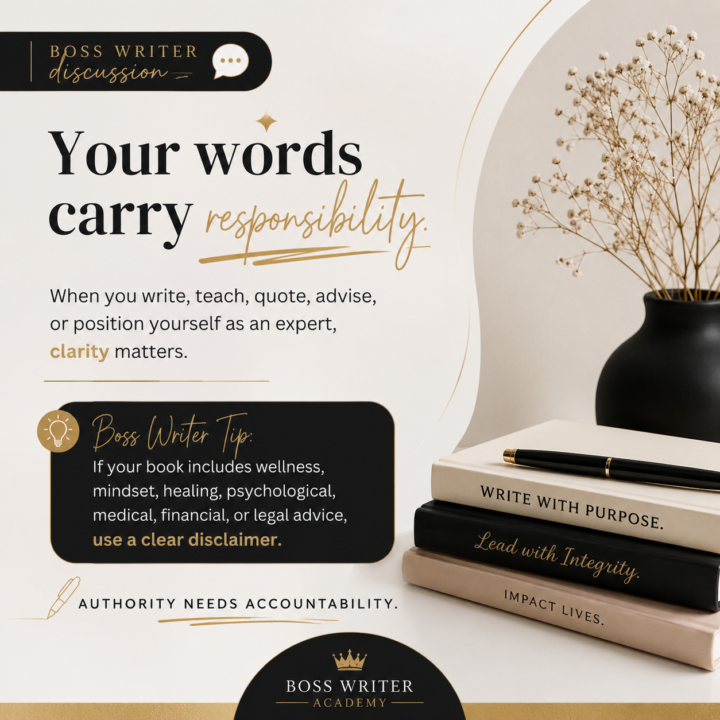
There is a conversation happening online right now around Dr. Cheyenne Bryant, credentials, public advice, and what responsibility looks like when someone is speaking from a place of authority. I don’t want us to focus on gossip. I want us to focus on the lesson. As authors, writers, coaches, speakers, and thought leaders, we have to understand that our words carry weight. When you write something publicly, publish it in a book, teach from a platform, or offer guidance that sounds psychological, medical, financial, spiritual, or legal, people may receive it as instruction. That means clarity matters. Credentials matter. Language matters. Disclaimers matter. Scope matters. A Boss Writer does not just ask, “Can I say this?” A Boss Writer also asks: Am I qualified to say this in this way?Could this be misunderstood as professional advice?Do I need to clarify my role, training, or limitations?Should I include a disclaimer in my book or content? Boss Writer Tip: If you are quoting, teaching, sharing advice, or writing about anything connected to mental health, trauma, healing, wellness, money, law, medicine, or psychology, and you are not licensed in that area, include a clear disclaimer. A disclaimer does not weaken your message. It protects your readers, your credibility, and your work. The lesson is this: Sometimes it is not just what we say.It is how we frame it, what authority we attach to it, and whether the reader understands the limits of what we are offering. Discussion:Where do you think authors should draw the line between sharing personal wisdom and offering professional advice? Comment your thoughts below.
1 like • 12d
This is such an important conversation, especially in today’s digital world where readers often view published content as expert guidance. I believe authors should absolutely share personal experiences, lessons, and perspectives, but there needs to be a clear distinction between personal insight and professional advice. Transparency is key. If someone is not licensed or formally trained in a specific field, framing the content as personal experience, opinion, or educational discussion rather than instruction is very important. Disclaimers, clarity, and responsible wording help protect both the audience and the author’s credibility. At the end of the day, influence comes with responsibility, and thoughtful communication matters just as much as the message itself.
0 likes • 11d
@Hassan Dajani You are welcome. I would love to connect more and hear how you’re approaching things as well.
1-2 of 2
@robert-amilcar-7518
Robert Amilcar | Book expert helping authors publish, market, build their brand, grow audiences, and turn manuscripts into success.
Active 11d ago
Joined May 18, 2026