Activity
Mon
Wed
Fri
Sun
Nov
Dec
Jan
Feb
Mar
Apr
May
Jun
Jul
Aug
Sep
What is this?
Less
More
5 contributions to Redirect K9s
7d •
I would like your opinion...
I am wanting to come up with a new community name due to Beyond the Leash already being taken on Youtube and for a couple of obedience schools. I am leaning towards Redirect K9s as I think it encompasses what I talk about on Tuesdays and Fridays while also still showing a working dog intent (hopefully regardless of starting point). I will also be redoing my about page to reflect this. I look forward to your thoughts and feedback.

1 like • 6d
I like the name Redirect K9s 😊 I think it’s clear and also has a working dog tone which is cool
May 2 •
Jack Russell Terrier
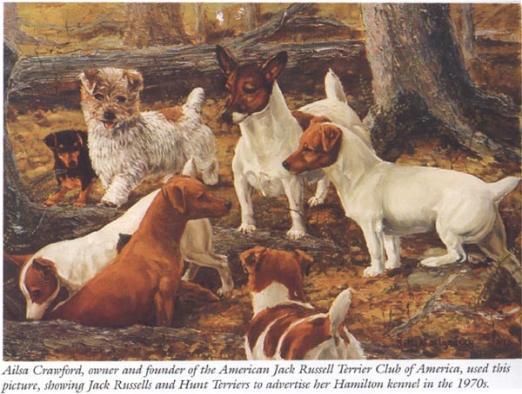
This came at the recommendation of @Paul Bunker The Jack Russell Terrier is an English breed known by about 500 names it seems and varies depending on what country you are in (America, Great Britian or Australia mainly). Here are a few options: Jack Russell Terrier, Russell Terrier, Connemara Terrier, English Jack Russell Terrier, Miniature Jacks, Puddin Jacks (probably my favorite) and Shorties just to start. The true origin story of the JRT, as they are most commonly known, is not 100% agreed on but one thing everyone seems to agree on is a man named Rev. John Russell is responsible. Rev. Russell (1795-1833) enjoyed hunting, particularly fox hunting, when he was not participating in church activities. He acquired his first little terrier, Trump, from the milkman that was passing by and offered to purchase her. The milkman agreed and Rev. Russell had what some believe to be the foundation female for the breed. It is stated that he really liked how she looked “white with a patch of dark tan over each eye and ear while a similar dot, not larger than a penny piece, marks the root of the tail. The coat, which is thick, close, and a trifle wiry, is well-calculated to protect the body from wet and cold but has no affinity with the long rough jacket of the Scotch Terrier. The legs are straight as arrows, the feet perfect, the loins and whole frame are indicative of hardiness and endurance.” There is debate on what year Trump was purchased (1815 or 1819) or whether or not she is part of the “pure line” or that Rev. Russell even bred a “pure line” to begin with. It is also said he was more of a hound man than a terrier man. So, if Trump is allegedly not the foundation of the “pure line” what exactly makes up the JRT we know today. This is where things get interesting. As previously mentioned the body confirmation of the early JRTs were preferable to Scotch Terriers (precursors of the Scottish Terrier) due to their longer legs. The JRTs were better able to keep up with the hounds in the field and with their white coats not able to be mistaken for a fox. One source also states that to increase the “courage and ferocity” bulldogs were sometimes thrown in the mix. There is one record of a smooth coated terrier that was a fox working breed named Pitch that is thought to the development of the now extinct Old English White Terrier (looks somewhat like a bull terrier but without the egg shaped head), smooth coated Black and Tan terriers, Old English Bull Terriers, Greyhounds and Beagles.
1 like • May 2
I’m a big JRT fan, such a big personality in a small body!! Thanks for sharing this, so interesting (as always)
Jan 30 •
Australian Cattle Dogs
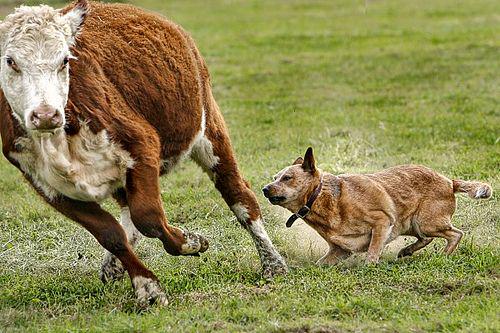
The Australian Cattle Dog aka Heelers have also been called Queensland Heeler, Halls Heeler, Blue Heeler and Red Heeler. The Australian Cattle Dog earned their other name, Heeler, due to moving cattle by nipping at their heels. This trait is present due to their dingo ancestry. What breeds were used to make up the Australian Cattle Dog is up for debate due to the records being disposed of but it is thought that some breeds include: Blue Collies, Kelpie, Bull Terrier and the Dalmatian (although the Dalmatian has been questioned). How a wild dog would breed with a domesticated dog is not entirely known but a popular theory is that a litter of Dingo puppies were abandoned and raised domestically and from there was able to breed with domesticated dogs. While the theory is a consideration it is in fact a man named Thomas Hall who is credited for developing the breed. It is said that Hall, a cattle rancher, imported dogs from the United Kingdom, such as the blue-speckled Highland Collie, other sources say bob-tailed drover dogs with a blue coat, and crossbred them with the wild Dingo. This crossbreeding created a dog that was sturdy, tough, robust, active and could handle the Australian Outback but also work alongside their human. It was in 1825 that Hall was first successful in breeding this new breed of cattle dog. Through continual and selective breeding, he had developed an extremely handy cattle dog by 1832. It wasn’t until after his death is 1870 that his dogs would become available to other people aside from friends and family. This is also where the breeding records of how the cattle dog came to be is lost to history due to the details of his breeding program being thrown away. Sometime between 1845 and 1855 another type of Heeler was developed. These were known as Timmins’ Biter and were leaner than Hall’s Heelers, were blue and had stumpy tails. Cattle dogs were also said to be mixed with Kelpie which helped further develop their herding abilities and changes to their markings.
1 like • Feb 1
@Christina Brewster hahaha absolutely chicken vs the egg 😆 He was very well suited to his job, it’s always great watching dogs do what their years of genetics tell them to do, with a bit of guidance of course 😊
1 like • Feb 2
@Stevi-Lee Alver I know right 😆 He definetly lived up to his name
Jan 22 •
Labrador Retriever
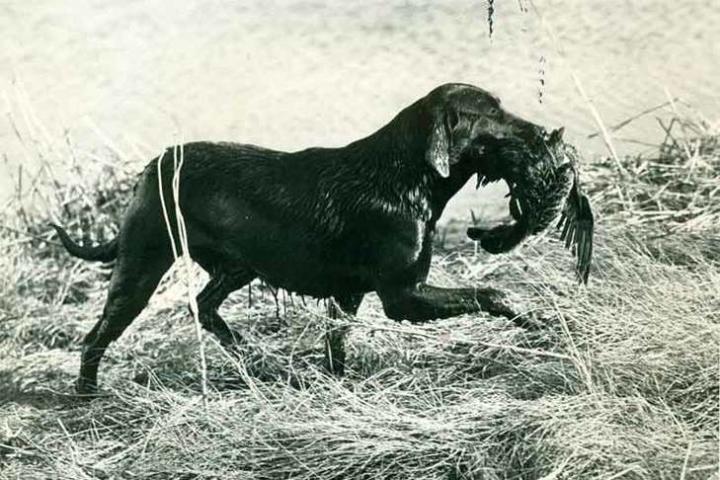
The Labrador Retriever that we know and love today has quite the interesting history. The Labrador Retriever how they are recognized today is originally from England but they actually go back further than that not only in time but also distance. The Labrador Retriever goes back to the 18th and 19th century but went by a different name and look entirely. The St. John’s Water Dog, named after Newfoundland’s capital, had a dense, oily waterproof coat and thick tail with more forward-facing ears. They loved the cold and the water and were more than happy to retrieve anything from lost fisherman hats to fish that managed to get away despite temperature and conditions. These hardy and useful dogs lived on the island of Newfoundland but are thought to be the result of Europeans coming over with their own hunting dogs and they are the ancestors of Newfoundland dogs. It is thought that, much like the spaniels, there were two distinct size and appearance of dogs, one that was large and long coated, and one that was smaller with a short oily coat, which the fishermen preferred as it was easier to maintain. The smaller dogs became known as St. John’s Water Dog and were very important and essential to the fisherman in Newfoundland. How the St. John’s Water Dog turned into the Labrador Retriever began with one man named James Harris, the 2nd Earl of Malmesbury, and he imported some of the St. John’s Water Dog dogs in the early 1800s and began breeding them for shooting companions. Later a man named Walter Scott, the 5th Duke of Beccleuch, also imported some St. John’s Water Dog dogs to Scotland and started his own breeding kennel, which is still in operation today. It wouldn’t be until a generation later, in the 1880s, when these two men’s sons met at a shoot and decided to work together and breed these two lines of St. John’s Water Dog together and thus the Labrador Retriever was born. The Labrador Retriever got their name from the Earl of Malmesbury who is thought to have been a little rusty on Canadian geography. It is also said that Newfoundland and Labrador were also used interchangeably when referring to the region. When he first saw these dog’s he, correctly, thought that they would be good at duck hunting.
1 like • Jan 22
@Christina Brewster I’m definetly keen to read further! It is interesting that the “original” labs had some white on their chest and toes, my 11yr old lab has some white on the back of her paw, I wonder if this is a throwback 🤔 I listened to the Labrador episode on Craig Koshyk’s podcast, Hunting Dog Confidential, it was so fascinating. It’s great to learn about the different breeds and their long line of genetics and what’s biologically fulfilling to them, then how to relate this to our training. I would love to visit that breeding kennel one day, it would be great to see their dogs!
1 like • Jan 22
@Christina Brewster ahh that is so cool about the Newfoundland!! I would have thought it was odd too 🤣
Dec '25 •
Introduce yourself...
Hello my name is Christina Brewster and I am a professional dog trainer who has a passion on how dogs think and perceive the world. I am a training partner with Chiron K9 and I am a certified Predation Substitution Instructor. The type of dog training I do is off leash detection but a lot of what it takes to have a great and dependable off leash detection dog are skills every dog can benefit from knowing. A big concern for both working dogs and pet dogs is chasing wildlife. A dog that is interested in chasing wildlife can find themselves in dangerous situations. They could run into traffic, they can get their gear caught up in branches, they can become impaled by branches or the animal itself, they can find themselves lost for extended periods, etc. Instead of getting frustrated and suppressing the dog’s quality of life I want to help owners, handlers and other trainers understand what is happening in their dog and how to redirect it in a safe way. “Frustration begins where knowledge ends” - Clinton Anderson
1 like • Dec '25
Hi there Christina and fellow dog enthusiasts! I’m Remi and I live in Australia. I’m a detection dog handler and have a business teaching others how to train their dogs for detection, specifically conservation and scent sports. Really keen to learn more about control while off lead as well as deep diving into various breeds. Looking forward to connecting and learning 😊🐾
1-5 of 5

Active 16h ago
Joined Dec 24, 2025