Activity
Mon
Wed
Fri
Sun
Oct
Nov
Dec
Jan
Feb
Mar
Apr
May
Jun
Jul
Aug
Sep
What is this?
Less
More
AI Agent Builders
8.3k members • Free
The Selfwork Club
429 members • Free
Clief Notes
48.5k members • Free
The AI Advantage
129.3k members • Free
11 contributions to Clief Notes

Jun 16 •
How many tokens should be used
Hi everyone, hope you're well I've got a question in regards to everyone's token usage! How many tokens is everyone using on average for each sizable feature they include? I understand that a "sizable feature" is different for each person and each project. I currently have the Claude pro subscription and every time I add a feature it takes up 40% roughly of my 5 hour window. I was wondering if everyone is experiencing something similar or perhaps I could be more efficient with my routing. As far as I'm concerned, I've followed what Clief has said as closely as possible, so I'm interested in understanding what other people have implemented to be more efficient with their tokens. To reiterate it's not a bad thing the token usage I do currently, instead I'm genuinely intrigued to see how everyone else is faring.

Jun 2 •
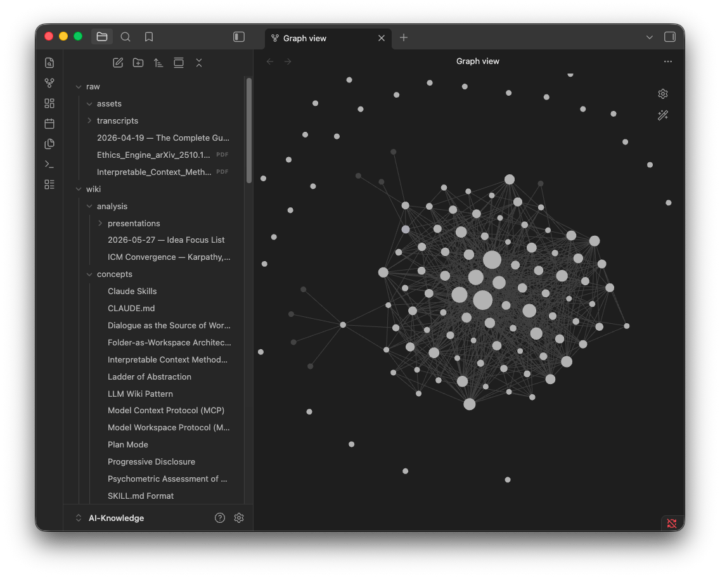
I built an ICM vault to learn ICM (Claude Code + Obsidian)
I kept watching Jake's videos, reading the ICM paper, Karpathy threads… and forgetting most of it a week later. Learning the wrong layer, but with my own knowledge. So I built the thing the content kept pointing at. Not a notes app. An ICM workspace for my own learning. The rules (sound familiar?): - raw/ is immutable. Transcripts, PDFs, papers. The LLM reads, never edits. - wiki/ is the LLM's workspace: entities, concepts, sources, analysis, overview. - index.md = catalog. log.md = append-only timeline. Welcome.md = the schema the agent follows. - Claude Code writes. Obsidian is the front-end. I read; it writes. - Every claim links to a source. No orphan facts. One ingest: I drop a transcript in raw/ and say "ingest it." A single 22-min Van Clief video cascaded into ~10 linked pages in one pass (a summary, 2 new entities, 5 updated pages, index + log), cross-linked, with contradictions flagged rather than silently resolved. After ~3 months: ~35 sources, 84 interlinked pages, every claim cited. No vectors, no RAG. The folder path is in the memory, and I can read every byte. I'm using the method to learn the method. Folders over agents, pointed at my own head. (I'm starting an AI-implementation practice in Brazil built on ICM, so this doubles as the knowledge base behind my client work.) Schema's attached if you want to start your own. What would you ingest first?https://github.com/jarantes-prog/icm-knowledge-vault
3 likes • Jun 2
This sounds very interesting, would you need obsidian as a prerequisite in order to use it? If you could create a GitHub page then this could actually become a very useful tool for people to utilise to not only keep up with ai but with any niche that is constantly being updated through the world! Thank you for this

Mar 13 •
Has anyone here changed careers?
Not long ago I had absolutely no background in programming. I started learning out of pure curiosity after discovering AI and realizing how powerful these systems were becoming. At first everything felt overwhelming syntax, debugging, concepts I had never seen before but I kept showing up every day and building small projects. Fast forward a few months later, after countless hours of learning and experimenting, I managed to land my first role as a Junior AI Engineer. The journey wasn’t easy, but it proved to me that with consistency and the right resources, changing careers into tech is actually possible. I'm curious, has anyone else here made a similar transition?
1 like • Jun 2
That's actually crazy man, going from not knowing anything about programming at all to landing a junior AI engineer job all within a couple of months is insane. How was the hiring process? With everything that is going on it seems like trying to get hired in tech right now is nigh on impossible - did you feel like that was the case? How did you do in the interviews as well, I'm genuinely curious?

Mar 10 •
vibe-code-rules.md
So I haven't had the chance to dig into the classroom yet so I'm not sure if this is covered anywhere.. but this is my set of general vibe coding rules that I have been working on to use across all projects. This way I have a single "source of truth" for best practices to include on all builds and try to keep things clean. So far it has been working pretty well (from an amateurs perspective haha) and looking forward to stress testing it more. Please take it and use it for yourself if you don't have anything similar yet. Also, I would really appreciate any feedback from the more experienced devs/engineers in the group. 🙏 Edit for clarity: this doc is something I have been applying to all vibe coding projects. Not all projects in general. Another edit for clarity: I am just getting through Jake‘s ICM paper now along with the classroom material. I was not aware that he also refers to the claude.md as a global file to be handed off to the highest level orchestrating agent. This global.md would be better named something more specific and placed around layer 3 of the workflow (someone please correct me if I’m wrong). Anyways, hope this clears up any confusion there may be. Decided to change the name to vibe-code-rules.md for clarity =)
3 likes • Jun 2
So can this be used in any workflow? Would this be listed as a global orchestrating MD file that would be read every time or only in situations where actual code would be written by the agent?

May 28 •
Built a reusable Claude Code project template that wires Jake's three-layer routing system into a full session architecture.
The template integrates three frameworks: Van Clief's routing (the structural backbone), Karpathy's behavioral rules (think before acting, minimum viable scope, surgical changes, goal-driven execution), and IBE intent preservation (the "why" behind every decision). Each tier has a clear job — CLAUDE.md routes, workspace context files carry domain knowledge, skills wire selectively per task. The core addition on top of Jake's routing: a session state pattern (STATE.md) that eliminates cold-start friction. Each session closes by setting the next session's intent. Work becomes a directed sequence rather than a series of isolated conversations. Results from two validations (a meta-framework design project and a non-software operational coordination project): - Zero context re-establishment at session start - Zero intent-misaligned rework - Second project stood up in ~25 min on first attempt, no structural modifications needed Template is public: https://gitlab.com/vigilkeep/ibe-workflow-template Happy to share the ADR that documents the one deliberate deviation from 3.3 guidance (CLAUDE.md runs ~70 lines instead of 40–50 — there's a specific reason).
1 like • Jun 2
The inclusion of the STATE.md file is actually ingenious. I've always done something like that in my own work without realising and once I saw that was what you were talking about it all made sense to me in my head, like I had a eureka moment. Formalising the STATE.md file is an excellent addition 👍
1-10 of 11

Active 3d ago
Joined May 12, 2026
Powered by