Activity
Mon
Wed
Fri
Sun
Nov
Dec
Jan
Feb
Mar
Apr
May
Jun
Jul
Aug
Sep
Oct
What is this?
Less
More
9 contributions to Unfiltered Guide to Parenting
Feb 11 •
Play is diagnostic (even when it looks messy)
If you slow down during play, you’ll see patterns. Not in what toys they pick In how their body uses space. Do they: - collapse into the floor quickly? - avoid rotation? - move fast but without control? - repeat the same pattern over and over? - shift positions easily? Play shows us: - endurance - balance - organization - problem solving - regulation Without a single worksheet. This is why structured “do this activity 10 times” advice misses the point. *Play isn’t homework.* It’s information. And most of it is visible long before milestones change.
0
0
Feb 6 •
Big feelings don’t mean fragile kids
We’ve started equating “regulated” with “calm.” That’s not accurate. A regulated nervous system can: - protest - cry - get frustrated - resist - recover Dysregulation isn’t about volume. It’s about whether a child can return to baseline with support. **WITH SUPPORT** A toddler who melts down but reconnects quickly? That’s development. A child who expresses big emotion but stays organized in their body? Also development. Silence isn’t always strength. Calm isn’t always capacity. Watch recovery Watch reengagement. Watch how the body reorganizes. That tells you far more than the size of the reaction.
Jan 20 •
What to watch instead of “what’s next”
When parents are told to “wait and see,” it usually sounds like: Do nothing and hope for the best. That’s not actually helpful. What is helpful is knowing what to watch while you’re waiting — because development doesn’t pause just because new skills aren’t showing up yet. Instead of asking: - What should they be doing next? - What milestone comes after this? - Are they behind? Try noticing: - how easily your child transitions between positions - whether movement looks smoother or less effortful - if they recover more quickly after frustration - how long they stay with play before moving on - whether their body looks more organized, even without new skills These are signs of integration, not performance. This is also why copying activities from the internet often backfires. If you’re chasing the next skill, you miss the information your child is already giving you. Development isn’t a checklist — it’s a pattern. And patterns show up in how a child moves, not just what they can do. If you’re watching closely, you’re not “doing nothing.” You’re doing one of the most important parts.
0
0
Jan 16 •
Why “nothing is happening” is often the point
One of the hardest parts of early development is this phase: Nothing looks different. Nothing feels measurable. And everyone around you is asking, “Are they doing X yet?” This is usually the part where parents assume something is wrong. But development doesn’t announce itself when foundations are forming. It gets quieter before it gets obvious. When a child’s nervous system is organizing, you might see: - longer pauses before movement - less frantic effort - more stillness, not more action - fewer “new tricks,” but better quality in old ones From the outside, it can look like nothing is happening. Internally, a lot is happening — just not in ways that photograph well or show up on checklists. This is why milestone pressure is so misleading, it trains parents to look for output instead of integration. And integration always comes first. If you’re in a season where things feel subtle, slow, or unimpressive — that doesn’t mean you’re behind. It often means the system is doing exactly what it needs to do. Trust the process!
1
0
Jan 12 •
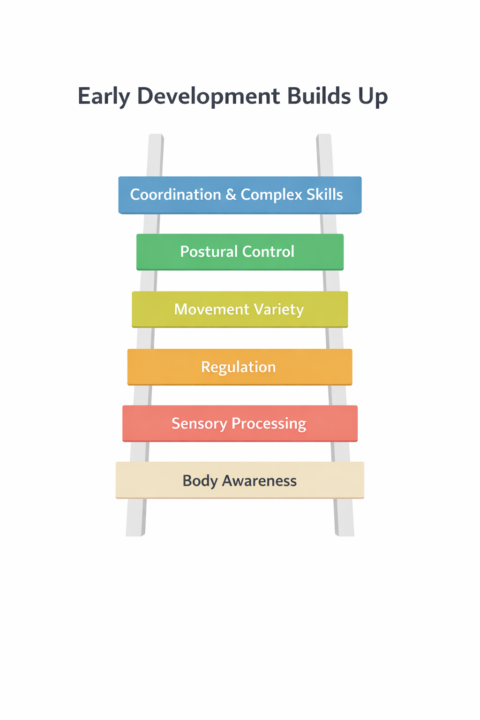
Developmental Ladder
Early development rarely shows up in big, obvious jumps. More often, it looks like: - small changes in how a child moves - slightly longer attention during play - less effort getting into or out of positions - quicker recovery after frustration These shifts are easy to miss if you’re only watching for milestones. Development works more like a ladder than a checklist. Each rung is built on the one below it. Bigger, more visible skills depend on smaller, quieter ones happening first. A child can’t skip rungs and expect the top to feel stable. They might reach it, but it often takes more effort, more support, or more regulation to stay there. Foundations tend to show up quietly — before skills become obvious. When those lower rungs are solid, higher-level skills come more easily and with less strain. That’s why understanding how development unfolds matters just as much as what shows up, We’ll keep coming back to this idea and how it shows up across early development. Remember to celebrate the small things!!🤩
1
0
1-9 of 9
Active 41d ago
Joined Jan 11, 2026