Activity
Mon
Wed
Fri
Sun
Aug
Sep
Oct
Nov
Dec
Jan
Feb
Mar
Apr
May
Jun
Jul
What is this?
Less
More
Memberships
I Am Loving Awareness Support
116 members • Free
5 contributions to I Am Loving Awareness Support
Jan 8 •
The Dangerous Confusion of Faith and Power
Freedom has never been comfortable. The price of a free society is not consensus or moral ease, but the sustained discipline of living alongside people who do not think alike without reaching for domination. That discomfort is not a defect of democracy. It is its defining condition. Moral language becomes most dangerous at precisely this point. This essay does not ask readers to affirm doctrine, accept miracles, or claim a religious identity. It asks a more fundamental question, one that has followed power throughout history: What happens when the language of virtue is used to justify behavior that contradicts the values it invokes? History answers with unsettling clarity. Before Christianity became an institution, Jesus of Nazareth emerged as a figure whose teachings challenged ego-driven power at its core. Across the canonical Gospels and early non-canonical traditions alike, the emphasis rests less on belief as membership and more on being as practice. The “kingdom of heaven” is not framed as a future destination or a tribal inheritance. It is presented as a present reality—within human conduct and human consciousness. Jesus repeatedly rejected the use of moral authority as domination. “You know that the rulers of the Gentiles lord it over them… Not so with you.” “Whoever wants to be first must be your servant.” “By their fruits you will recognize them.” Stripped of theology, the ethic attributed to Jesus is exacting. It elevates humility over dominance, truth over manipulation, mercy over exclusion, and service over self-promotion. The measure of faith is not what one claims, but how one lives when belief becomes inconvenient. This understanding of Jesus was not lost on America’s founders. Thomas Jefferson compiled The Life and Morals of Jesus of Nazareth by removing miracles to preserve what he believed mattered most: the ethical teachings themselves. Jefferson did not reject morality. He sought to protect it from distortion by power, superstition, or institutional control.

2 likes • Jan 8
Thank you for your continuation of cutting through the noise with your words Brian.
Sep '25 •
An Opportunity for Miracles
A miracle is a shift in perception, a realization that all minds are joined when the ego falls away. Suffering, painful though it is, can become the very soil in which healing takes root. Yet healing never forces itself upon us—it waits for our choice. Each person must decide whether to take responsibility for their own suffering, or to project it outward as blame. This moment is not a time for accusation. It is a time for awakening, for personal responsibility. It is a time for miracles. Blame is the ego’s favorite weapon. It points outward to avoid looking inward. It builds walls where bridges could stand. It convinces us that our pain is caused by others, while quietly reinforcing the patterns that keep us trapped in fear. Yet the truth is far simpler: we suffer because we resist what is. We resist our own responsibility. We resist the truth that peace begins within. To see this clearly is to reclaim the power to heal. Suffering teaches until the lesson is learned. Many of us only awaken through pain—through moments when life forces us to see that the old ways no longer work. In this sense, suffering has value, not because it is desirable, but because it can become the turning point. The moment I stop resisting and accept responsibility for my perception, the suffering dissolves. It has done its work. What remains is a clarity that does not come from winning arguments or blaming others, but from opening to what is true. We are being offered such a moment now. It is not a time to sharpen our weapons of ideology, but to soften our hearts. It is not a time to divide ourselves further into camps of right and wrong, but to recognize the deeper truth that we are reflections of one another. What I condemn in you is always a mirror of what I fear in myself. What I celebrate in you is always a reminder of what I am. To realize this is to undo the illusion of separation, and with it, the illusion of enemies. The culture around us profits from outrage. Media corporations sell division as though it were a drug, feeding us a steady drip of fear, blame, and indignation. Outrage may keep us entertained, but it does not keep us whole. Each clip we watch, each headline designed to inflame, pulls us deeper into a trance of separation. We do not even notice that we are being sold our own suffering. The hangover of that drug is emptiness, anxiety, and despair. Yet the remedy is simple: a pause, a breath, a moment of conscious presence. When I feel that rush of indignation, I can ask: Is this really who I want to be? Or am I just consuming the product being sold to me?
2 likes • Sep '25
YES YES YES A THOUSAND TIMES YES!! Was just reading your book before going into work when this notification popped up. Something said I needed to read this right now, and that I did. Thank you!!
Sep '25 •
4th Street Live with Jacob Green
Just dropped. Went all in. I hope that maybe it will help someone. Not sure how I’m feeling about it. But it’s out there now. Feels good being vulnerable, but definitely exposed. I’ll write more later once I wrap my head around it. Showed my parents and they said they were proud of me and they love me, and for me that’s enough.
1 like • Sep '25
Very inspiring Brian. I’ve been struggling with writing the past 2 years. I used to write every day and it just poured out. I wrote down some notes from watching this but my biggest takeaway is, “write it for yourself”. I’ve noticed I will start to write and I’ll imagine someone else reading it, so then it becomes inauthentic and I lose my motivation, flow and focus. I’ll carry this with me, thank you
1 like • Sep '25
@Brian Woody sometimes I get overwhelmed with how much I have to say so I end up writing nothing. Ever experienced that?
Sep '25 •
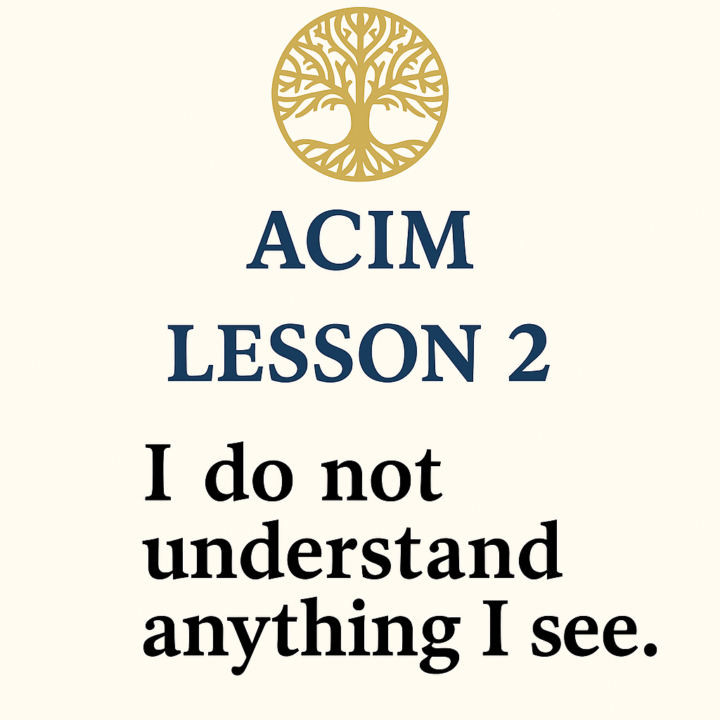
ACIM - Lesson 2
Lesson 2 🔉Listen to Audio in the attached file. I have given everything I see in this room [on this street, from this window, in this place] all the meaning that it has for me. 1. The exercises with this idea are the same as those for the first one. ²Begin with the things that are near you, and apply the idea to whatever your glance rests on. ³Then increase the range outward. ⁴Turn your head so that you include whatever is on either side. ⁵If possible, turn around and apply the idea to what was behind you. ⁶Remain as indiscriminate as possible in selecting subjects for its application, do not concentrate on anything in particular, and do not attempt to include everything you see in a given area, or you will introduce strain. 2. Merely glance easily and fairly quickly around you, trying to avoid selection by size, brightness, color, material, or relative importance to you. ²Take the subjects simply as you see them. ³Try to apply the exercise with equal ease to a body or a button, a fly or a floor, an arm or an apple. ⁴The sole criterion for applying the idea to anything is merely that your eyes have lighted on it. ⁵Make no attempt to include anything particular, but be sure that nothing is specifically excluded. (ACIM, W-2.1:1–2:5)
1 like • Sep '25
I’m interested in this but am not quite sure what it all means. Suggestions to where I start? Never heard of this before
1 like • Sep '25
@Brian Woody I see! Perception without judgment
2 likes • Sep '25
I read a book recently titled, “Stolen Focus” by Johann Hari. This book goes over all of the things affecting our focus; phones, pollution, sleep, crappy food, etc. Johann talks about the importance of “flow states” and how most people don’t enter them as often due to a world filled with distractions. A great read and goes into depth on these topics… I would close the book often, fully enraged by how people are profiting off of stealing our awareness, our ability to focus. But, knowledge is power and being introduced to the beauty behind “flow states” and how important they are, makes me look through the world with different eyes. What am I doing today? Whatever puts me in a flow. I am the creator of my reality!! Funny side note, in the beginning of this book, the author talks about how he had an epiphany and went on a 3 month trip with a flip phone and no access to the internet. It was the best thing he’s ever done. I found this book on the very last day of my 2 month trip in New Zealand, with the flip phone I had gotten 4 months prior, sitting in my purse :)
0 likes • Sep '25
@Brian Woody no I haven’t but it looks like a great read. Downloading now
1-5 of 5

@rach-speirer-1933
If every person lived as you do, how would the world feel?
Active 35d ago
Joined Sep 8, 2025
ENFJ
Los Osos , CA