Activity
Mon
Wed
Fri
Sun
Sep
Oct
Nov
Dec
Jan
Feb
Mar
Apr
May
Jun
Jul
Aug
What is this?
Less
More
Project Biohacked - Peptides
14.4k members • Free
RNS-Ravens Nest
7.1k members • Free
GLP-1 Real Talk Community
1k members • Free
Peptides for Newbies
7.4k members • Free
KRISTINA’S PEPTIDE JUNKIES 24
1.3k members • Free
StartingMyResearch
27 members • Free
Hacksmith's Free Peptalk Group
2.3k members • Free
Pep Talk - For Better Health
3.2k members • Free
Biohacking Peptide Playground
7.6k members • Free
5 contributions to KRISTINA’S PEPTIDE JUNKIES 24

Jul 1 •
BPC
Big day in the biohacking lab. After endless research, I finally told my screaming joints to shut up and went for it. First 250mcg dose of BPC-157 is officially in the books. I definitely had to give myself a high-stakes locker room pep talk to ignore the, don't stab yourself, signals my brain was firing off, but hey, apparently heart palpitations from pure anticipation are totally standard. Here’s to hoping my tendons appreciate the message I just sent them.
1 like • Jul 1
@Kristina Marie I started low. Is it possible to feel any positive effects after initial dosing? My mind must be playing tricks, but I swear my shoulder pain lessened 30 percent.

Jun 22 •
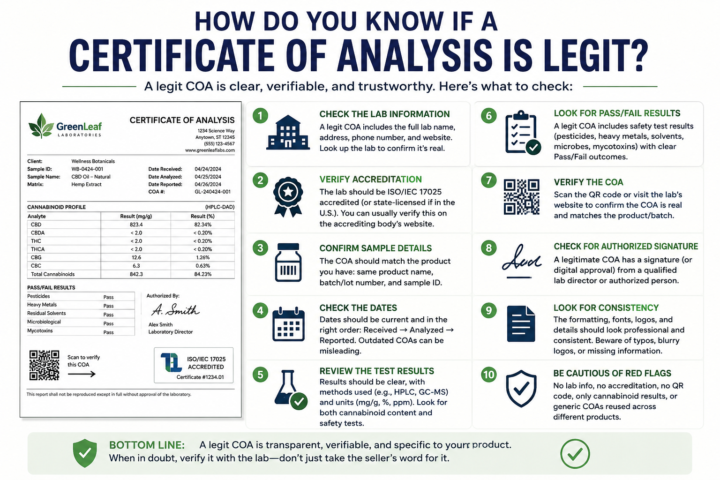
EVALUATING CoA’s FOR LEGITIMACY
When evaluating a Certificate of Analysis (COA), don't just look at the purity percentage. A COA is only as trustworthy as the laboratory and the information it provides. ✅ 1. Verify the Laboratory Exists A legitimate COA should include: - Full laboratory name - Physical address - Phone number - Website - Email contact Take 30 seconds and verify the lab online. Red flag 🚩: - No website - Generic Gmail address - No physical address - Lab cannot be found online ✅ 2. Confirm the Lab Performs Independent Testing The vendor and testing laboratory should be separate entities. Red flag 🚩: - Vendor "testing themselves" - No indication of third-party testing Independent testing reduces conflicts of interest. ✅ 3. Check for Accreditation Look for: - ISO/IEC 17025 accreditation - DEA registration (when applicable) - State licensing (when applicable) You can often verify ISO accreditation directly through the accrediting body's website. Red flag 🚩: - Accreditation logos present but no certificate number - Claims of accreditation that cannot be verified ✅ 4. Match the Lot Number The lot number on the product should exactly match the lot number on the COA. Check: - Product name - Lot number - Batch number - Sample ID Red flag 🚩: - Same COA used for multiple lots - Lot numbers don't match ✅ 5. Review the Test Date A legitimate COA should show: - Date received - Date analyzed - Date reported Red flag 🚩: - Very old testing - Future dates - Missing dates ✅ 6. Verify Testing Methodology For peptides, you should typically see methods such as: - HPLC (High Performance Liquid Chromatography) - UPLC - LC-MS/MS - Mass Spectrometry A purity result without methodology means very little. Red flag 🚩: - No test method listed - No chromatogram available when requested ✅ 7. Look at the Actual Results For peptides, look for: - Purity % - Net peptide content (mg) - Identity confirmation - Moisture content (if reported)
1 like • Jun 23
Thank you for sharing this important reminder to review all of your COA's for any discrepancies. I have used AI and attached COA's for a second look. Thank you
Jun 10 •
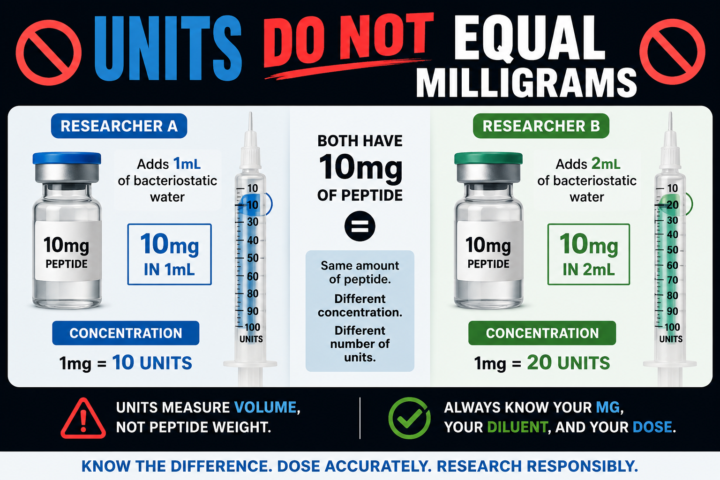
Units ≠ Milligrams: One of the Most Important Concepts in Peptide Research
If there is one thing I wish every new peptide researcher understood, it's this: Units do NOT equal milligrams. Let me say that again for the people in the back: Units are not a measurement of how much peptide is in the vial. They are simply a measurement of volume based on how much liquid you added to reconstitute the peptide. This is where many dosing mistakes happen. Example: Let's say you have a vial that contains 10mg of peptide. Researcher A adds 1mL of bacteriostatic water. Researcher B adds 2mL of bacteriostatic water. Both researchers still have exactly 10mg of peptide. The amount of peptide didn't magically change. What changed is the concentration. Researcher A - 10mg in 1mL - 1mg = 10 units - Researcher B - 10mg in 2mL - 1mg = 20 units - Same peptide. Same milligram amount. Different number of units. This is why asking: "How many units should I take?" is impossible to answer without knowing: - How many milligrams are in the vial - How much diluent was added - What dose is being targeted Why This Matters: Imagine two different vendors selling the same peptide. Vendor A's laboratory testing shows the vial contains 9.2mg. Vendor B's laboratory testing shows the vial contains 11.1mg. Both may be labeled as "10mg." If you are dosing based solely on units and not the actual laboratory-tested content, your dosing could be significantly different than intended. This is why I constantly emphasize: ☑️Review the CoA ☑️Verify the actual tested amount ☑️Use a peptide calculator ☑️Understand your concentration ☑️Never assume units equal milligrams The Takeaway: Milligrams tell you how much peptide you have. Units tell you how much liquid you're drawing into the syringe. They are not interchangeable. The researchers who take the time to understand this concept make fewer dosing errors, get more consistent results, and become far more confident in their research. If you're new to peptides, learning concentration calculations and dosing calculators is one of the most valuable skills you can develop.
2 likes • Jun 10
Great information for the ones that are unsure of the difference. Thank you for sharing this important information.
Jun 3 •
Zep / Tirzepatide
Has anyone who was on Zepbound, continue with ROU Tirzepatide? I am worried about cost and have purchased Tirzepatide. I know it is the same ingredient, just looking for information as I will be switching this week.
0
0

0 likes • May 15
@Win Teel I took my first 1mg Mots and got a warm flush feeling over my body, felt like racing. No serious effects such as breathing, swelling or palpitations that lasted for an hour or so, lessened as the time went on. But today, I just generally feel good. Not a superhero, just overall general well being. Tomorrow i may reduce my shot to 500mcg. Thoughts?
1-5 of 5
@philip-digaetano-9372
52 and following the quiet trail of peptides—where small molecules hint at big secrets
Online now
Joined May 14, 2026
Powered by