Activity
Mon
Wed
Fri
Sun
Nov
Dec
Jan
Feb
Mar
Apr
May
Jun
Jul
Aug
Sep
Oct
What is this?
Less
More
ITWS Financial Services
98
Free
The Path To Freedom
71
Free
Auction Property Academy
672
Free
Dirty Title Goldmine
513
$5/m
Surplus Funds Collective(Free)
2.4k
Free
8 contributions to Dirty Title Goldmine

Jul 21 •
Operators: what's your actual lead-to-payout timeline?
Question for the folks who've done a few deals - from first contact with an owner to actually getting paid, how long does a typical surplus deal take you? Does it differ much between foreclosure and tax deed? And where's the biggest time sink - getting the signature, the filing, or the county/court processing? Trying to set realistic expectations, so real numbers help a lot. Appreciate anything you can share 🙏
1 like • Jul 21
@Ellis San Jose Appreciate you sharing that, Ellis - the 2 months to 2+ years range is exactly what I needed to hear, and the "expensive seminar" line is painfully real 😂
Jun 25 •
Would You Trust AI Leads If You Controlled the Proof?
Most operators I’ve talked to don’t really trust “AI-generated leads.” And honestly, I get it. If a lead just appears in a spreadsheet with no clear source, no documents, no audit trail, and no way to verify it fast, it’s hard to trust. But what if the AI wasn’t just “generating leads”? What if it was doing the heavy lifting in the background, while you still had full control? You could see the county source. You could see the auction record. You could open the case documents. You could verify the surplus amount. You could check liens, ownership, deadlines, and contact data. The AI would just remove 80% of the painful manual work: auction tracking, document reading, skip tracing, case organization, and first-pass qualification. So my question is: Would you trust AI-assisted leads if every case was source-backed, transparent, and easy to verify? Or is the trust issue deeper than that?
2 likes • Jun 25
Im not selling anything I promise, I just want to learn from people.

Jun 10 •
Any input on IRS liens as a roadblock?
I’m looking at a dirty-title file where IRS liens may be the main roadblock. Basic facts: As is value is roughly $110k IRS liens appear to be around $38k+ There are also heirs, legal/title costs, closing costs, and other deal expenses. After rough math, the deal may not have enough spread unless the IRS issue can be handled cleanly. From what I understand using AI, there are a few possible paths: 1. Certificate of Discharge — remove the IRS lien from this specific property so it can sell, while the taxpayer’s IRS debt may still remain. 2. Lien release / expiration — if the collection period expired or the IRS failed to refile before the “Last Day for Refiling.” I think they expire in 10 years unless renewed. 3. Payoff through closing — assume the IRS gets paid what its lien position is worth. 4. Offer in Compromise — possible in theory, but likely slower and taxpayer/estate-specific. My main question for people who have actually worked these: How do you handle IRS liens operationally when underwriting dirty-title deals? Do you usually: 1. treat the IRS amount as a hard payoff at closing. 2. try for a discharge from the specific property or an offer in compromise. 3. wait for expiration/self-release 4. or just kill the file unless the spread is still strong after paying the IRS? I am not assuming the IRS “settles cheap.” I’m trying to understand what the practical playbook is so I don’t waste time on files where the IRS lien kills the economics.
4 likes • Jun 22
Operational playbook for this is almost always the Certificate of Discharge if you want to save the deal. The IRS actually has a specific process for this where if you can prove the taxpayer has zero equity left in the property after senior liens and reasonable closing costs are paid, they will discharge the property because their lien is technically valueless. If you treat that $38k as a hard payoff at closing on a $110k asset with multiple heirs, the math is dead. Don't waste time on an Offer in Compromise here, it takes way too long and kills your timeline.

Jun 17 •
We failed to blend in
Tonight we scoped out a very rough house to confirm a rumor of squatters. The back alley dogs alerted to us cruising the alley behind the houses. The resident showed his confrontational side. My wife wasn't feeling like this was the encounter she imagined so we went home.

2 likes • Jun 22
Listen to the gut feeling every single time. Scoping properties in the dark is always a gamble, especially when local dogs wake up the whole block. Next time it might be easier to drop by during a busy weekday morning with a high vis vest and a clipboard. You blend right into the background because everyone just assumes you are with the county or a utility company.
Jun 13 •
Started With Squatters
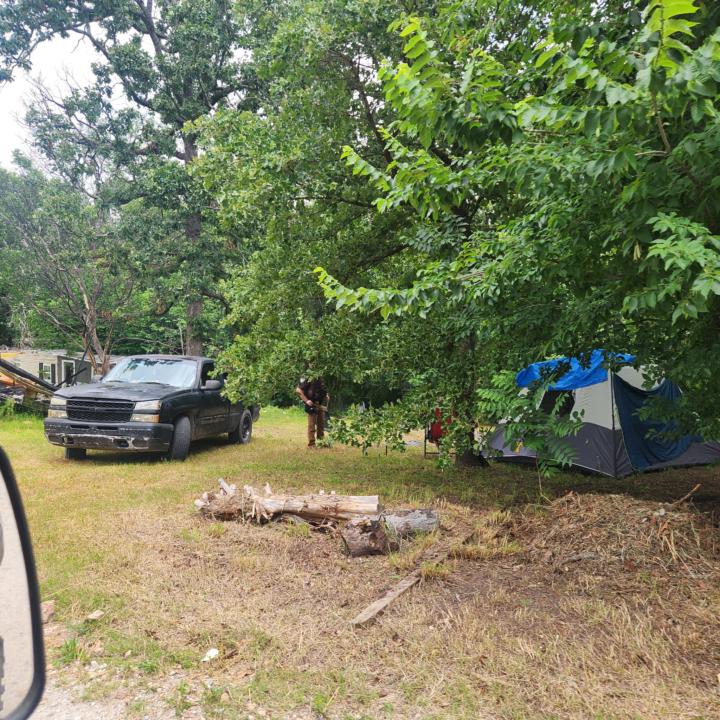
Maybe I'm an outlier but I see value in squatters. They validate the property's utility. Here's a picture from this morning when the local sheriff visited our uninvited guests. By noon we had a promissory note and mortgage signed with a notary. If they follow through, we'll get the down payment on Sunday and they avoid a criminal trespass charge. Sometimes everyone gets a happy ending.
2 likes • Jun 22
Turning a trespasser into a tenant buyer under sheriff supervision is a legendary execution. My only worry with this play is always the follow through. If they weren't paying rent before, getting them to honor a promissory note long term is a gamble. Did you look into their actual background or income history before signing, or was this purely a tactical move to get them on paper so eviction is cleaner if they default?
1-8 of 8

@pavle-andjelkovic-5912
Mapping how surplus teams find, qualify & track claims across counties. Learning from people doing the work
Active 49d ago
Joined Jun 20, 2026
Powered by