Activity
Mon
Wed
Fri
Sun
Oct
Nov
Dec
Jan
Feb
Mar
Apr
May
Jun
Jul
Aug
Sep
What is this?
Less
More
Owned by Patrick
Whether you're a veteran scientist trying to troubleshoot a pesky experiment or just a random human curious about biology, all are welcome here :)
The Energy Data Scientist
1k members • $23/month
Synthesizer
46.9k members • Free
Microscope Views (FREE)
2k members • Free
Fellowship of Mad Scientists
51 members • Free
Chemistry Physics Engineering
173 members • Free
shribe! research lab
125 members • Free
Microbiology with Dede!
28 members • Free
Science Nerd 🤓 🧫🧬🔬⚗️🔭
150 members • $3/month
Leaving Cert Biology Skool
1.9k members • Free
9 contributions to Microbiology with Dede!

Jun 8 •
🧠 Mindset | Sunday Reflection
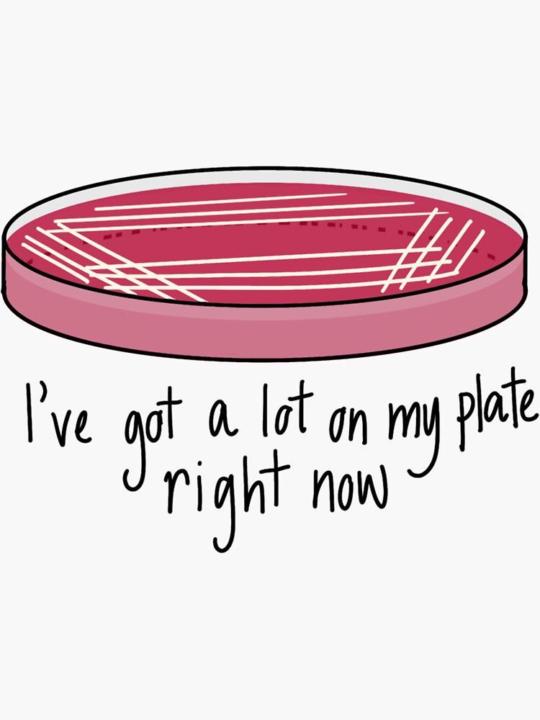
As you head into a new week, you might have a lot on your plate too… 📚 Exams to study for 🔬 Organisms to learn 💼 Work responsibilities 🏠 Life outside the lab Just remember: You don’t have to tackle everything at once. Take it one task, one chapter, one organism, and one day at a time. 💙 Don’t worry if your plate looks full right now…A full plate doesn’t mean you’re failing. Sometimes it means you’re growing. Even the busiest plates get read one colony at a time. 🧫😉 Happy Sunday, everyone. Rest up and get ready for a great week ahead. ✨

2 likes • Jun 9
@Deiondra Chalwell what if life’s throwing a buffet at me and it’s all you can eat…and I’m full haha
Jun 5 •
🧪 Practical Lab Tip | Nocardia
If a culture is growing slowly and you’re seeing branching Gram-positive rods… 👉 Don’t discard it too early as contamination. Nocardia can be slow-growing and may initially look insignificant compared to faster-growing organisms. 💡 High-Yield Reminder When the patient is: • Immunocompromised • Has chronic pulmonary symptoms • Has a brain abscess …a “weird branching rod” deserves a closer look 👀
1 like • Jun 7
Hey @Deiondra Chalwell do you think you could provide a good visual/photo of what this would look like in reality? Visual learner here
0 likes • Jun 9
@Deiondra Chalwell awesome so freaking cool and I see what you mean by the fungus-like appearance! Almost looks like the axons of neurons too
May 29 •
🧪 Lab Fact Friday
Did you know? 👉 Listeria monocytogenes can grow at refrigerator temperatures 👀🥶 That’s why contaminated: • Deli meats • Soft cheeses • Unpasteurized dairy …are classic associations. 💡 Cold temperatures DON’T stop this organism.
1 like • Jun 1
Well…triply noted lol
May 25 •
🧫 Organism of the Week | Listeria monocytogenes
This week we’re covering an aerobic non spore-forming Gram-positive rod... 👉 Listeria monocytogenes 🧠 Key Identification Clues: • Small Gram-positive rods • Non–spore-forming • Tumbling motility • Beta-hemolytic • Facultative intracellular organism 🔬 What makes it unique? 👉 Can grow in cold temperatures (“cold enrichment”) 👉 Shows characteristic tumbling motility ⚠️ High-Yield Clinical Associations: • Neonatal meningitis • Pregnant women • Immunocompromised patients • Contaminated deli meats/unpasteurized dairy 🧠 Think Pattern: 👉 “Pregnancy + tumbling motility + cold growth = Listeria” 💙 This organism LOVES showing up on exams 👀
1 like • May 26
Is this the bacteria that causes leprosy?
1 like • May 26
@Deiondra Chalwell awe ok thank you for the clarification! I feel slightly silly for not noticing the distinction before I posted my question be cause during my schooling we learned about the various genetic mutations that can cause some individuals to never fully clear the infection and thus develop the infamous physical characteristics of the disease. These people typically have a form of immunodeficiency that prevents or highly limits the ability of their macrophages, which typically deal with such infections, from completely degrading the bacteria once they’ve been phagocytized.
May 21 •
🧫 Bacillus Week 🔬 | Mini Quiz Challenge
Let’s see how well you know your Gram-positive spore-forming rods 👀 Drop your answers below like this:👉 1-A, 2-B, 3-C… 🧠 Question 1 Which of the following is NOT a key characteristic typically associated with Bacillus species? A) Gram-positive B) Rod-shaped C) Acid-fast D) Spore-forming 🧠 Question 2 The presence of beta-hemolysis on a blood agar plate would be MOST suggestive of which Bacillus species? A) Bacillus anthracis B) Bacillus cereus C) Both A and B D) Neither A nor B 🧠 Question 3 A Bacillus species exhibiting motility is most likely: A) Bacillus anthracis B) Bacillus cereus C) Neither A nor B D) Both A and B 🧠 Question 4 Which Bacillus species is considered one of the most highly pathogenic microorganisms? A) Bacillus cereus B) Bacillus subtilis C) Bacillus anthracis D) Bacillus thuringiensis 🔥 Question 5 (ASCP Style) A large Gram-positive rod isolated from a wound culture is: • Spore-forming • Non-motile • Non-hemolytic on blood agar Which organism is MOST likely? A) Bacillus cereus B) Clostridium perfringens C) Bacillus anthracis D) Listeria monocytogenes 💡 Answer reveal + explanations loading

1 like • May 21
1) C 2) B 3) A 4) C 5) C
1-9 of 9

@patrick-grandinetti-5100
Former Molecular and Cellular Biology Ph.D. student that just wants to share his love of all things biology.
"Part-time" mad scientist.
Active 3d ago
Joined Apr 28, 2026
Arizona