Activity
Mon
Wed
Fri
Sun
Oct
Nov
Dec
Jan
Feb
Mar
Apr
May
Jun
Jul
Aug
Sep
What is this?
Less
More
$1k Commission Blueprint
551 members • $17/month
💰 AI Online Income Lab
92 members • Free
The ClickBank Profit Club
811 members • Free
Simple Cash Society by SAA
67 members • $15/m
Blue Ocean Affiliates
739 members • Free
Super Affiliate Academy (Free)
12.3k members • Free
AI Automation Made Easy
20.5k members • Free
Remote Jobs Only
2.5k members • Free
Ascend Circle
792 members • $27/month
17 contributions to Super Affiliate Academy (Free)

24d •
Use Free Tools Until You Have Cash Flow
Resist the urge to spend heavily on premium software suites, expensive design platforms, or complex legal setups before generating your first dollar. Modern free tools and AI can easily handle your initial graphic design, basic landing pages, and email distribution. Spending money does not validate a business idea, customer demand does. Keep your overheads at zero, bootstrap your launch, and reinvest actual profit into paid upgrades only when incoming revenue fully justifies the expense.

0 likes • 2d
@Kandice Tanjipah Me too,
0 likes • 1d
@Rebecca Larsen I agree.

Mar '25 •
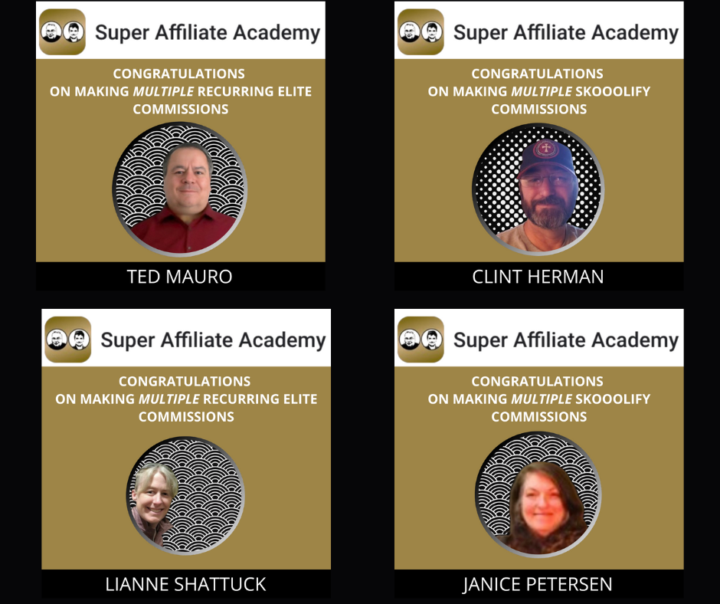
🏆SAA Wall of Fame – These Members Took Action & Got Paid! Who’s Next?
Major shoutout to our incredible members who have been taking action and racking up commissions—both one-time and recurring—since joining Super Affiliate Academy! @Ted Mauro @Lianne Shattuck @Jan Petersen @Clint Herman @Michele Hart @Michael Capps II @Rick Lindner @Herwig Radlgruber @Caterina Christakos @David Collier @Melvin Sillcock @Ron James @Chris Hobbs @Jenelle Livet @Richard Parsons @Jetton Meador @Anthony Miller @Nick Bullimore @Barbara Blue @Lonnie Love @Stephanie Lewis @Robert Rhomes @Daryl Thompson @Anthony Sunderland @Nathaniel White @Halima Abshir @Whitney Wisner @Becky Auer @Nikki Ditchfield @Rob Devlin @Wesley Wong @Gary Johnson @Gary Wittmann @Sonja D'Angelo @Adam Gray @Jonathan McFarland @Carven Izaks @Shirley Chauvin @Sue Barber @Doc Humphreys @Elsje Naude @Mike Marino @Shan Din @Rebecca West @Eric Lafontaine @Mike Jean
0 likes • 2d
@Kandice Tanjipah Thank you. me too.
1 like • 2d
@Andrew Charles Yes, I'm starting to grasp the videos step by step.
12d •
Stop Copying, Start Modeling
When you copy a top marketer’s current tactics, you are copying their harvest, not their planting. You don't see the months of testing, audience research, and quiet iterations behind their success. Don't copy surface tactics, study their foundational principles, adapt their frameworks to your niche, and express them authentically through your own unique, unmistakable voice.
1 like • 2d
Copy the process, not the post. Their tactic worked because of everything you can't see. Model the thinking, make it yours. 🙌

0 likes • 2d
Excited!

4d •
The words on the link should survive the landing page
The words on the link should survive the landing page. If your button says `See the lifetime plan` and the destination now opens on a monthly subscription, the problem starts before the click. The reader was promised one decision and handed another. That mismatch can inflate curiosity clicks while hurting trust, conversions, and refund quality. Make a destination-promise sheet with: - page or email, exact linked words, surrounding sentence, audience, and affiliate disclosure position - final resolved URL, product, vendor, offer, device, country, and check date - what appears in the first mobile screen: product name, price language, billing period, CTA, deadline, availability, and key limitation - promise status: confirmed, partly confirmed, contradicted, unavailable, redirected, or unknown - evidence URL or screenshot reference, owner, fix, retest date, and result Audit ten important links: 1. Start with the links receiving the most legitimate traffic or sitting closest to a recommendation. Copy the exact anchor or button text and one sentence around it. Do not summarize it more favorably in the sheet. 2. Open each destination in a private window on a phone-sized screen. Follow authorized redirects and record the final domain, product identity, visible offer, geographic restriction, login wall, and error state. Do not bypass access controls or fake a location. 3. Ask one question: can a reasonable reader confirm the linked promise from this first screen? `Get pricing` can lead to current pricing. `Watch the demo` should reveal a demo. `Claim the discount` needs a real, current discount with clear terms. If confirmation requires hunting, mark it partly confirmed. 4. Check the official pricing, terms, license, refund, or product page for any factual claim involving cost, rights, scarcity, compatibility, or guarantees. Record unknown when the vendor does not provide evidence. 5. Fix the smallest honest element first: change the linked words, add a limitation beside the link, route to a better official page, or remove a stale claim. Keep the affiliate disclosure clear before or beside the recommendation. Never cloak a mismatch with a more aggressive button.
0 likes • 2d
The link is a promise. If the landing page breaks it, trust dies before the sale. Fix the words, not the button. 🙌
1-10 of 17

@parveez-buruj-7210
I’m focused on building real momentum, sparking engagement, and turning every connection into growth. 🚀
Active 9h ago
Joined Sep 13, 2026
Powered by