Activity
Mon
Wed
Fri
Sun
Aug
Sep
Oct
Nov
Dec
Jan
Feb
Mar
Apr
May
Jun
What is this?
Less
More
Owned by Ossie
Double your revenue, without paid ads! Free Blueprint and rate calculator included.
Memberships
V1B1N Tribe 🌸🧜♀️🍉🦋🔆🕺💕
735 members • Free
Skoolers
167.8k members • Free
Comunidad UX/UI 💻📱🚀🌟
353 members • $9/month
Wingman Operator Academy
6 members • $49/month
THE SKOOL HUB
5.4k members • Free
FB2Skool Traffic Engine
25 members • Free
Earn With Content 💸
1.9k members • Free
Skool Growth Lab
141 members • Free
Swearabulary
26 members • Free
7 contributions to Start a Business with No Money

🔥
4d •
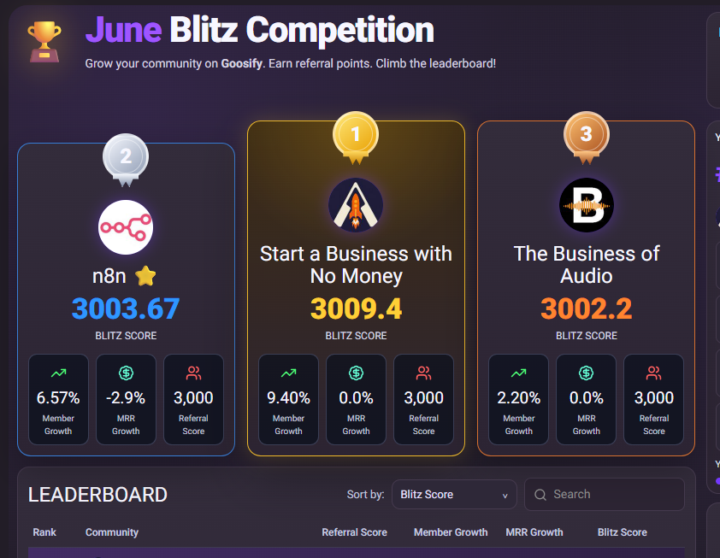
We won the BLITZ!
... And well done too to my super worthy competitors and friends up on the podium with me @David Ashby & @Donny Baker. 𝗧𝗵𝗲 𝘀𝗲𝗰𝗿𝗲𝘁? I did say that if we won I would show you how - well, there's a small but brilliant cheat code here. Just tell a friend or two about Wingman, and when they realise how brilliant and awesome it is, and wonder how they ever Skooled without it, you get a massive amount of points! 𝗧𝗼𝗽 𝗧𝗶𝗽 The power combo - Combine it with The Free Skool Extension to give your skool superpowers! And, to WIN a 1:1 with @Goose Dunlavey to plan my next strategy, it would have been worth signing myself up several times to win that!

🔥
0 likes • 3d
@Adam McCollough Did all that but screwed it up along the line. Having said that, what am building now, online, is anew world with new rules, and CRM's which I've never used. Probably I can compare that to a job scheduling system :)
🔥
1 like • 3d
@Donny Baker @Adam McCollough Goose made an official post about it, did he not mention anything? I didn't really read it, did you?
🔥
3d •
I literally can't keep up with your DMs..
I really appreciate that so many of you are directly asking me for advice and questions in the DMS, which I do actively encourage because conversation leads to opportunities for everyone. HOWEVER, I am only one person with so many hours in each day and I literally cannot keep up. Because I want to help all of you and some of you are waiting weeks for a reply from me. I would really encourage you to make a new post here in the group with your question, and tag the most appropriate resident experts who is most likely to be able to be able to assist. (I'm @Adam McCollough ) That way our conversations are also open and available to help other people who might have similar problems, you will get your problem solved faster, and you will have the help and different viewpoints of 20 experts and 500 community members. There is a category already set up called. "Ask an expert". Please feel free to continue to send me DMS, I love hearing from all of you but I just want to let you know that this could be a much more effective way to find answers. I will also be adding an ask me anything live session every week in the free community tier when the tiers go live in the middle of this month, so watch the calendar for this and be sure to add it to your personal calendar as a recurring event.

🔥
3 likes • 3d
haha will I ever have no new notifications to open?
🔥
6d •
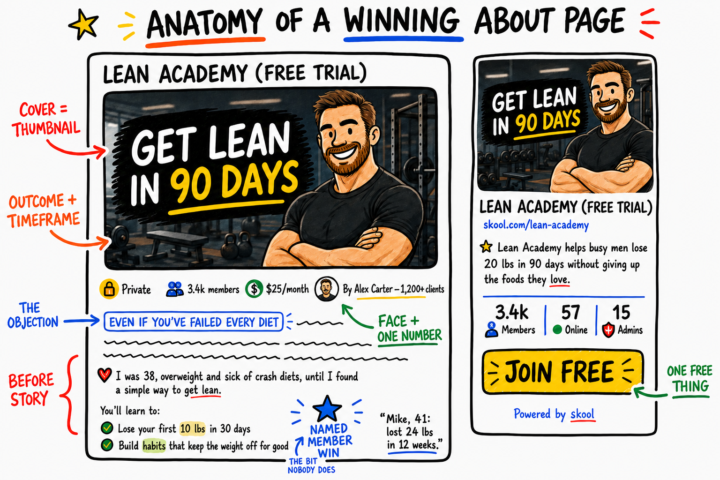
I analysed the top 100 Trending Skool About pages
I went through the About pages of the top 100 trending communities on Skool Discovery. On each one I looked at the headline, the body text, the proof they show, the cover image, the group description and the price. I wanted to see what they have in common and what tends to get someone to join. Here is what I found. THE HEADLINE Most of them open with the result you get, not the subject or the method. So instead of "a real estate community" it is "close your first deal in 90 days". Instead of "learn AI video" it is "make your first viral AI video in a day". One automation group opens with "automate 5 tasks in 7 days". A faceless YouTube one opens with building a channel without ever showing your face. A careers one opens with "if you're applying and getting no response, it's not bad luck, it's your strategy". Most of the time there is a number and a timeframe in that first line. A lot of them follow the promise with an "even if" line, to deal with the obvious objection before someone clicks away. "Even if you've never made one." "Even if you're a complete beginner." "No code, no experience." The About pages that just named the subject, like "a community about X", were usually the weaker ones. I think the result works better because someone only spends a second or two deciding, so the first line has to be the thing they actually want in their words. That is probably why so many of them lead with it. THE FOUNDER AND THE SPECIFIC NUMBER Every one of them has a real founder name and a face on the About page, not a logo. And there is almost always one specific number next to the name. Not "lots of students", but things like "$556,452 in member ad revenue", "34,000 sales", "helped 750 coaches", "$150M in ad spend", "100M views a month", "1,000+ doors". A specific number is more believable than a round one. An exact figure like that looks like a real count rather than an estimate. A lot of them also add a short before-story with the number. "Laid-off nurse to creator." "Father of three feeding his family from Etsy." "Engineer who quit his job and bought 1,000 doors." "Surgeon who went full-time on YouTube." It makes the result feel like something a normal person could reach, instead of something only the founder could do. The strongest ones put a few proof points together, like "$25M in career sales, $3.5M online, 750 coaches helped, 3x Skool Games winner". The weaker ones just said something like "Amazon coach" with no number.
🔥
2 likes • 6d
@Adam McCollough I was not referring to gatekeeping, I was merely wondering if it was the same post I saw before. To be honest I did not look into the post as it was like midnight here, I was on my way to bed 😜
🔥
0 likes • 6d
@Adam McCollough add 10 to that young man.
🔥
22d •
If you have a Skool Community, do this TODAY
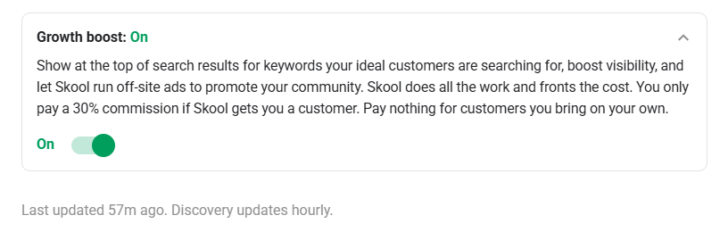
Skool just dropped the new "Boost" feature, and you need to take action right now. 𝗚𝗼 𝗶𝗻𝘁𝗼 𝘆𝗼𝘂𝗿 𝘀𝗲𝘁𝘁𝗶𝗻𝗴𝘀 𝗮𝗻𝗱 𝗺𝗮𝗸𝗲 𝘀𝘂𝗿𝗲 𝗕𝗼𝗼𝘀𝘁 𝗶𝘀 𝘁𝘂𝗿𝗻𝗲𝗱 𝗼𝗻. It is completely FREE until Tuesday, June 16th. This is a massive opportunity to leverage an external platform to get free members into your world without spending a penny of your own cash on ads. Go to: Settings>Discovery>Growth Boost Button Because Skool uses your Cover Image for these promotions, you need to make sure it’s high-quality, clearly explains exactly what you do, and is built to convert. If it isn't, you are completely wasting the opportunity. While you're at it, take the time to update and optimise your About page. Do not lose these free leads because your profile looks unfinished. If you leave Boost turned on after Tuesday, it switches to a 30% affiliate commission. As I've always said, 𝗽𝗲𝗿𝗳𝗼𝗿𝗺𝗮𝗻𝗰𝗲-𝗯𝗮𝘀𝗲𝗱 𝗮𝗱𝘃𝗲𝗿𝘁𝗶𝘀𝗶𝗻𝗴 𝗶𝘀 𝘁𝗵𝗲 𝗮𝗯𝘀𝗼𝗹𝘂𝘁𝗲 𝗯𝗲𝘀𝘁 𝘄𝗮𝘆 𝘁𝗼 𝗺𝗮𝗿𝗸𝗲𝘁 𝗯𝗲𝗰𝗮𝘂𝘀𝗲 𝘆𝗼𝘂 𝗼𝗻𝗹𝘆 𝗽𝗮𝘆 𝘄𝗵𝗲𝗻 𝗮 𝘀𝗮𝗹𝗲 𝗶𝘀 𝗮𝗰𝘁𝘂𝗮𝗹𝗹𝘆 𝗺𝗮𝗱𝗲, 𝗺𝗮𝗸𝗶𝗻𝗴 𝗶𝘁 𝘁𝗵𝗲 𝗽𝗲𝗿𝗳𝗲𝗰𝘁 𝘇𝗲𝗿𝗼-𝗿𝗶𝘀𝗸 𝘀𝗮𝗹𝗲𝘀 𝗺𝗼𝗱𝗲𝗹. Unless you are an absolute master of Google Ads and understand how to strictly monitor your ad spend, this is a super risk-free way to keep promoting your community on Meta and outside of the Skool ecosystem.and optimise Check your settings now, and make sure this feature is turned on.. I’ll add a graphic below to show you exactly where to look. 1. Check Growth Boost Is Turned on 2. Check and Update Your Cover Image 3. Make sure your about me page id fully optimised for Max conversions 𝗟𝗲𝘁'𝘀 𝗴𝗲𝘁 𝘀𝗼𝗺𝗲 𝗙𝗥𝗘𝗘 𝗦𝗸𝗼𝗼𝗹 𝗰𝗼𝗺𝗺𝘂𝗻𝗶𝘁𝘆 𝗺𝗲𝗺𝗯𝗲𝗿𝘀!
🔥
3 likes • 22d
What you meant to say it don't touch anything, unless you want to lose out.
🔥
Jun 1 •
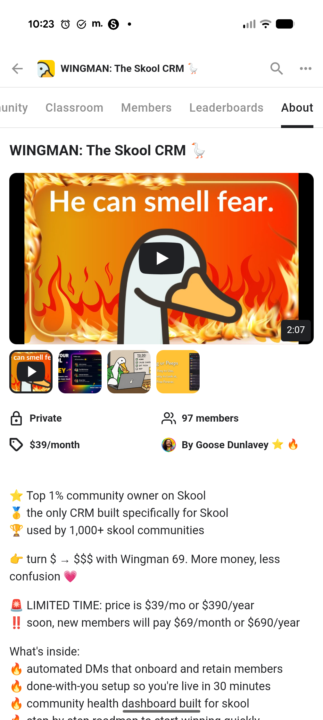
A TINY window of opportunity to get Wingman for $39pm instead of $69
Wingman from Goosify is officially launching in it's full form TODAY. It's offered at $69pm, but because it's not quite morning in LA yet, there are a few hours of opportunity to get in at the offer price of just £39 and get it locked in at that price forever. It's also coming with a 50% affiliate program which means you only have to recommend it to two people and yours is free for life. Exactly the price we like to pay for things at start a business with no money. And you have a 7-day free trial in order to test. it's right for you and bring two friends on board too. If you don't know what wingman is yet, I'll be explaining it over the following months since I am an official wingman operator. There are still a few slots left for my own wingman crew who I am also offering 100% free training on this amazing CRM, and the opportunity for your voice to be heard for new features you'd like added too. Just message below or send me a DM if you'd like to be part of that. JOIN here and refresh the page. If it still says $39 when you sign up for the free trial then that's the price you will get forever.
🔥
1 like • Jun 1
[attachment]
1-7 of 7

🔥
@ossie-osmond
Ossie | 35+ yrs maintenance plumber
Helping plumbers build better businesses & more freedom 🪠
Founder, Plumbing Business Skool — no gurus, real talk.
Online now
Joined May 27, 2026
Omnipresent. I'm all over!
Powered by