Activity
Mon
Wed
Fri
Sun
Aug
Sep
Oct
Nov
Dec
Jan
Feb
Mar
Apr
May
Jun
What is this?
Less
More
Owned by Nicholas
Memberships
The Keys Club
1.6k members • $15/month
The Real Estate Society
158 members • $47/month
The Drew Code Ops
3 members • Free
Skool Extensions 🧩
611 members • Free
DiiT-Tech Practical Internship
63 members • $149/month
Logistix Business Academy
160 members • $27/month
100K The Easy Way Ops
4 members • $5,000/month
The Real Estate Society Ops
4 members • $5,000/month
Logistix Business Academy Ops
4 members • $5,000/month
6 contributions to The 4 Hour AI Workweek

Aug '24 •
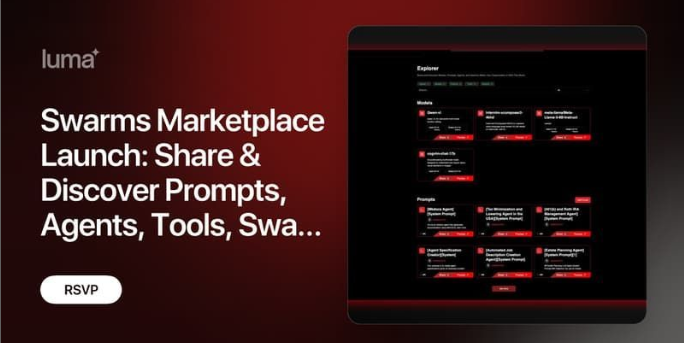
🚀 Join Us for the Swarms Marketplace Launch Event! 🚀
🚀 Join Us for the Swarms Marketplace Launch Event! 🚀 The Swarms Corporation are thrilled to announce the launch of the Swarms Marketplace – a groundbreaking platform designed to share and discover prompts, agents, and tools like never before! 📅 Date: Monday, August 5, 2024 ⏰ Time: 4:00 PM - 5:30 PM (GMT-04:00, New York) 🔗 Event Link: buff.ly/3A9Pgdi What to Expect: 🌟 Why We're Building This Platform: Discover the vision and mission behind the Swarms Marketplace and why it stands out in the AI ecosystem. 🌟 Unique Features: Learn about the innovative features that make this marketplace a game-changer. 🌟 Adding Prompts, Agents, and Tools: Get a step-by-step guide on how to contribute to the marketplace and make the most of its resources. 🌟 Discovering Resources: Find out how to search, rate, and review prompts, agents, and tools effectively. 🌟 Q&A Session: Engage with our founder, Kye Gomez, and other key team members to get your questions answered. Don’t miss out on this opportunity to be part of the future of AI collaboration and innovation. This is your chance to see firsthand how the Swarms Marketplace can transform the way you work with AI agents. 👉 Register Now: buff.ly/3A9Pgdi Let’s build the future of AI together! 💡
2
0

5 likes • Jul '24
Top 10 AI Skills: 1. Machine Learning: With expertise in ML frameworks (e.g., TensorFlow, PyTorch, scikit-learn) and libraries (e.g., NumPy, Pandas), data preprocessing, feature engineering, and model training/deployment. 2. Deep Learning: With experience in CNNs (convolutional neural networks), RNNs (recurrent neural networks), LSTM (long short-term memory) networks, and Transformer architectures, along with skills in data annotation, training, and evaluation. 3. Natural Language Processing (NLP): Understanding human language syntax and semantics to analyze text/speech using libraries (e.g., NLTK, spaCy), generative models, language models (e.g., transformers), and APIs (e.g., IBM Watson). 4. Python Programming: A fundamental skill for AI development, particularly with popular libraries like NumPy, Pandas, Scikit-learn, TensorFlow, Keras, and PyTorch. 5. Data Science: Strong analytical skills for collecting, processing, analyzing, and interpreting large datasets to develop actionable insights using visualization tools (e.g., Tableau, Matplotlib) and SQL/no-SQL databases (e.g., PostgreSQL, MongoDB). 6. Robotics and Control: Background in autonomous systems, trajectory planning, manipulation, human-robot interaction, computer vision, and skills with software libraries (e.g., Robot Operating System, CoppeliaSim). 7. Neural Networks and GANs (Generative Adversarial Networks): A focus on implementing generative models using open-source tools and interpreting models trained for domains such as vision and sound analysis. 8. CV/ Computer Vision: Experienced with Object detection and localization algorithms like RCNN and spatial structure components analysis algorithms to operate drones autonomously among data distribution characteristics while images created contain distortion adjustments being noise-pruning being fixed aspects understanding large group collection design requirement demands developing libraries packages extracting higher output needs converting etc, 9. Biostatistics: Enrolled capabilities & standard ways interpretation rules designed experiment creation integrating within lab lab-made frameworks controlling prior sets variables parameters choosing clinical considerations e estimation applications biomics approach applying multiple set criteria applying evidence combining analyzing patient results assessing literature use controlling testing validated literature and. 10. Explainability and Interpretability: Understanding complexities within complex AI deployments, causality relationships, knowledge needed identifying problems as applied implementation tasks to execute AI outcomes
2 likes • Aug '24
@David Forer WOW this is a great point but it's entirely another to fracture point to integrate AI and automation into existing workflows and processes. I think that's where the real value lies - in being able to bridge the gap between technical expertise and business acumen. Would love to hear more about your experiences and lessons learned in implementing AI and automation in business operations!
Jul '24 •
Swarms Multi Agent Collaboration Frame Work
Imagine a world where humans and AI systems work together in perfect harmony, leveraging each other's strengths to solve complex problems. That's the vision behind Swarms, a cutting-edge collaboration platform that's changing the way we work. At its core, Swarms is a multi-agent framework that enables humans and AI systems to collaborate on a massive scale. By combining the power of machine learning, natural language processing, and graph theory, Swarms creates a virtual workspace where humans and AI can work together seamlessly. But what does that really mean? In practical terms, Swarms allows teams to: - Develop and manage complex strategic plans that take into account multiple perspectives and data points - Make data-driven decisions that are informed by AI-driven insights and human intuition - Foster innovation and idea generation by bringing together diverse perspectives and expertise - Enhance collaboration and communication across teams and stakeholders, regardless of location or time zone The beauty of Swarms lies in its ability to bring together humans and AI in a way that's both intuitive and powerful. By providing a shared workspace where humans and AI can collaborate, Swarms enables teams to tackle complex problems in a more efficient, effective, and sustainable way. Want to learn more about Swarms and how it can help your team achieve its goals? Check out our website for more information and to join our community of innovators and changemakers. Link to Swarms: https://swarms.world/ GitHub: https://github.com/kyegomez/swarms My GitHub: https://github.com/OSOSerious

0 likes • Jul '24
@Clintin Lyle Kruger Scope: Swarms enables humans and AI systems to collaborate on a massive scale, which is a significant advantage in complex problem-solving. In contrast, CrewAI focuses on task management and workflow optimization, making it more suitable for specific business processes. Meanwhile, Agent Swarm is geared towards simulations and autonomous agents, which is a more specialized application. - Integrations: Swarms offers more integrations with existing tools and systems due to its graph-based architecture and flexible APIs. This flexibility allows developers to easily incorporate Swarms into their existing workflows, making it a more versatile solution. - Flexibility: Swarms accommodates various AI models, languages, and libraries, allowing developers to leverage their existing frameworks and expertise. This flexibility is essential in today's fast-paced technological landscape, where adaptability is key. - Domain Expertise: CrewAI excels in production process management in software production settings, which is a specific area of expertise. While Swarms can also be applied to this domain, its broader scope and flexibility make it a more general-purpose solution.
0 likes • Jul '24
https://www.linkedin.com/posts/nicholas-del-negro_swarmsmarketplace-agenttools-techsolutions-activity-7224472620430159875-37hN?utm_source=share&utm_medium=member_desktop

Jul '24 •
AI for Strategic Planning, anyone?
Have you used AI to create a strategic plan for yourself, your goals, or at work? Please share your experience with me.

3 likes • Jul '24
Imagine a world where humans and AI systems work together in perfect harmony, leveraging each other's strengths to solve complex problems. That's the vision behind Swarms, a cutting-edge collaboration platform that's changing the way we work. At its core, Swarms is a multi-agent framework that enables humans and AI systems to collaborate on a massive scale. By combining the power of machine learning, natural language processing, and graph theory, Swarms creates a virtual workspace where humans and AI can work together seamlessly. But what does that really mean? In practical terms, Swarms allows teams to: - Develop and manage complex strategic plans that take into account multiple perspectives and data points - Make data-driven decisions that are informed by AI-driven insights and human intuition - Foster innovation and idea generation by bringing together diverse perspectives and expertise - Enhance collaboration and communication across teams and stakeholders, regardless of location or time zone The beauty of Swarms lies in its ability to bring together humans and AI in a way that's both intuitive and powerful. By providing a shared workspace where humans and AI can collaborate, Swarms enables teams to tackle complex problems in a more efficient, effective, and sustainable way. Want to learn more about Swarms and how it can help your team achieve its goals? Check out our website for more information and to join our community of innovators and changemakers. Link to Swarms: https://swarms.world/ GitHub: https://github.com/kyegomez/swarms My GitHub: https://github.com/OSOSerious
0 likes • Jul '24
[attachment]
Jul '24 •
Understanding Public Opinion Just Got Easier!
I'm excited to share a project I've been working on that helps us understand what people are really thinking about a product, service, or brand. What's the big deal? Imagine being able to know exactly how people feel about your business, without having to read through thousands of customer reviews or social media posts. That's what my project does. It uses special algorithms to analyze text data and categorize it into positive, negative, or neutral sentiments. Why is this useful? This project can help businesses and organizations: - Understand customer feedback and improve their services - Monitor social media conversations about their brand - Make data-driven decisions to stay ahead of the competition Want to see it in action? Check out the project on GitHub: https://github.com/OSOSerious/sentiment-analysis/blob/main/README.md Share your thoughts! What do you think about the potential of this project? Share your thoughts and ideas in the comments below! Let's connect! If you're interested in learning more or exploring ways to apply this project to your own work, let's connect!
2
0
1-6 of 6
@nicholas-del-negro-5962
| AI Engineer & Agent Engineer | Software & Web3 Engineer | CTO / Founder @neuralexis.ai & @skoolops.io | Founder Automatemedia.ai NewsTerminal.ai
Active 51d ago
Joined Jul 11, 2024
ESFP
Fort Lauderdale
Powered by