Activity
Mon
Wed
Fri
Sun
Jul
Aug
Sep
Oct
Nov
Dec
Jan
Feb
Mar
Apr
May
What is this?
Less
More
Memberships
AI Agent Developer Academy
2.8k members • Free
AI Workshop Lite
24.2k members • Free
AI Automation Society
383.5k members • Free
AI Automation Agency Hub
319.7k members • Free
AI Automation (A-Z)
154.8k members • Free
AI Integrators
618 members • Free
20 contributions to AI Automation Society

💎
⭐
4h •
🚀New Video: Opus 4.8 Just Dropped. Here's How To Actually Use It.
Opus 4.8 just dropped and the benchmarks are honestly nuts, but the numbers only tell part of the story. In this video I break down my key takeaways after reading through Anthropic's own documentation, and how I'm thinking about slotting Opus 4.8 into my actual workflows. If you want to actually get the most out of this model instead of just running it the same way you ran 4.7, start here. TOKEN DASHBOARD REPO

4 likes • 3h
Thanks anthropic , the better to build your replacment with
1 like • 3h
Ever feel like chasing the bigger, badder, uberest tech hard-on is its own business model? They’re not doing what’s good for you—they’re doing what they think is good for them (which is debatable). I get Nvidia—the more compute they sell, the more they can charge for doing the same job with higher calculations per second. But at some point, what is enough? For most business use cases, a bigger, badder model is not going to help unless you’re trying to freeform it (which is probably a bad idea in any event). Business works off reliability. ***Small, customer-trained models that dynamically and agentically operate headless CRM/ERP workflows seamlessly are the future of business.(mostly deterministic) Yes, the colossal trillion-scale models are interesting and all, but ultimately I’m skeptical of the AGI thing and of the benefits even if we get there. Right now, better training data (synthetic) and improved architectures are the levels we need to be pushing for business. But don’t take my word for it—Elon Musk says we can get 10x to 20x denser small specialist models. That’s just one level we can push to make small models better.
19h •
Need help with association- Dynamics of BigTech VS you.
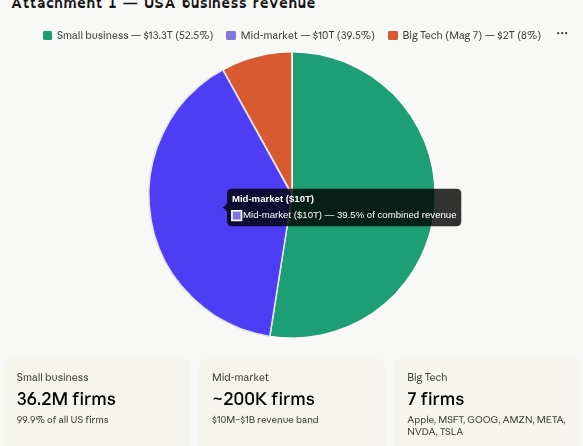
If you run a business today, you're almost certainly renting your intelligence. The price creeps up. The terms change without asking you. And somewhere in the back of your mind, you've already accepted it — they're the giants, you're not. That's just the deal. Before you settle for that, look at what the numbers actually say. See attachment 1 (USA) and attachment 2 (World) below. You expected a giant. You got a sliver. Taken all together — every one of the seven companies most of us rent from — Big Tech is a tiny slice of the market. In the US, small businesses alone outweigh them by about 6.6 times. Worldwide, it isn't even close. So sit with that for a second, because it changes the story you've been telling yourself. Now here's the part that matters even more. Once you strip away the surface differences, most businesses are doing about 80% the exact same work. It's why CRMs are such a big thing — a plumber, an insurance broker, and a SaaS founder look nothing alike, yet underneath they're running nearly identical processes. See attachment 3 below. So here's what's actually true. You already do most of the same work every other business does. You already run the same handful of tools. And you already rent your AI from the same seven companies as everyone else reading this. Which means the thing standing between you and Big Tech was never size. It was coordination. They move as one. We move as millions — millions of separate customers, each paying alone, each absorbing the price hikes alone, each one easy to ignore. But "separate" is a choice, not a law of nature. The same numbers that make any one of us look small make all of us impossible to ignore. We don't have to out-build Big Tech. We don't have to out-spend them. We just have to stop standing apart. That's the whole idea here — pooling the millions who were never actually small, just scattered. If the math lands for you, you already know which side of it you're on. 👇 The numbers, at a glance Attachment 1 — USA business revenue:
0 likes • 5h
@Vlad Richicinschi Lets get together on this I think it can be done, Im willing to deticate time to it, The platform is blocking me from contacting you directly and I'd normaly never do this but : im deal z guy at G mile.
💎
⭐
1d •
If you've ever felt "AI Overwhelm", please read this.
Every single person following AI right now is overwhelmed. Including me. I make videos about this stuff for a living and I still feel the pressure. New model drops. New framework. New feature update. It feels like every single day. But after hearing a ton of you guys bring up "AI overwhelm" week after week, I realized this: → There's a HUGE difference between knowing the "what" and knowing the "how." Staying aware does not mean testing everything. Most new tools and features only need the "what." You see the title. You understand what it does. You move on. The "how" is reserved for the stuff that solves a problem you actually have right now. So when something new drops, I ask myself one question: Does this solve a specific pain point I'm currently dealing with? If yes, I test it in a real scenario. I test it against something that actually matters to me. If no, I save the link. I mentally file it away. And I keep walking. Because here's the thing. Your north star is probably very different from mine. Part of my job is to experiment, form opinions, and share what I think is useful. So naturally I test a lot of stuff. But if your north star is building a business or getting better at your craft, then every shiny new tool might just be a distraction. The number one mistake I see people make is they try to learn everything. They watch every video. They test every tool. They jump to the next thing before the last thing even had a chance to work. And if I've contributed to your overwhelm with my daily uploads, I apologize. hehe. But a lot of people think that this ties directly into how you measure your day. Productivity is not how many hours you worked. It's how many meaningful outputs you created that actually moved the needle towards your north star. Someone can work 12 hours one day and feel insanely productive, but they were just watching tutorials and playing around with new tools. Meanwhile someone else sits down for 5 hours, ships the one thing that actually matters, and makes more progress.
2 likes • 7h
AI overwhelm isn't an information problem. It's a trauma response. Think about it. We got blindsided once — the ChatGPT moment — and our nervous system never reset. So now we refresh, we hoard links, we watch every launch, bracing for the next ambush. That's not curiosity. That's hypervigilance. It's the same wiring that keeps checking the door long after the threat is gone. Picture yourself five years out. AI is just... there. In your tools, your work, your life, boring as electricity. And you'll look back at this version of you — frozen, scanning the horizon, terrified of missing the thing — and feel tender toward him. Because he was just scared. You don't need to catch every wave. You need to get off high alert. The tech isn't the emergency. Living like it is — that's the thing quietly costing you
0 likes • 7h
@Rick Bourne A Claude/Codex setup, done right, could do (roughly) 80% of your company's work automatically. Future A: You don't own your tools (tech stack), you don't own your data, and you don't control your AI. 1. They can and will raise the price. 2. They can change the way it works whenever it's good for them. 3. They can and will deplatform you whenever it's convenient for them. 4. It might take 10-20 years, but sooner or later they will eventually take over your business — either by edging you out, or by offering your service for free as a value-add to their platform. Future B — An Association: We get together with 10k other users globally and use Claude/Cursor/Codex to build out our own tech stack. We host our own sovereign data for each company on our own VPS, on co-owned servers. We train our own open-weight models for high efficiency and ultra-dependability (not built in a way to spend more tokens that they can charge for, which AI companies seem to be doing). **You control your own future, or you'll be a digital serf — entrepreneurship notwithstanding.
1d •
Most Small Businesses Won't Survive the Next 24 Months. Here's the Stack That Will
In eighteen months, two operators in the same market — same trade, same skill, same prices — will have completely different businesses. One will be hiring. The other will be wondering what happened. The difference won't be talent. It'll be a stack. The vice grip Jaw one. The customer who waited three days for a callback now expects three minutes. Not because they got impatient — because somebody else's system just answered in ninety seconds. Once one operator crosses that line, the bar moves for the whole market. Jaw two. Your competitor isn't smarter than you. Doesn't care more. But he just hired an army that never sleeps, never forgets a lead, and writes better proposals than his old assistant did. He pays it a fraction of one salary. He's already winning deals you used to win. Agency, coach, local service, ecom — the jaws don't care what you sell. You've seen this movie The CRM auto-followup era: guys with sequenced follow-ups in 2014 quietly ate the lunch of the guys on a spreadsheet. The system worked 24/7 while the spreadsheet guy went to bed. That was slow compounding. The agent era isn't slow. An agent can identify two hundred prospects, write personalized outreach for each, send it, handle objections, and book meetings — overnight. The 30-year operator who built it honestly is going to lose to a 23-year-old with the right stack. Not because the kid is better. Because the kid has leverage the operator doesn't know exists yet. That's the tragedy. And it's the call. But here's the trap inside the trap Say you see it coming and move fast. If the stack isn't yours, you're on rented land. You've watched this play out twice already. Ads. Big tech got every small business hooked on cheap reach, cranked the price, changed the algorithm at will. Half your margin pays the platform tax. You don't own your customers — you rent access to them. Email. Try running your own mail server in 2026. You functionally can't. Fifteen years of standards and lobbying turned the open protocol of the internet into a toll road Microsoft and Google collect at.
4
0

🚀
Mar 17 •
There is no magic button
I've talked to thousands of founders. Same pattern every time. Chasing the shiny new tool that's going to magically make them rich. I get it. I did it too. But I built to 150,000 followers and a six-figure agency in under a year. Not because I found a magic button. Because I showed up every single day and didn't stop. n8n made consistency possible. It didn't make it automatic. There are a million ways to make money with AI. There is no one right path. There's just the right path for you. And that path still requires: → Focus → Hard work → Commitment over time The tool is just leverage. What are you actually committed to right now? Drop it below 👇
2 likes • Mar 19
Dogged determination+focus+refusal stay down, its like a muscle.
1-10 of 20
@nadim-ru-9205
New to highlevel long, time business owner /marketer Been Made my living online for the past 20+ years
Active 1h ago
Joined May 6, 2025
Colorado, USA
Powered by