Activity
Mon
Wed
Fri
Sun
Sep
Oct
Nov
Dec
Jan
Feb
Mar
Apr
May
Jun
Jul
What is this?
Less
More
Owned by Muhammad
Discussion on HealthTech and Digital Transformation including AI and Machine Learning
Memberships
Free Skool Course
71.4k members • $1
Top Chess Community
20.3k members • Free
The Stronger Human Movement
28.1k members • $5/month
The Holistic Gut Health Hub
22.2k members • Free
3 contributions to HealthTech

Jun 1 •
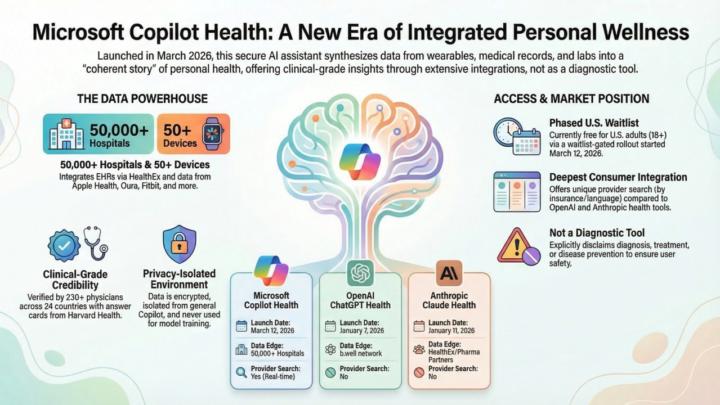
🚨 The Architecture of Medical Superintelligence
One insight from Dr. Harvey Castro's latest article really stood out to me: We're moving from fragmented health data → to a continuous health narrative. For decades, healthcare operated in silos:• Wearables tracked activity• EHRs stored medical records• Labs produced reports• Physicians connected the dots manually Now AI is beginning to unify all of these into a single contextual view of a person's health. According to the article, the foundation of "Medical Superintelligence" consists of: 🧠 Longitudinal MemoryAI that understands your health history, patterns, and trajectory. ⌚ Real-Time PhysiologyContinuous signals from wearables such as sleep, HRV, activity, and recovery. 🏥 Clinical DepthIntegration of diagnoses, medications, physician notes, and lab results. ⚙️ Decision OrchestrationAI systems capable of simulating the reasoning of multiple specialists simultaneously. The most interesting takeaway wasn't the technology itself. It was the shift in the physician's role. As AI becomes better at pattern recognition and diagnosis, doctors increasingly become: ➡️ Validators➡️ Context Interpreters➡️ Trust Builders Because AI may understand data... But it still doesn't understand fear, values, uncertainty, or human meaning. The future isn't: ❌ AI vs Doctors It's: ✅ High Tech + High Heart Where AI handles complexity and humans provide wisdom, empathy, and trust. 💭 Discussion: If an AI assistant could understand your complete health story—including your medical records, wearable data, medications, and lifestyle habits—what decisions would you trust it to make, and what decisions should always remain in human hands?
0
0
May 21 •
Welcome! Introduce yourself + share a pic of your workspace 🎉
Let's get to know each other! Comment below sharing where you are in the world, a photo of your workspace, and something you like to do for fun. 😊
1 like • May 22
Really amazing services it actually helps the whole community by making processes more efficient and organised. My vision is to help healthcare providers move away from manual systems and adopt simple, smart digital solutions 🏥 I focus on building tools like EMR systems for secure patient records, automated appointment management to reduce scheduling workload, and patient portals so patients can easily access their reports anytime. Overall, it’s all about saving doctors time, reducing admin stress, and improving the patient experience in a more efficient and modern way Thank you for joining my community💗
May 21 •
The best investment isn’t crypto, real estate, or AI. It’s your health.
Most people wait until they get sick to care about health. Then suddenly: - sleep matters - food matters - stress matters - movement matters Health isn’t expensive.Ignoring it is. What’s ONE health habit that changed your life the most? Mine: Going gym without my phone.
1-3 of 3
Active 40d ago
Joined May 20, 2026
karachi, Pakistan