Activity
Mon
Wed
Fri
Sun
Sep
Oct
Nov
Dec
Jan
Feb
Mar
Apr
May
Jun
Jul
Aug
What is this?
Less
More
Owned by Michael
You can only make money with AI when you don't sound like AI. Learn how to create content that feels real, builds trust, & generates serious revenue.
This is where AI money-making ideas go on trial. Innocent means real opportunity. Guilty means empty hype.
MULTIPLY your coaching
1.6k members • Free
Clief Notes
45.9k members • Free
Empowered AI Collective™
3.6k members • Free
AEO - Get Recommended by AI
1.8k members • Free
AI Automation Agency Hub
332.7k members • Free
Leadership Skool
1.7k members • Free
Community Launch
15.7k members • Free
Template Skool
3.6k members • $10/month
AI Money Lab
90.4k members • Free
23 contributions to AEO Advantage

6h •
The AI Answer Share Audit™ | Find Out How Ready Your Business Is for AI Search — Then Fix What’s Holding You Back
AI search is changing how customers discover businesses, products, experts, and brands. My new and FREE "AI Answer Share Audit" is a 17-page fillable system designed to show you how clearly AI systems can understand, trust, and potentially surface your business. You’ll work through a 100-point AEO diagnostic covering eight critical visibility areas, then run an AI Reality Check™ to compare your website signals with what AI platforms are actually surfacing. Once you know where the weaknesses are, the system helps you identify your three biggest priorities and turn them into a focused 30-Day Repair Plan. 🔥 WHAT’S INSIDE: ✅ 100-Point Answer Share Score ✅ 8-Pillar AEO Audit ✅ Dedicated audit worksheets ✅ AI Reality Check™ ✅ Observed AI Visibility Index ✅ Priority Diagnosis System ✅ Repair Action Library ✅ Personalized 30-Day Repair Plan ✅ Fillable PDF you can complete digitally ✅ Re-Audit Framework to measure improvement 🚀 HOW IT WORKS: 1️⃣ Complete the 8 audit sections 2️⃣ Calculate your 0–100 Answer Share Score 3️⃣ Test how AI systems actually surface your business 4️⃣ Identify your 3 weakest visibility pillars 5️⃣ Build your 30-Day Repair Plan 6️⃣ Improve, re-test, and measure your progress My goal here is to help you stop guessing whether your business is ready for AI search. Now you can measure it. Find the gaps. Fix them... and become the obvious answer!
2
0

May 7 •
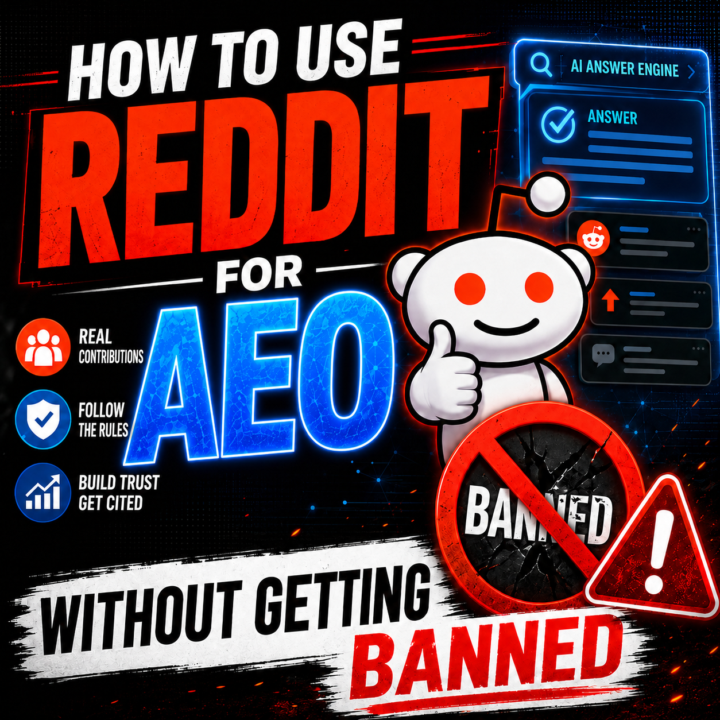
How to Use Reddit for AEO Without Getting Banned
Reddit is one of the most powerful Answer Engine Optimization surfaces on the internet right now, but it is also one of the easiest places to destroy your credibility if you show up like a marketer. This guide shows you how to use Reddit the right way: by building trust, contributing real value, identifying citation-worthy threads, and positioning your expertise where AI answer engines are already looking. Inside, you’ll learn how to create a Reddit presence that does not look promotional, find the subreddits that actually matter for your niche, comment in ways that earn authority, avoid moderator landmines, and turn real participation into long-term visibility across ChatGPT, Perplexity, Gemini, Claude, and other AI-driven search experiences. This is not a spam playbook. It is a trust-first Reddit AEO operating system. You’ll get: - A practical Reddit AEO strategy built for real-world use - The 90-day account-building protocol - Subreddit selection and citation-mapping methods - Comment templates that build trust without pitching - Post frameworks that avoid removal - Self-promotion rules that keep you safe - Mod outreach templates and recovery strategies - A 30-day action plan to start building momentum If you want your brand, product, service, or expertise to show up where AI engines are pulling real human answers, Reddit can no longer be ignored. This guide shows you how to play the long game without getting banned before the game even starts.
May 5 •
Gary Vee on AEO
Gary Vee is calling it: AEO and GEO are now unavoidable. Making sure your brand shows up when people ask ChatGPT, Gemini, Perplexity, Google AI, and other answer engines what to buy, who to trust, or where to go next, is extremely important. This isn’t just about ranking anymore. It’s about being the answer. The brands that create clear, useful, trusted content now are going to be the ones AI recommends later. SEO used to get you found. AEO and GEO will now get you chosen.

Apr 27 •
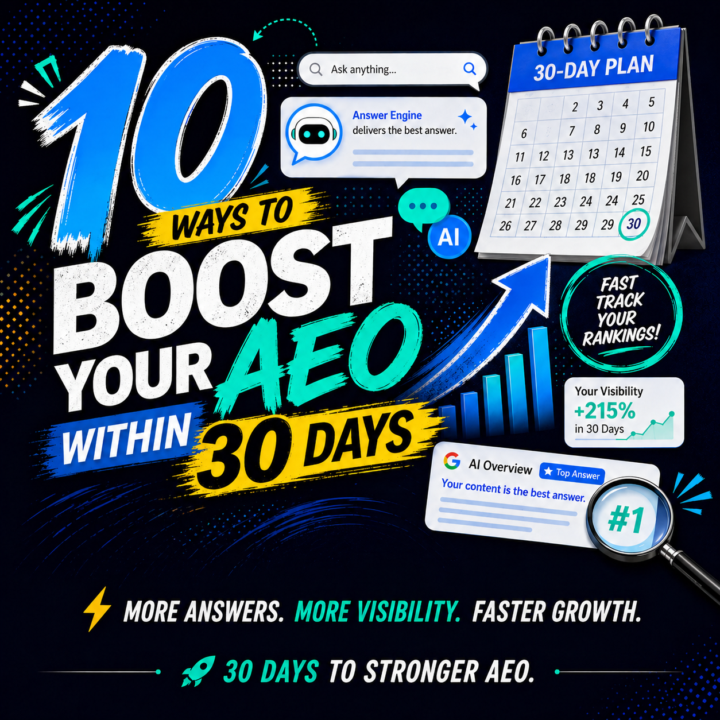
10 Ways to Boost Your AEO Within 30 Days
AI engines are answering questions your customers used to Google. If your brand is not part of those answers, you are invisible in a way that SEO alone cannot fix. Here are ten specific moves you can make in the next thirty days. Restructure your FAQ pages around conversational phrasing. AI models pull from content that mirrors how people actually speak. Rewrite every question on your site the way a real human would ask it out loud, not the way a copywriter would write it. Publish opinion-driven content on trending industry topics. AI engines favor authoritative takes over recycled summaries. State a position. Defend it with evidence. Models reward specificity and conviction. Claim and optimize your entity presence everywhere. Wikipedia, Crunchbase, LinkedIn, industry directories. AI models cross-reference multiple sources to validate who you are. Inconsistent information across platforms tells models you are unreliable. Create "comparison content" that names competitors directly. When someone asks an AI "which is better, X or Y," the model needs pages that explicitly address that matchup. Be the one who wrote it. Embed structured data markup aggressively. Schema markup is not just for Google anymore. AI models use structured data to understand relationships between your products, services, and expertise. Answer questions nobody else is answering. Use tools like AlsoAsked or AnswerThePublic to find second and third-layer questions in your niche. The deeper the question, the less competition for the AI citation. Build topical clusters, not isolated blog posts. AI models assess topical authority holistically. Five interlinked pieces on one subject outperform fifty scattered articles across random topics. Get quoted or cited in third-party publications. When multiple independent sources mention your brand in context, AI models treat you as a verified authority. Pitch podcasts, contribute guest articles, participate in expert roundups. Audit what AI engines currently say about you. Ask ChatGPT, Perplexity, and Gemini about your brand today. Document every inaccuracy. Then create content specifically designed to correct those gaps.
Apr 27 •
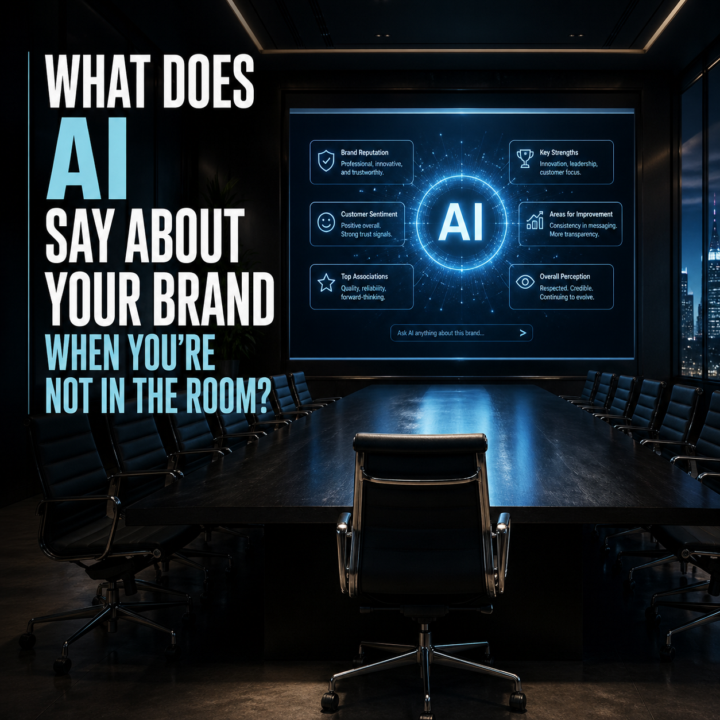
Jeff Bezos Said 'Your Brand Is What People Say About You When You're Not in the Room.' AI Changed the Room.
Jeff Bezos defined your brand as the conversation happening without you. In 2026, that conversation is happening inside AI models. When someone asks ChatGPT to recommend a digital product creator in your niche, does your name come up? When Claude is asked to find the best Etsy shops for printable planners, is your shop mentioned? When Gemini summarizes the top voices in AI and ecommerce, are you on the list? This is the new "room." And most creators have zero presence in it. The way you get into that room is through content volume, specificity, and consistency. AI models learn from the internet. The more high-quality content you produce with your name attached to a specific niche, the more likely AI systems are to associate your brand with that category. This is not SEO. This is AEO. Answer Engine Optimization. And the creators who understand it now will own their category when everyone else figures it out in two years. Your brand is no longer just what people say. It is what AI says. That's why it's imperative to start controlling that narrative today. How are you optimizing for AI discovery?
1-10 of 23

@michael-essany-6921
I help brands and creators make sense of, master, and monetize AI | AEO, automation, agents, content, ecommerce, & new emerging income opportunities.
Active 5h ago
Joined Mar 22, 2026
Chicago, Illinois