Activity
Mon
Wed
Fri
Sun
Aug
Sep
Oct
Nov
Dec
Jan
Feb
Mar
Apr
May
Jun
Jul
What is this?
Less
More
Memberships
Career Preventive Maintenance
33 members • Free
12 contributions to Career Preventive Maintenance

18d •
🎉 Grand Opening Celebration – July Special!
We're excited to welcome you to Strategic Resume & Leadership Solutions! To celebrate our launch, we're offering a FREE Resume Evaluation & Career Action Plan (a $149 value) for a limited time. Your evaluation includes: ✅ Professional Resume Review ✅ ATS Compatibility Assessment ✅ Career Recommendations ✅ Personalized Career Action Plan Appointments are limited and will be scheduled on a first-come, first-served basis. Once all available slots are filled, this offer will end. How to claim your FREE Resume Evaluation 1. Register here: https://forms.gle/hSCbSvwbzDVcTjtR9 2. Select "Resume Evaluation & Career Action Plan – $149." 3. Choose "Other" as your preferred payment method. 4. In Additional Notes or Requests, enter: Strategic Resume & Leadership Solutions Skool Grand Opening Our team will review your registration and contact you to schedule your evaluation. If you know a professional, recent graduate, veteran, career changer, or someone preparing for their next opportunity, invite them to join this community and share this post. Together, we can help more people earn interviews, promotions, and reach their career goals. Strategic Resume & Leadership Solutions Strategize. Position. Lead. Succeed.


1 like • 5d
I received this complimentary Resume Evaluation and Career Action Plan from Dr. Samuel Valme through Strategic Resume & Leadership Solutions. His review went beyond résumé formatting. He evaluated my transferable experience, identified career paths that aligned with my background, highlighted skills I should continue developing, and provided a practical 30-day action plan. What I appreciated most was the clarity the process gave me. Dr. Samuel helped me recognize how my experience in military human resources, administrative operations, customer service, real estate, and logistics support could translate into operations, coordination, and leadership opportunities. He was professional, encouraging, and intentional about helping me understand both the value I already bring and where I can continue growing. I would recommend his services to veterans, career changers, experienced professionals, and anyone who needs greater clarity and direction in their job search.
Jun 3 •
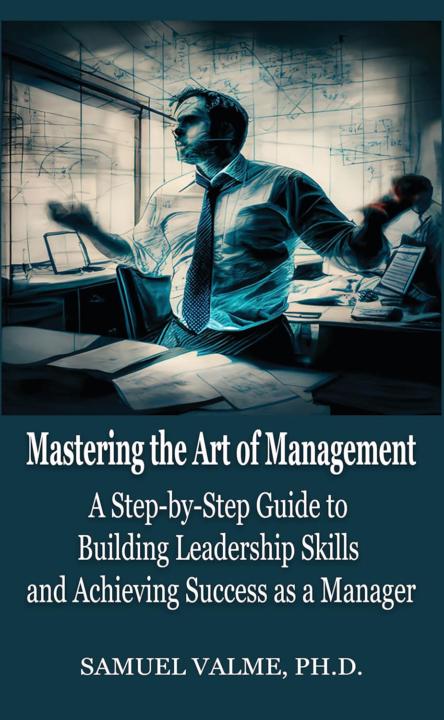
Mastering the Art of Management
📚 Leadership Development Discussion As we continue building our leadership skills together, I highly recommend getting a copy of my book, Mastering the Art of Management: A Step-by-Step Guide to Building Leadership Skills and Achieving Success as a Manager. Available on Amazon: Mastеring thе Art of Managеmеnt 📖 Paperback: $19.99 I wrote this book to address a gap I consistently observed in the workforce—many leaders and aspiring managers were promoted into leadership roles without being equipped with the essential skills needed to effectively lead people, make decisions, communicate clearly, and drive results. Inside the book, you'll learn: ✅ Effective communication strategies ✅ Team-building techniques ✅ Decision-making frameworks ✅ Problem-solving skills ✅ Self-awareness and leadership growth ✅ Networking and relationship building ✅ Continuous learning strategies ✅ Growth mindset principles Whether you're a new manager, aspiring leader, or experienced professional, this book provides practical, step-by-step guidance to help you strengthen your leadership capabilities and achieve greater success. While purchasing the book is not mandatory, I strongly encourage it as a resource that can help sharpen your leadership skills and create a common foundation for many of our discussions within this community. 💬 Discussion Question:What leadership skill do you believe is most important for success in today's workplace, and why? 👇 Share your thoughts below and let's learn from one another. #LeadershipDevelopment #CareerGrowth #ManagementSkills #ProfessionalDevelopment #ExecutiveLeadership
1 like • 5d
I received my copy of the book in June and have been so busy that I hadn't started reading it yet. With that being said, I can tell this book is exceptionally well aligned with what I want to develop for my new role: leadership, communication, project management, problem-solving, process improvement and change management. The timing is meaningful because I can use it as part of my preparation to become a stronger administrative professional and eventually move into coordination, operations or management. I am going to focus on reading it through three lenses: 1. What does this teach me about myself? Because Dr. Valme emphasizes self-awareness and reflection, note: - Strengths I already possess - Habits or skills that need development - How I respond to pressure, feedback and conflict - How I communicate when expectations are unclear - What kind of leader I am becoming 2. How could I apply this at my new company? For every major concept, ask: “What would this look like in my department?” For example: - Communication: Confirming instructions, writing clear emails and documenting decisions - Team building: Supporting cooperation without overstepping your role - Decision-making: Gathering facts before recommending a solution - Problem-solving: Looking beyond the immediate issue to identify its cause - Continuous learning: Using Emory’s internal training and professional-development resources - Growth mindset: Receiving correction without becoming discouraged or defensive 3. What can I practice immediately? Not waiting until I have a management title. Choose one behavior from each chapter that I can practice as an administrative assistant. Leadership begins with ownership, judgment, reliability and influence—not merely authority over employees. I'm going to keep a simple Management and Leadership Learning Journal: Chapter or concept What stood out What it revealed about me How I can apply it at my new company Action I will practice Here we go, Chapter 1...
1 like • 5d
✅ Chapter 1 Done. My overall assessment is that Chapter One provides a clear, practical foundation. Its greatest value for me is the reminder that management development can begin NOW, through how I approach my administrative role, rather than beginning only after I receive a management title. Have you purchased the book yet? What was your take on chapter one? How does it apply to you and your current role?
21d •
🎾 Career Success Starts With the Right Coach
One of the biggest myths in today's job market is that you have to figure everything out on your own. Tennis champion and entrepreneur Venus Williams has partnered with EZRA to provide 1,000 early-career professionals with FREE one-on-one career coaching. Participants will receive personalized coaching focused on leadership, confidence, communication, career planning, and professional growth. This opportunity is a great reminder that even the world's top performers rely on coaches to reach the next level. Lessons We Can Learn: ✅ Coaching is an investment, not a sign of weakness. ✅ Strong communication and leadership skills can open new opportunities. ✅ Building confidence is just as valuable as building technical skills. ✅ Never stop learning, no matter where you are in your career. ✅ Look for opportunities that help you grow before you need them. 📖 Read the full story:Black Enterprise: Venus Williams and EZRA Team Up to Give 1,000 Young Professionals Free Career Coaching If you're serious about growing your career, don't wait for opportunities to find you. Take advantage of resources, coaching, and communities that help you become the professional employers are looking for. #CareerDevelopment #CareerCoaching #LeadershipDevelopment #ProfessionalGrowth #JobSearch
1 like • 5d
This is an important reminder that coaching is not only for people who are struggling, beginning their careers, transitioning into a new industry, or preparing for greater responsibility. I believe coaching can benefit anyone who is committed to growth. There is always room to improve how we communicate, lead, make decisions, manage our time, develop systems, refine processes, and understand ourselves. A good coach can help us recognize blind spots, communicate the value of our experience more clearly, and focus on areas we may not have identified on our own. Coaching does not replace personal responsibility or hard work, but it can provide clarity, accountability, perspective, and direction. Even high performers need someone who can ask the right questions, challenge their thinking, and help them continue developing. When we remain teachable, we recognize that coaching is not a sign that something is wrong. It is evidence that we are intentional about becoming better. Growth should not begin only when a problem appears, or an opportunity is already in front of us. Continuous improvement prepares us for opportunities we may not even see coming.
25d •
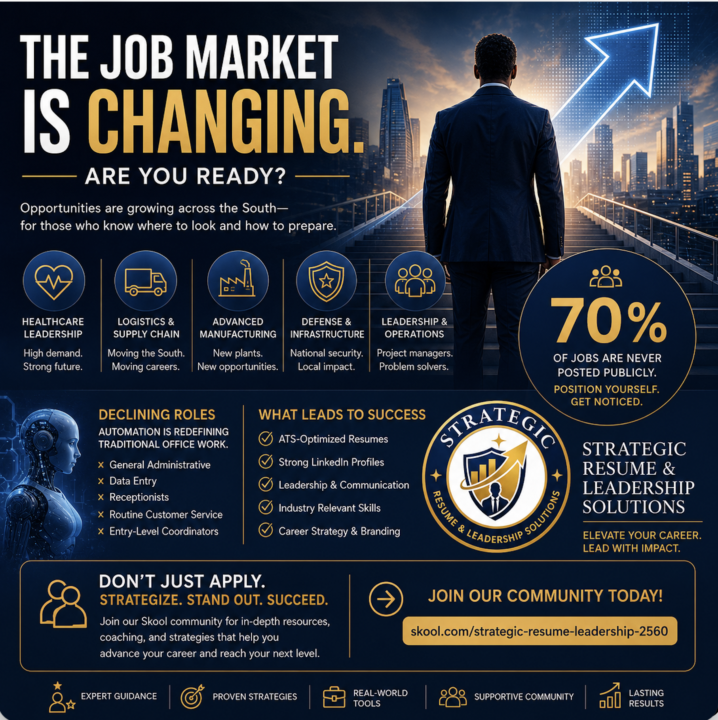
📊 The Southern Job Market Is Changing. Are You Ready?
Over the past several weeks, I have been studying labor market trends across the Southern United States. One thing became very clear. The South is becoming the nation's biggest growth engine for middle-class careers. From Georgia to Texas, employers are investing billions in healthcare, logistics, advanced manufacturing, defense, energy, and technology. New opportunities are being created every day. But there is another side to this story. Companies are hiring differently than they did just a few years ago. This is what economists are calling a "low-hire, low-fire" job market. Employers are hiring carefully. They aren't filling positions as quickly, and they're looking for candidates who can prove they have the right skills from day one. That means sending the same resume to every job is no longer enough. Here's where the greatest opportunities exist right now: ✅ Healthcare Leadership ✅ Logistics & Supply Chain ✅ Advanced Manufacturing ✅ Skilled Trades ✅ Energy & Utilities ✅ Cybersecurity & AI Infrastructure We're also seeing strong demand for what I call "bridge careers." These are leadership and management positions that combine experience with problem-solving and strategic thinking, including: • Project Managers • Operations Managers • Program Managers • Procurement Specialists • Compliance Professionals • Quality Managers • Federal Contract Specialists These careers often provide excellent salaries, long-term stability, and are much harder to replace with automation. The biggest skills employers are looking for Across nearly every industry, employers continue to say they need professionals who can demonstrate: ✔ Leadership ✔ Project Management ✔ Communication ✔ Problem Solving ✔ AI Awareness ✔ Process Improvement ✔ Change Management Technical knowledge is important—but it isn't enough anymore. Employers want people who can lead teams, improve processes, and solve business problems. Five actions you should take today 1. Update your resume. Make sure it highlights measurable accomplishments, leadership experience, and is optimized for Applicant Tracking Systems (ATS). 2. Tailor your resume for every application. One resume no longer fits every opportunity. 3. Strengthen your LinkedIn profile. Recruiters search LinkedIn every day for qualified candidates. 4. Build leadership skills. Whether you're seeking a promotion or changing careers, leadership is one of the fastest ways to increase your value. 5. Target growing industries. Focus your job search on sectors that are expanding, not shrinking.
0 likes • 5d
This post is timely, especially for experienced professionals and career changers who may not realize how valuable their transferable skills are. (That was me)😒 The idea of “bridge careers” stood out to me because many professionals already have leadership, communication, compliance, problem-solving, and process-improvement experience, even when their previous job titles do not perfectly match the role they are pursuing. The challenge is learning how to communicate that experience in a way that shows an employer the value they can bring from day one. I also agree that AI awareness is becoming essential, but it should not replace sound judgment, emotional intelligence, or the ability to work well with people. The strongest candidates will know how to use technology to improve productivity while still bringing discernment, accountability, adaptability, and human connection to the workplace. This market requires more than submitting applications. It requires intentional preparation, continuous learning, and a clear understanding of how your experience solves the employer’s current problems.
Jun 17 •
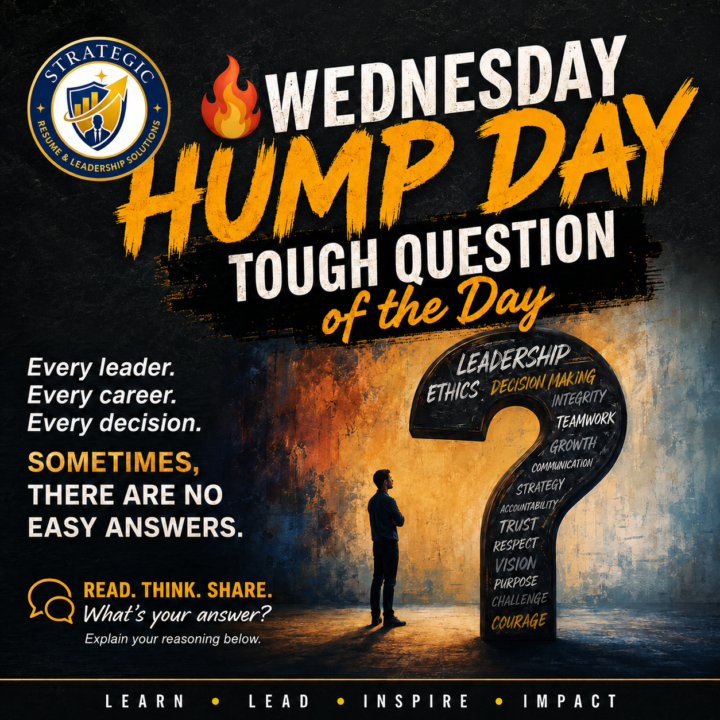
🔥 Wednesday Hump Day Tough Question of the Day
Every leader, manager, and professional eventually faces difficult decisions that don't have easy answers. Today's challenge is designed to test your leadership, communication, decision-making, and problem-solving skills. There are no perfect answers—only thoughtful perspectives. 💬 Read the scenario, share your response, and explain your reasoning. You may be surprised by how differently others approach the same problem.
1 like • 5d
My response would depend on the seriousness of the violation, but I would not ignore it simply because the person involved was my supervisor. First, I would make sure I understood the policy correctly and separate facts from assumptions. If the issue appeared unintentional, was not illegal, and did not create an immediate safety or ethical concern, I would consider addressing it privately and respectfully with the supervisor. Sometimes a direct conversation allows a problem to be corrected before it escalates. If the violation involved safety, discrimination, harassment, fraud, retaliation, misuse of confidential information, or another serious concern, I would follow the organization’s established reporting procedures and document only the relevant facts. I would avoid workplace gossip and keep the matter as confidential as possible. The risks could include retaliation, damage to the working relationship, being misunderstood, or failing to act and allowing harm to continue. That is why courage must be balanced with WISDOM, DISCRETION, and PROPER procedure. The leadership principles involved are integrity, accountability, fairness, respect, and moral courage. Leadership is not protecting a title or an individual at the expense of the organization and its people. It is being willing to do what is right while handling the situation professionally.
1-10 of 12
@melissa-lewis-9791
Real estate advisor, systems builder, and Kingdom-centered teacher helping people move with clarity, confidence, and purpose.
Active 5d ago
Joined Jun 3, 2026
ISFJ