Activity
Mon
Wed
Fri
Sun
Oct
Nov
Dec
Jan
Feb
Mar
Apr
May
Jun
Jul
Aug
Sep
What is this?
Less
More
Owned by Markus
Hier ist deine Community im deutschsprachigen Raum, rund um die Themen künstlicher Intelligenz und allen wichtigen Ereignissen darum!
Welcome to the #1 beekeeping community for beginners and hobbyists!
Winkler Gilde
2.4k members • Free
Agent J
2.6k members • Free
8 contributions to Modern Beekeeping

Aug 14 •
First time using a Liebig dispenser this year
Honey harvest is done here in Germany, no more flow right now, so it's straight into winter prep. This year I tried the Liebig dispenser for the first time to evaporate formic acid instead of my usual method. Still getting a feel for how much and how fast it evaporates depending on temperature, so I'm watching the mite drop closely before deciding if I'll stick with it next year. After treatment it's slow feeding time, since our winter bees need to build up real fat reserves. They live up to six months instead of the usual few weeks, so if the timing on treatment or feeding is off, that's the generation that pays for it. Anyone else running the Liebig dispenser this year? Curious how it's going for you.
Jan 31 •
Varroa Mite Treatment: A Simple Guide for Beginners (Formic Pro vs. Oxalic Acid)
Let's talk about the tiny vampire that's probably living in your hive right now: Varroa destructor. If you're new to beekeeping, you might be thinking, "Mites? Really? How bad can a little mite be? Let me tell you a story. In my second year of beekeeping, I had a gorgeous, thriving hive going into fall. The population was strong, the honey stores were abundant, and I felt like I'd finally figured this whole beekeeping thing out. I'd heard about varroa mites, but I figured I'd deal with them "later." By January, that colony was dead. Not from cold. Not from starvation. From varroa mites and the viruses they spread. That was a brutal lesson, and one I never want you to experience. Today, we're going to talk about varroa mite treatment in a way that's actually useful for beginners. No PhD required, just practical, actionable information. What Are Varroa Mites (And Why Should You Care)? Varroa mites are external parasites about the size of a pinhead that feed on bee larvae and adult bees. Think of them as ticks for bees. They weaken the bees directly by feeding on them, but the real damage comes from the viruses they transmit—deformed wing virus, acute bee paralysis virus, and others. Here's the scary part: every hive has varroa mites. It's not a question of if, but how many. A few mites? Your bees can handle it. A few hundred mites? Your colony is in serious trouble. A few thousand? You're looking at colony collapse. The goal isn't to eliminate every single mite (that's nearly impossible), but to keep the population below the threshold where they cause significant damage. That threshold is roughly 3 mites per 100 bees, or about 3% infestation rate. This is where a lot of beginners get confused. You can't just treat whenever you feel like it. Varroa mite treatment timing depends on your climate, your colony strength, and what treatment you're using. Here's my general rule of thumb: Spring Treatment (March-April): A light treatment to knock down the mite population before the main nectar flow. This gives your bees the best chance to build up strong and healthy for the season.
0 likes • Aug 6
@Michelle Martin if you want to, we can do a Zoom Call
1 like • Aug 7
@Michelle Martin CEST
Jan 31 •
Our #1 Goal: Making Your First Year Beekeeping a Success!
Hey there, fellow bee enthusiasts! 🐝 Welcome to what I genuinely believe is the most supportive and down-to-earth beekeeping community you'll find anywhere online. Whether you're still dreaming about your first hive or you've already got bees buzzing in your backyard, you've found your people. Let me start by sharing something personal: I'll never forget the day I brought my first package of bees home. My hands were shaking so badly I could barely hold the hive tool. I'd read every book, watched countless YouTube videos, and still felt completely unprepared. That night, I lay awake wondering if I'd made a terrible mistake. What if I killed them all? What if I got stung a hundred times? What if my neighbors hated me? Here's what I wish someone had told me back then: You're not alone in feeling this way. Every single beekeeper—from the hobbyist with two hives to the commercial operator with hundreds—started exactly where you are right now. Nervous. Excited. Overwhelmed. And that's completely normal. Why This Community Exists This community was born from a simple realization: first year beekeeping doesn't have to be so scary. The learning curve is steep, sure, but it's so much easier when you have experienced mentors and fellow beginners walking alongside you. Our mission here is crystal clear: to make your first year (and every year after) a genuine success. Not just "keeping your bees alive" success, but the kind of success where you actually enjoy the journey, feel confident opening your hive, and maybe even harvest some golden honey at the end of the season. What You'll Find Here This isn't just another beekeeping forum where questions disappear into the void. This is an active, engaged community where real beekeepers share real experiences. Here's what we've built for you: In the Classroom:We've created a comprehensive beekeeping course online that takes you from absolute beginner to confident beekeeper. It's structured around the seasons, so you'll always know what to do next. No fluff, no filler—just practical, actionable guidance.
3 likes • Feb 5
@Atinuke Akinrinde Welcome. That is precisely our goal.
0 likes • Jul 23
@Xiangyuan Long welcome! Pleaaaase tell me: What is a double-queen system??? Never heard of it
Jan 29 •
Welcome to Modern Beekeeping 🐝🌍
Hey you — awesome to have you here! I’m Markus, a beekeeper from Germany, and I’ll be your host in this community. Our admin team is also made up of German beekeepers, but this is not a “Germany-only” space — the whole point is international exchange. Different climates, different forage, different hive styles… same core problems. And that’s where this gets fun. 😄 What this community is about Beekeeping is full of “industry solutions” that are… let’s say enthusiastically priced 💸😅Our mission is simple: ✅ Practical, simple solutions to real beekeeping problems✅ Tools, workflows, and smart hacks that save you time, money, and frustration✅ Sharing what works — without the marketing fog If the industry sells something expensive, we ask:Can we solve this simpler? Cheaper? Better? What you’ll find inside - Guides & checklists (practical, field-ready) - Problem-solving threads (post your issue, get help) - Tool & gear breakdowns (what’s worth it vs. what’s hype) - Live trainings (recorded and published here) - Interviews with beekeepers and specialists (also published here) - And yes: DIY solutions and maker stuff too — including 3D printing when it makes sense, but not limited to it 🧰🖨️ This community is free — and will stay free No bait-and-switch. No “free for now”.Modern Beekeeping is free for everyone and will remain free. ✅ New here? Here’s how Skool works (super simple) Skool is basically a clean, focused home for a community + learning: 1) Classroom 📚This is where you’ll find trainings, recordings, and structured content. 2) Community feed 💬This is where we talk, share wins, ask questions, troubleshoot, and post updates. 3) Calendar 📅Upcoming live sessions, interviews, events — everything scheduled in one place. 4) Levels 🏆Skool rewards participation. The more you contribute, the more you level up — simple gamification to keep things active (and honestly: it works). Your first action (do this now 👇) Reply to this post with: 1. Where are you from? (country/region) 2. What hive system do you run? (Langstroth, Dadant, National, Zander, etc.) 3. Your #1 beekeeping problem right now (Varroa, queen issues, feeding, swarming, wintering, moisture, robbing…)
1 like • Jun 8
@Kevin Griffin If you want to post something, you always have to select the right category; otherwise, you won't be able to submit it. It's right below your post. And the AI Section isn't unlocked until Level 3. But I actually mentioned that in my welcome messages. Did you read them? You should reach Level 3 very quickly, though. Every time you post something or reply to someone and another member gives you a Like, you earn points and can level up. That’s how we build an engaged and helpful community
1 like • Jun 8
@Kevin Griffin the more colonies you have, the harder it is to keep track of everything if you don’t keep records. For example: A queen test should be checked after 3 days at the latest. Or your checks for swarming activity should be done exactly 7 days later, because they swarm after 8 days. That works as long as everyone is on the same page, but if, for example, you catch a swarm and treat it directly with oxalic acid because it’s currently brood-free, the situation arises where the colonies are all at different stages. And no one can keep track of that. Also, starting in the second year, you have to form splits, and those will eventually cause trouble. Or if you want to breed queens. I recommend a good mobile app that also has voice input. My colonies are marked with a QR code, and the app then does everything automatically based on my report.
Mar 12 •
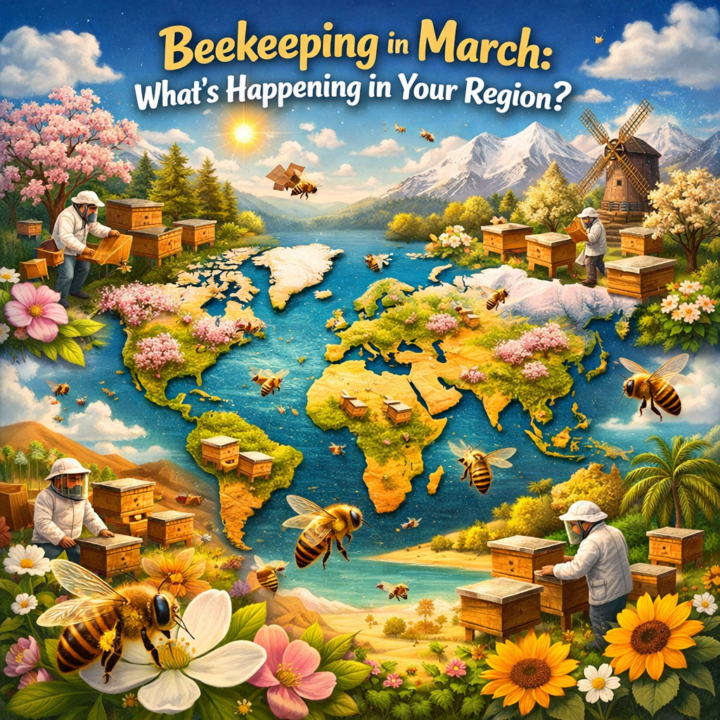
🐝 Beekeepers around the world – what’s happening in your apiary right now?
March is one of the most interesting months in beekeeping. In some places colonies are just waking up after winter. In others the nectar flow has already started. And somewhere else people are preparing splits. Nature runs on different clocks depending on where you are. That’s what makes global beekeeping so fascinating. So let’s compare notes across the planet 🌍 👇 Tell us in the comments: 1️⃣ Where are you located? (Country / Region) 2️⃣ What’s the current weather like? 🌦️ 3️⃣ What are your bees doing right now? 4️⃣ What beekeeping tasks are you working on this month? Examples could be: - First inspections - Feeding or pollen patties - Adding space or supers - Checking brood patterns - Preparing splits - Monitoring Varroa - Swarm prevention - Or maybe your bees are still clustered because winter isn’t over yet. It would be amazing to see how different March looks for beekeepers in Europe, North America, South America, Africa, Asia, and Australia. Let’s build a global snapshot of beekeeping in March. 🌍🐝 I’ll start: 📍 Southern Germany 🌤️ Early spring weather, first warm days 🌼 Hazelnut and early pollen sources 🐝 Colonies starting brood expansion Now it’s your turn 👇
1 like • Mar 13
@Ökke Imker how many hives do you have? And where are you located?
1 like • Mar 13
@Ökke Imker Carnica?
1-8 of 8

@markus-habermehl
AI & marketing Coach, father, hunter and beekeeper. Former NATO soldier
Active 8h ago
Joined Jan 29, 2026
ESTJ
Bayern
Powered by