Activity
Mon
Wed
Fri
Sun
Aug
Sep
Oct
Nov
Dec
Jan
Feb
Mar
Apr
May
Jun
Jul
What is this?
Less
More
Memberships
ACT Prep
650 members • Free
AI Automation Agency Hub
329.4k members • Free
SAT Prep
17.6k members • Free
The 1550+ Formula
710 members • $99/m
37 contributions to Gamify SAT

15d •
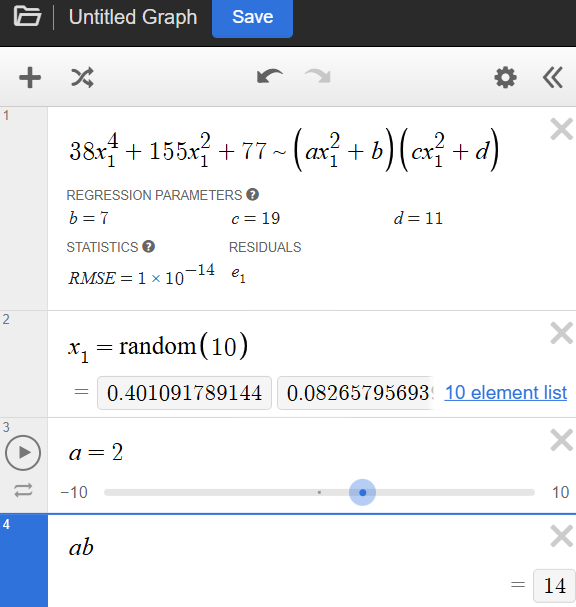
Does Anyone know why this works
In the problem it said that the left side had a factor of (ax^2+b). When I set x1 equal to random(10), that makes sense to me but how can you just assign "a" a number when you dont know it actually and how does that magically just make them all whole numbers. Please help.

3 likes • 15d
when you do x1=random(10), you are essentially telling desmos to treat x1 as a variable and find the 4 unkown constants: a, b, c and d. Because there are only 3 terms (x^4, x^2, constant), they are only 3 equations. So you are asking desmos to solve for 4 unknows with 3 equations. There are infinite set of solutions and desmos will randomly give you one set of these numerous solutions. When you do a=2, you are giving desmos another equation, so now there are 4 equations for 4 unknowns, fullly solvable. When you put a=2, b, c and d all become integers. that is not magic. That's just only solution for b, c and d and they happen be all integers. When you put other values for a, you will get other unique values for b, c, d and here is an example (a=8)

May 13 •
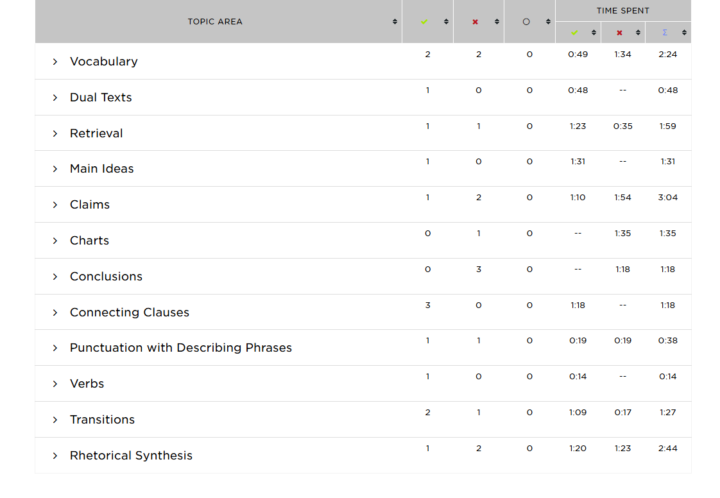
Hey yal.... Please help!
I just took a reading practice test. 570, How do i improve with all these stats?
2 likes • May 13
@Ethan Joiner is this Princeton reveiw 1400+ course? How much is it?

0 likes • Mar 16
@Sadiqah Hossin lol

Mar 15 •
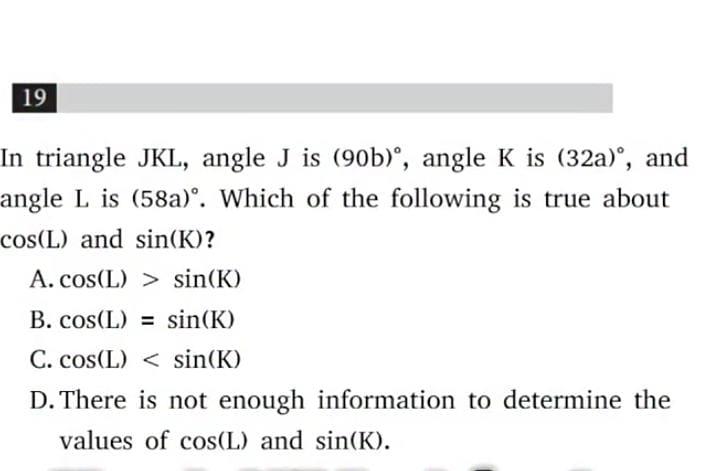
The last question on module 2 math
This is similar to the last question on the module 2 maths. I Couldn't figure out the answer to this one and i was running out of time so i had to guess but what answer did u guys pick
1 like • Mar 16
@Hamy Mv u r not tripping. Somehow it's hard to grasp for most members.
1 like • Mar 16
@Hamy Mv Yes

Feb 5 •
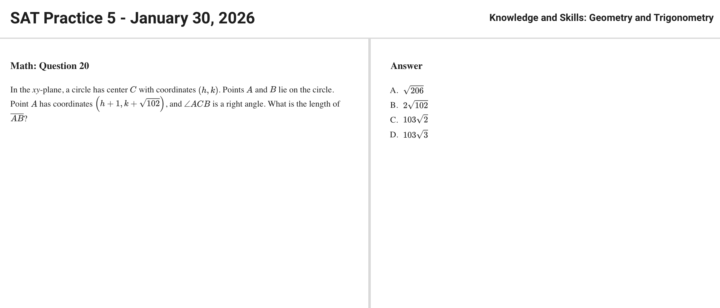
Hard Geometry/Trig Question (at least hard for me)
does anyone know a time-efficient method to tackle this problem? i know the answer is D, but the College Board method does not seem time-efficient at all. pls help
1 like • Feb 5
understand the concept. triangle ACB is a special 45-45-90. AB is sqrt(2) of the radius. Obviously the vale AB is not dependent on the center (h,k) of the circle. So just let h=k=0 for convenience. The answer is A. https://www.desmos.com/calculator/yx57xnsnql
1-10 of 37
@mark-lusun
Learned Desmos from James Lu, The Desmos Demon himself. Bring your hardest SAT math Q's and I will ALWAYS find an elegant solution. Marknificent Math.
Active 1m ago
Joined Jun 26, 2026
Powered by