Activity
Mon
Wed
Fri
Sun
Jul
Aug
Sep
Oct
Nov
Dec
Jan
Feb
Mar
Apr
May
What is this?
Less
More
Memberships
Get Good With Horses Courses
274 members • Free
13 contributions to Get Good With Horses Courses
Apr 21 •
Question about motivation and learning
Hi everyone, I’d love to hear your thoughts and experiences around motivation in horses during training. Over time, I’ve noticed a consistent difference in my horse’s attitude depending on whether I include positive reinforcement (food rewards) in a session or not. I alternate between sessions with rewards and sessions without them, so it’s not something I use all the time. When I work with food rewards, I see noticeably more willingness from my horse to explore, offer responses, and actively try to figure out what I’m asking. The learning feels more proactive, almost like the horse is engaged in solving a puzzle rather than just responding. On the other hand, when I train using only pressure–release (pressure applied, in the lighest possible way, and release when the correct response happens), I sometimes feel that the motivation drops. The horse does respond, but it feels more mechanical and less enthusiastic. A clear example for me is backing up on the halter: - With pressure–release alone, the horse might shift weight back or take a single step, but often seems less engaged. - Using rewards, I’ve been able to build this up to 4–5 relaxed, intentional steps, with much more focus and curiosity from the horse. I want to emphasize that I’m intentionally using low‑value rewards (meadow hay pellets, while my horse has access to forrage ad libitum), and I’m not seeing “cookie monster” behavior, but I am seeing more interest and participation. So my question is: - Do you see this difference in motivation as well? - How do you interpret it in terms of learning theory and emotional state? - How do you personally balance pressure, release, and reinforcement to keep horses motivated without over‑reliance on rewards? Really interested in hearing different perspectives 🙏
Apr 14 •
Late greying horse?
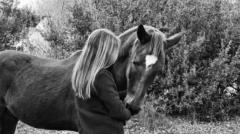
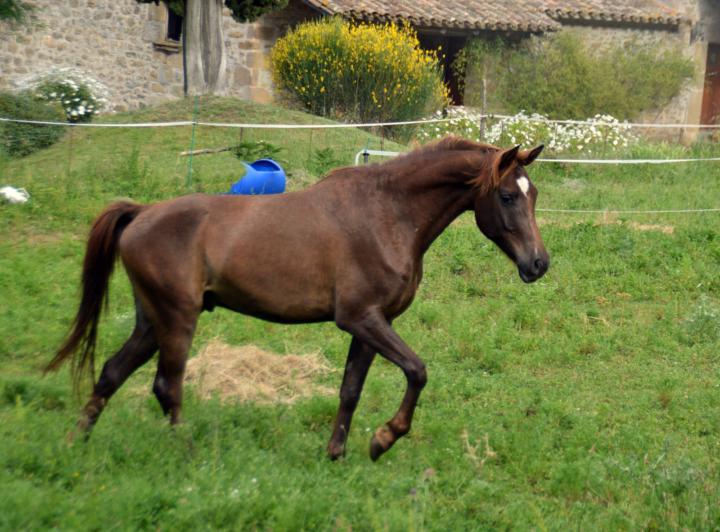
Hi everyone! I’d love to hear your opinions and experiences on my horse’s coat colour, because I’m genuinely unsure and would really appreciate an outside perspective. My horse was born light chestnut, then darkened significantly as he grew (dark chestnut/almost liver chestnut at 4yo), and over the last year he has started to lighten again. What caught my attention is that during this winter he has developed white hairs in his mane, and these hairs are growing white from the root, not just sun-bleached tips. The rest of the mane and tail are still mostly reddish, as is the body coat. I noticed his skin is dark. Genetically: - His sire is grey, but known to be heterozygous (Gg) - His dam is chestnut So statistically he had a 50% chance of being grey and a 50% chance of staying chestnut, which is part of why I’m so unsure. At 5 years old, he still largely looks chestnut, just lighter than before, which makes me wonder: - Could this still be a normal chestnut “colour evolution” with some random white hairs? - Or does this pattern (lightening over time + white hairs appearing from the root, especially in the mane during winter) sound like early or late-onset greying to you? I’m honestly a bit conflicted because visually he doesn’t look like a typical young grey yet... I’m finding it a bit hard to wrap my head around the idea that he might actually be changing color. The picture where he appears darker is exactly from a year ago (4yo) and the second and third one arefrom yesterday. Thanks! 🥰
3 likes • Apr 16
@Zoë Coade it's kind of a mystery! Didn't know about the frosting/ticking terms! Makes him even more special to me! 😍 I'll keep a close eye on him!
Apr 12 •
🐎 Week 15 - 2026
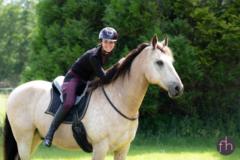
✨Share something that felt better this week… ▪️Maybe your horse stayed with you a bit longer? ▪️Maybe something finally clicked? ▪️Maybe you handled a moment differently than you would’ve before? ▪️Maybe you just showed up when it would’ve been easier not to? That all counts and love for you to share… 🐴✨🫶

5 likes • Apr 12
This week I’ve gone back to basics with my horse, now focusing on “lower the head.” It’s a simple exercise, but it feels really important right now. I’m going through a bit of a difficult time personally, but I still showed up and stayed consistent. Even if progress feels slow, I’m keeping my motivation and building from the ground up again. He makes everything instantly better. Lucky to have Kai in my life. 🐎
Mar 31 •
👉 What Shows Up for You?
Quick one - where do you struggle most in your body when working with your horse? Not what you know but what actually shows up when you’re in the moment. Hands, shoulders, feet, eyes…it all matters more than we think, and often it’s the smallest habits that make the biggest difference. So I’m curious 👇 Which body part(s) do you find the hardest to get right or get control of? Drop your thoughts in the comments. 🐴✨🫶
Poll
10 members have voted

4 likes • Mar 31
I also struggle with voice cues. I tend to talk more than necessary, and that can be confusing, especially when my body position might be saying something else. I’m working on becoming more aware of that so I can be clearer for my horse and build better communication together.
Mar 31 •
🐴 GET GOOD HORSEMANSHIP TIP 25.
✨ Don’t train the problem - train what’s underneath it. The behavior you see is rarely the real issue, it's the surface expression of something missing. When we focus only on fixing what’s going wrong, we often end up chasing symptoms. The problem with this is that the symptoms change but the foundation stays the same. Biting, rushing, pulling, resistance - they’re not random, they’re information. 👉 Real progress begins when we step back and ask: What hasn’t this horse been shown clearly enough yet to move on? Because when the foundation improves, the problem / issue / misunderstanding often disappears without ever being directly trained. ➡️ This is when I usually say to a student that although it might not feel like this exercise or communication I am teaching you right now is linked directly to your questions - if you trust the process it will start to. Question: Have a think about what maybe hasn’t been made clear enough yet for your horse? Feel free to drop in the comments 👇
2 likes • Mar 31
@Hyuck June Kang same here! I'm teaching my horse to yield to pressure; it's slow, but we're seeing little improvements every time 💪
1-10 of 13
@magali-de-soler-4595
Veterinarian living in Catalonia (Spain). Currently getting good with Kai (formerly Far), a 5 year-old angloarabian gelding.
Active 14h ago
Joined Jan 20, 2026
Powered by