Activity
Mon
Wed
Fri
Sun
Aug
Sep
Oct
Nov
Dec
Jan
Feb
Mar
Apr
May
Jun
What is this?
Less
More
Memberships
Chase AI Community
70.3k members • Free
AI Automation Society
418.5k members • Free
7 contributions to AI Automation Society

2h •
Information Overload
Hello to all of you ! How do you stay structured and up to date without drowning in the AI info-flood ? New, interesting repos keep popping up on GitHub, but keeping track is getting harder and harder. How do you actually filter out the truly relevant repos/insights without scrolling for hours or missing the important stuff? Appreciate any engagement 💯

5h •
Replacing Power BI Dashboards with AI-Coded Dashboards: Real Saving or Hidden Cost?
I’ve been seeing people replacing Power BI dashboards with dashboards built using AI coding tools like Claude Code. Some influencers are also selling this idea as a way to reduce license costs and build dashboards faster. Has anyone here tested this or actually implemented it in a real business workflow? Did it really save money? How was the maintenance, governance, sharing, security, and user adoption compared to Power BI? I’m curious to understand where this approach makes sense and where Power BI still wins.
0 likes • 2h
In general I'd always lean toward a standard reporting tool for a few reasons: 1. Error-prone-People make mistakes building dashboards: a wrong aggregation or join, and the numbers just aren't reliable anymore. Standard tools at least enforce some baseline of modeling and validation. 2. Maintenance- burden Self-built dashboards need active upkeep. When data sources or requirements change, they break quietly, and nobody notices until someone questions the numbers. 3. Bus factor -The biggest risk: the person who built it leaves or is out, and now there's a system nobody understands or wants to touch. Standard tools have a known structure and ecosystem of docs/support, so onboarding a successor is much easier. That said, I use both - self-built dashboards only when I hit specific limitations in reporting tools, usually around visualizations. For me that's an ad-hoc data request, not a long-term replacement. I wouldn't currently recommend it as a substitute for a standard BI tool in a business workflow, mainly because governance, security roles, and sharing are usually missing or have to be built from scratch in custom solutions.

8h •
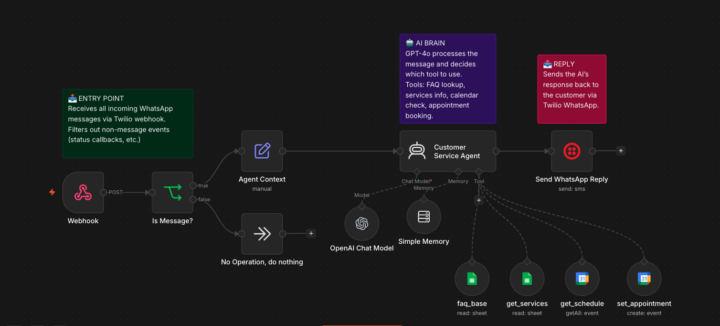
Finished of my WhatsApp AI Receptionist
Built with n8n, AI Agent node with 4 tool integrations + memory so it keeps context across the conversation. Self-taught, zero coding background, only a few weeks into n8n. Feels like my best project so far and I'm thinking of offering it as a service. Anyone here figured out how to land first clients for something like this? Cold outreach, local biz, referrals... what's actually worked for you at the "no reviews yet" stage?
0 likes • 2h
@Tariq Belgharouadi Just as a heads up, Google Sheets nodes tend to hit rate limits pretty quickly once a workflow scales up. It's worked fine for smaller/simpler setups, but anything with higher volume or frequency runs into throttling issues fast.

💎
⭐
1d •
🚀New Video: Fable 5 + Karpathy’s LLM Wiki is Basically Cheating
I ingested all my YouTube videos into an LLM wiki and turned them into a connected second brain that my AI OS can actually reason over. In this one I show you how to build the same thing in about five minutes using Claude Code and Obsidian, based on Andrej Karpathy's LLM knowledge base idea. You drop in sources, the AI reads them, splits them into cross-linked wiki pages, and keeps the whole thing organized with routing rules so it can find anything fast. By the end you'll know how to set up the vault, write the schema, ingest a PDF and a URL, and decide when to keep your wiki flat versus structured.
0 likes • 3h
Amazing 💯

6h •
N8N or Claude Code?
This might be a dumb question, But are people still using N8N to make workflows or just using claude code to make the workflows for them?
0 likes • 3h
Both together 💯
1-7 of 7

Active 2h ago
Joined Jun 28, 2026
Powered by