Activity
Mon
Wed
Fri
Sun
May
Jun
Jul
Aug
Sep
Oct
Nov
Dec
Jan
Feb
Mar
Apr
What is this?
Less
More
Memberships
Inertial Propulsion Workshop
21 members • Free
16 contributions to Inertial Propulsion Workshop

2d •
Deep Dive Group?
I mentioned before the thoughts of a small group of people who would be working on something a bit larger in scale than the PIE. This would be a select, and private group, and an application along with an NDA would be needed to join. I won't entertain the idea if there is no interest. And a "heads-up" there would be a small cost to be involved with this covering administrative fees. If you were to get started into it and find you do not want to continue, there would be a 14 day grace period before paying anything (it's only fair), but the legally binding NDA would stand. There are no other details yet as this is only a "scouting mission" to determine interest. Please let me know a simple yes or no. No hard feelings either way, and if you'd rather DM me privately I fully understand. Thanks!
Poll
4 members have voted

1 like • 2d
Great idea!

6d •
New Publication On Inertial Propulsion
Hey folks, As of today, I released a new publication which attempts to rigorously formalize spatial mass displacement system (colloquial known as inertial displacement systems) into 3 fundamental categories, in terms of the Mach formalism I put forward back in August. It was mostly written in response to folks who keep saying that this field is dead, and genuine thrust based systems remain an impossibility. Its titled:"A Short Historical and Technical Examination of Fundamental Spatial Mass Displacement Systems" You can can read my working version here: https://www.researchgate.net/publication/403702161_A_Short_Historical_and_Technical_Examination_of_Fundamental_Spatial_Mass_Displacement_Systems Even though it says its a "short" “examination”, this field is far too broad, containing all manner of nuance, for me to cover every system with extreme analytical rigor. That being said I place a number of well known systems in "the hot seat" and try to give fair and tactful treatments. The good news is, now that I've finished this, I can probably work on making lesson plans/scripts for skool that covers such items in more detail! This work ended up being about 100 ish pages, and when I started 4 months ago I thought it would only be around 40-50 at most. I'm still in the midst of small final edits—it in terms of writing— but as is. it contains very important information for enthusiast and builders alike. I'm human like anyone else, so I'm not the all knowing final word on this matter. I just hope it pushes the field forward. Nam qui curat
1 like • 3d
The field of Inertial propulsion is anything but "dead." The same critics that were saying this thirty years ago got to eat crow when they witnessed Cook and Thorsen's devices on a live stage in 1996. There are at least two devices that are being tested for space drives as we speak.
4d •
Welcome New Member
I want to welcome David Mathes to The Workshop, I appreciate that you are here! David has interest in multiple areas of propulsion and science including inertial, gravitic and electrostatic... Truly "Universal Propulsion"!!! David, feel free to look around, comment, post, or just "hang out"! Note: My apologies for the delay! Not sure what happened to my welcome post, I intended for it to be posted here a couple of days ago...
3 likes • 4d
Welcome David! Great job Bryan with your presentatiom on APEC!
20d •
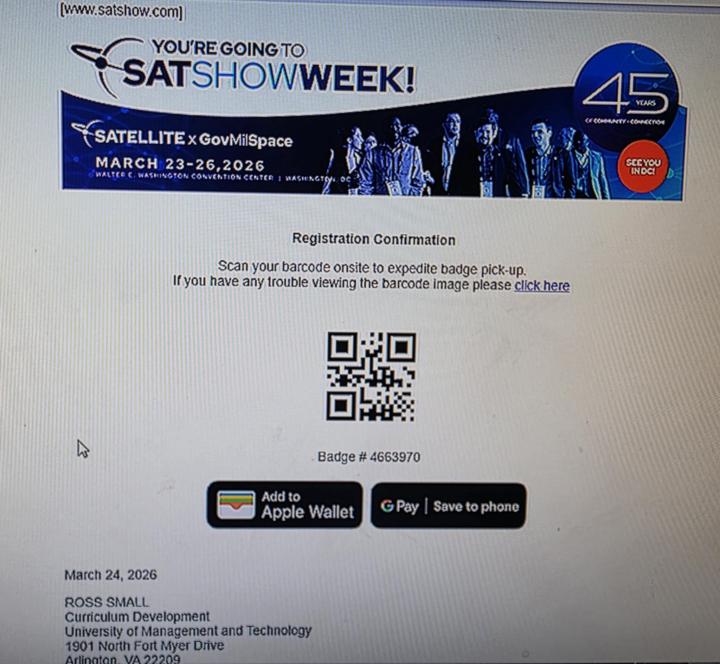
Genergo Photos from Sat Show Week
I have uploaded the photos taken at SATCOMWEEK to the Genergo Classroom Workshop. Access them from the classroom or directly from the link here. https://www.skool.com/inertial-propulsion-workshop-9027/classroom/8f1894c5?md=c08ce7b3974b4f619f567af65319cb75 I am told the reps were glad to speak about how they have tested it in multiple conditions including a "drop test" from a tower where the device(s) showed a significant course change not related to air flow or the earth's magnetosphere! Interestingly, Genergo has actually launched from Cape Canaveral yet nobody here in the states is talking about it!

3 likes • 20d
I wonder why they are so quiet about it.
3 likes • 18d
I think the distraction is with the newer developments with brute force rocket engines. Most of the larger major companies like SpaceX and Blue Origin are still pushing the improvements with these rockets as the answer for reaching space. The cost is still very expensive and the fuel is consumed in minutes. They are not practical for long missions into space.
22d •
Genergo Space Update
This week Genergo Space had a display at the SAT SHOW in Washington DC and I had a friend/colleague who was able to go and speak directly to their representatives! I will be posting more about this both here and on YouTube but I wanted to show everybody one of the most amazing things, something that validates EVERYTHING WE are all working toward. An international expo with signage for PROPELLANTLESS PROPULSION 😲!!! I will have more about this later, but wanted to get this posted ASAP! Validation!!!
1 like • 20d
Time for inertial propulsion's heyday!
1-10 of 16
@larry-deavenport-7126
Larry is retired and mentors other in Electrokinetics and related fields.
Active 21h ago
Joined Feb 3, 2026