Activity
Mon
Wed
Fri
Sun
Oct
Nov
Dec
Jan
Feb
Mar
Apr
May
Jun
Jul
Aug
Sep
What is this?
Less
More
The Forge
45 members • Free
5 contributions to The Forge

Feb 25 •
The Perfect Font
After personally struggling with fonts for readability in various environments, I've just found what I would consider to be the perfect font; Jetbrains Mono (normal). https://www.jetbrains.com/lp/mono/ Jetbrains Mono is special because ... - Open Source and Free: Licensed under Apache 2.0. - Distinct Characters: No more confusing O or 0, or 1, i , and l. - Increased Letter Height: Enhanced x-height for much better readability - Consistent Character Widths: Uniform width of all characters. - No Character Overlap: F and t won't flow over other letters. - Massive Language Support: Supports 152 different languages! - Versatile Weights: Includes 8 clear weights, each with its own italics version. - Coding Ligatures: Includes 142 coding-specific ligatures to make logic easier to scan. - Universal Support: Works everywhere from your terminal to Word. Check it out yourself!
1 like • Jul 14
Excellent!
Apr 26 •
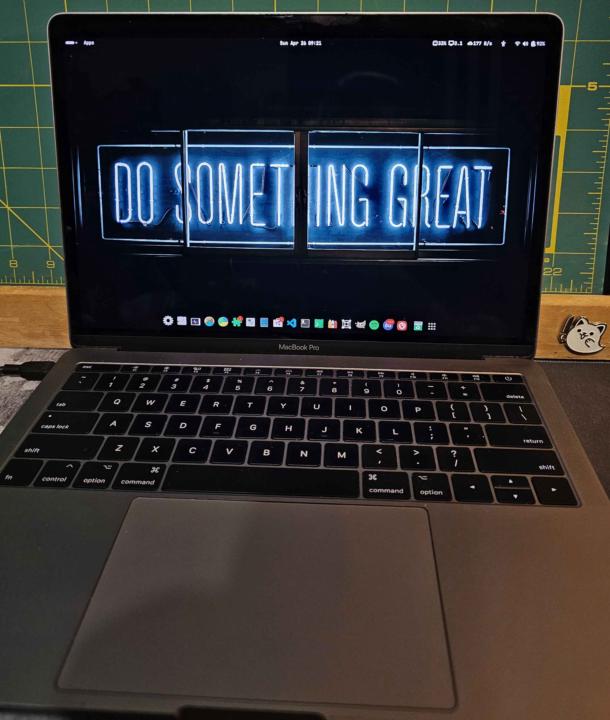
Introducing My Linuxbook Pro!
A friend of mine recently gave me a 2017 Macbook Pro that Apple no longer supports for tech shenanigans. So, I decided to wipe it and reimage the device with Linux Fedora Workstation 43. But why? Because after ~ 5 years Apple chooses to no longer support the device. They refuse to give it any operating system or security updates which effectively kills the device and forces the user's hand to purchase another. Planned obsolescence at its finest. However, that provided me with the opportunity to upcycle the device into a Linux laptop. And it worked well! - Who: Michael Roby II :) - Device: A 2017 Apple Macbook Pro - What: Switching a Mac's OS to Linux - Operating System: Fedora Workstation 43 - Firmware Version: 529.140.2.0.0 - Kernel: Linux 6.17.12-300.fc43x86_64 - OS Architecture: x86_64 - GNOME Version: 49 - Windowing System: Wayland - When (finished): 2026.04.25 - Where: IL, US Status: As of 2026.04.26 07:47, the device is functioning correctly and at the expected speed. Everything appears good. Other fun things: - I installed Ptyxis to be my primary terminal emulator because of the many improvements and customization options over the already awesome GNOME Terminal. - I installed Foot to be my secondary lightweight terminal emulator for quick changes and viewing. - Installed GNOME Tweaks, Thermald, Thermald-monitor, and a few other utility programs for better insight and control of the device. - I installed Impression to make bootable flash drives easily, and then made one for Arch Linux and Kali Purple that I'll mess around with soon--more to come! - I installed the Google Antigravity AI IDE from the terminal. So I'll be exploring that as well! - I installed Bottles to run Windows programs in their own bottles on my Linux machine. - I installed VSCode--my preferred IDE, and synced it with my laptop to have another, independent, instance of it that won't impact the performance of the one on my laptop.
1 like • Apr 26
upcycle > recycle. Very nice
Apr 5 •
My Perfected File Naming Format
Today I wanted to share my perfected file naming format and explain why it looks the way it does on all the files you've seen so far and will see in the future. First, l'll introduce it to you, then I'll break it down. I've also included a .pdf for easy reading and a .txt file for using as a reference in your terminal. ====== THE NAMING FORMAT: title_descriptor_YYYYMMDDtHHMM_m####.ext title_descriptor_YYYYMMDDtHHMM_p####.ext For this post it would be: theforge_my_perfected_file_naming_format_20260405t0714_m0500.txt ====== THE COMPONENTS: - title_descriptor — To represent the contents, the name should be all lowercase words, separated by underscores; no capital letters, spaces, dashes, or special characters. - YYYYMMDD — To represent the date, I use an ISO 8601 adjacent format with a 4 digit year, a 2 digit month, and a 2 digit day (the date of creation or export). - tHHMM — To represent the time, I also use an ISO 8601 adjacent format with a lowercase letter ‘t’ to indicate the start of the documented time, followed by 24-hour time, then the hour and minutes. For the UTC time offset, I use two different indicators depending on if the timezone is ahead, or behind, UTC. - m#### — To represent a time behind UTC the offset indicating character is an "m" for minus # of hours (e.g., m0500 = UTC-5). - p#### — To represent UTC or a time ahead of UTC, the offset indicating character is a "p" for plus # of hours, and standard UTC is simply “0000” (e.g., p0200 = UTC+2 and p0000 = UTC). - .ext — To represent the file type I use the corresponding file extension (e.g., .txt, .md, .pdf, .csv, etc.) at the end. If I don't know the file type, or the file’s contents will be switching file types, I just use ".ext" as a placeholder. EXAMPLES: ai_assistant_summary_20251005t1140_m0500.txt guardian_druid_builds_20251102t1745_p0200.pdf unix_cli_reference_20251001t0930_p0000.txt ====== THE MANDATORY RULES: 1. Use only lowercase letters, numbers, periods and underscores.
2 likes • Apr 6
Looks great, keep the content coming.
Feb 12 •
AI FOR EVERYDAY #1 - Google's NotebookLM
I wanted to get the ball rolling on explaining some of the work I’ve been doing with AI, so I decided to create a new series, AI For Everyday (AIFED). In this series I’ll be going over some of the helpful ways that I’ve been able to incorporate AI into my everyday life to be more informed, more efficient, and ultimately achieve better outcomes. This will be in addition to another series I am working on as an introduction into AI and various AI tools, but that is still in progress at this time. But, without further ado, AI FOR EVERYDAY #1 - Google’s NotebookLM See the attached PDF for my introduction to Google's Notebook, and a how to on how you use it yourself! https://notebooklm.google.com
1 like • Feb 17
very helpful, thanks.
Jan 2 •
Welcome To The Forge - Where Mastery Is Made
Welcome! I'm Michael Roby, and this is my space dedicated to consistent learning, improvement, and disciplined reflection. Here in The Forge, I'm sharpening three blades: - Artificial Intelligence (AI) & Machine Learning (ML) - Linux Command-Line Interface (CLI) - Tanking Mythic+ in World of Warcraft as a Guardian Druid I'll be sharing resources, insights, tips, and handy tricks — so be sure to join and walk with me as I learn these lessons and grind toward mastery. It's free! And remember: you are the only one who can forge a better life for yourself.
1 like • Jan 2
Looks great! Cant wait to see more.
1-5 of 5