Activity
Mon
Wed
Fri
Sun
Jul
Aug
Sep
Oct
Nov
Dec
Jan
Feb
Mar
Apr
May
Jun
What is this?
Less
More
Memberships
The Credit Club
509 members • $47/month
Clief Notes
37.3k members • Free
Improvifi PROgram
1.5k members • Free
The DM Edge
727 members • Free
Mobility Toolkit
32.1k members • Free
The Blueprint Training
4.8k members • Free
Unlimited Leads™
1.9k members • Free
Service Trading Blueprint, IMA
490 members • Free
5 contributions to Clief Notes

4d •
Happy to be here
Its refreshing to be in a group where I know literally know nobody. I grew up on a printing press catwalk. 2nd Gen printer, studied marketing a lot due to that, got a degree in computer science. So I always find myself in tech circles and marketing circles. And I usually see a familiar face. Not 1 in here. Thats kind of cool and exciting. Love watching what everyone in here is talking about and creating. Once I get the hang of this stuff, I will definitely be trying the competitions! Cheers!
0 likes • 1d
@David Vogel thank you! Ill definitely check it out.
1 like • 1d
@Alex Parnell welcome! And thank you! Ive got about 2 weeks of field work to clear out of my way. Then I get to endeavor this stuff!

6d •
It's Hard Keeping Up with Curtis
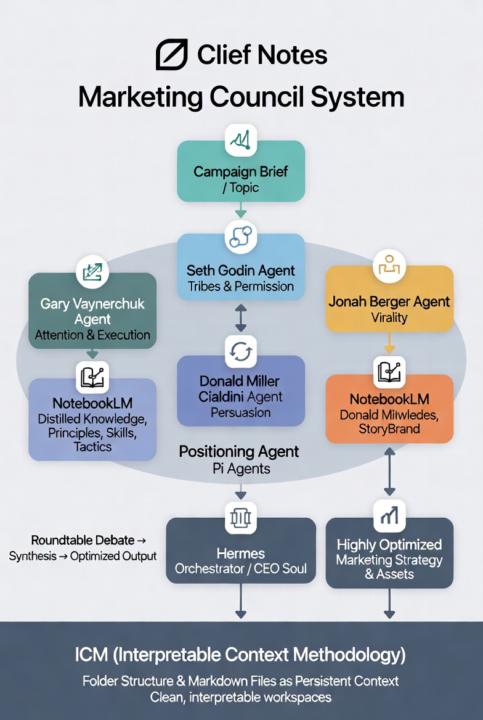
After watching @Curtis Hays series "Systems Worth Amplifying" Here’s the latest systems upgrade I’m running: a stacked Marketing Council that delivers maximum strategic and tactical value with minimal token burn. The Core Concept Using ICM (Interpretable Context Methodology) as the foundational layer for Hermes and Pi agents. Clean folder structures, markdown context, and persistent files keep everything interpretable and framework-agnostic. NotebookLM serves as the knowledge refinery: it ingests full books, frameworks, and top ideas from a host of marketing experts (Vaynerchuk, Godin, Cialdini, Donald Miller, Berger, Ries/Trout, and more). It distills them into structured, high-signal outputs — principles, tactics, quotes, integrations, and ready-to-use skills. Hermes acts as the persistent orchestrator / “CEO” soul — handling long-term memory, brand modeling, ICM-based context, and the self-improving learning loop. Lightweight Pi (Pi-mono) agents function as specialized council members — each embodying one expert or role with pre-loaded, distilled knowledge. How the Council Works 1. Feed the system your campaign/topic/brief. 2. Hermes routes it to the relevant Pi specialists using ICM context. 3. The “council” roundtables: each specialist contributes from their domain (attention & execution, tribes & permission, persuasion, storytelling, virality, positioning, etc.). 4. Hermes synthesizes the debate, resolves creative tensions, and delivers a highly optimized final result with clear rationale from the stack. This turns static expert knowledge into a living, collaborative marketing brain that compounds over time. Why It Delivers Maximum Value at Minimal Tokens - ICM keeps context clean and interpretable (no bloated prompts). - NotebookLM preprocessing means agents get distilled essence, not raw books. - Narrow Pi specialists + smart delegation = tiny per-agent contexts. - Hermes learning loop turns repeated wins into reusable ICM skills.
1 like • 5d
@Curtis Hays it do journal intermittently. Its more of a brain dump than anything else. I guess as I am purging it I mentally index thing based on importance, and work with that. Not so much as a reference for future me to go sort through.
1 like • 4d
@Curtis Hays perfect. Ill keep an eye out.

👑
⭐
18d •
🏆 WEEK 5 COMP WINNER 🏆
Yet again making this SO hard to decide, I am bringing together a rubric just to be able to really break these down its getting so close. OVER 37 ENTRIES. Spent all day today looking at YouTube Videos, testing apps, reading through markdown files. Going to spotlight six (no particular order), then a few thoughts on where this is heading as well as the winner out of everyone. 🥊 @Ariel Ortiz , The Praeceptor Honest read: if Ariel had been premium last week, he was the winner and again this week easily can take home the prize but more importantly they are premium now! He went premium and somehow raised his own bar. Idea for a Native iOS app in Swift 6 , three YouTube videos including a 4:28 behind-the-build, voice mode pipeline, 17 operator extractions (Grove, Munger, Walsh, Aurelius, Naval, more). Hero copy reads "A room. Not an app." which was really a great hook, one of those opening lines that makes you very curious right off the rip. What I'd take from Ariel beyond this comp: he treats every brief like a product launch. Even the video stack alone is a walk towards the idea that distribution matters as much as tech now. 🔗 https://praeceptor-web.vercel.app 🔗 https://github.com/orteug/the-praeceptor 📹 https://youtu.be/Cfs1KAC2Ry0 🔥 @Ruby Sparks , The Gut Mechanic Ruby's a monster. Every week crushes it without a doubt. The landing pivots from consumer pain into a B2B sales pitch in one stat (the $530B-lost-to-employee-health number) and her voice across the entire page is sharper than what most paid brand consultants ship. She also created an ENTIRE skool community for it. Which is a win in its self. Twenty years of chronic illness in the founder story. IG, Skool, a 14-minute course, B2B framing layered into the consumer hook so the consumer side does discovery and the B2B side does monetization.
2 likes • 17d
Congrats @Daniel Neuhaus this is insanely good. Im new to this, but this inspired me to try out one of the weekly challenges once I get a working folder system. Can't believe how exciting this group is.

19d •
Do you talk to people outside the community about AI?
At a going away party this weekend, I was talking to some government workers who mentioned they're mandated to use Copilot at work every day. Naturally curious I asked, "Oh what do you use it for?" They both sheepishly admitted that they don't. "We just don't see how it's useful for what we do." Later that night: birthday dinner at a German restaurant I'd been trying to get to for years. Some old theater colleagues: a props artisan, a lighting designer, they spend their days with hands-on physical work. AI didn't come up once. Meanwhile I was sitting at the table quietly asking Claude to translate the menu. It didn't just give me definitions — it told me the story behind one of the dishes. Monks during Lent, hiding meat inside pasta to get around fasting restrictions. Made for a very fun conversation topic but nobody noticed I had found out from Claude. It's very interesting being inside this bubble of thinking about how to make the most of AI all the time and finding that everybody else seems to just not care. A small win though, my brother got a Claude subscription this weekend. I've been sharing with him what I've been able to do with what I've learned here and it took him a bit to get over the hurdle of paying for a subscription (he's very frugal), but after a day auto-transcribing a jazz improvisation recording straight to sheet music, he's already organizing his context with folders and texting me about projects he wants to build. How is everyone else finding how people outside the community talk about AI?
4 likes • 19d
I talk about it. People listen. But there eyes glaze over after a certain point.
26d •
💡 Everybody Will Have To Use AI
"Everybody will have to use AI. Because if you don't use AI, you will lose your job to somebody that does" -- Jenson Huang, CEO Nvidia I keep hearing this exact tension in conversations with friends, family, and coworkers. The moment AI comes up, the vibe shifts: “It’s going to take all the jobs. It’s evil. We’re all doomed.” But what if we’re looking at it backwards? AI already holds within it essentially all the books humanity has ever written. It’s a tool that gives us access to knowledge far beyond any single human lifetime — compressing centuries of wisdom, science, creativity, and experience into seconds. Instead of replacing us, it can expand us. It lets us ask better questions, solve harder problems, and explore realms we couldn’t reach alone. Every major technology in history (fire, electricity, computers, the internet) was feared for the jobs it would destroy. Yet each one ultimately created far more opportunity than it eliminated — for those who learned to wield it. The key isn’t resisting AI. It’s learning to guide it intelligently. Just like effective prompting: you don’t tell the model *how* to do something step-by-step. You clearly describe the outcome you want. The same principle applies to our relationship with AI as a society. We decide the direction. We set the guardrails. We choose whether it amplifies human potential or something else. --------------------------------- Edited: This just dropped from AWS CEO The “AI will take all jobs” story is too simple. Some jobs will shrink. Some will change. Some new ones will appear. But the real divide may be behavioral. People who avoid AI will feel hunted by it. People who test it early will see where it helps. That does not make the transition painless. It just makes panic a bad strategy. --------------------------------- So I’m curious — where do you stand? - Are you already using AI regularly in your work or life? - Or do you still see it mainly as a threat? - What’s the best way you’ve found to reframe this conversation with people who are skeptical or afraid?
3 likes • 25d
We're early. At about 2% adoption that puts us in a time frame of about 1997 if compared to the internet. Thats a year before Google launched. Thats way before Amazon ate every book stores lunch and then moved into regular commerce. We havent even seen the start of what AI can do. We are playing with toys still.
1-5 of 5

Active 4h ago
Joined May 12, 2026
ENTJ
Antarctica
Powered by