Activity
Mon
Wed
Fri
Sun
Aug
Sep
Oct
Nov
Dec
Jan
Feb
Mar
Apr
May
Jun
What is this?
Less
More
Memberships
Serving Humanity Community
2.4k members • Free
Anelia Sutton
195 members • Free
11 contributions to Anelia Sutton

Dec '25 •
Go to War — Be Calm, NOT Soft
Family…When you step into a legal battle, you must Go to War.But hear me clearly: Go to war. Be calm. NOT soft. The recipe is always the same — no matter what response you get from corrupt court officials. Corrupt people do corrupt things. Liars lie. So don’t be shocked when they act like exactly what they are. Their entire strategy is to shake you… to drain you… to make you so depleted that you give up. Don’t give them that satisfaction. Stick to the plan. Go to war. Be calm. NOT soft. When I work with a client, all I do is write down everything they tell me. That’s it. They hire me to do the same thing they could’ve done for themselves. I’m honored to help — but I’m not needed. Because you know what happened to you better than anyone else on this Earth. The only thing truly missing ISN'T: - being new to law...you can learn it - or not knowing court rules...they’re on the courthouse website The REAL missing ingredient is confidence in yourself. When you put these three together: 1. The Law 2. The Court Rules 3. Confidence in Yourself …you become unstoppable and that’s how you win. The corruption is out of control and the need for tools is great. So I put everything I learned in my 7+ years in the trenches in my book, The Law Revolution. Why? Because it is not humanly possible for me to help everyone one on one. This is WHY I wrote it. It is a blueprint written in plain language so that ANYONE at any level from beginner to advanced legal researchers can master their own journey. Get it and read it 25 times. It is literally what I did when I was a beginner, kneehigh to a grasshopper. There were days when I would spend an entire day reading the same paragraph over and over until it "stuck". No shame in being a beginner. Beginners will always have a special place in my heart because it is where we ALL begin any new journey. Alright, let me close with this... If you receive something from a court. They expect you to give into fear and panic.


1 like • Dec '25
Power Move

Oct '25 •
Mens Rea & Actus Reus
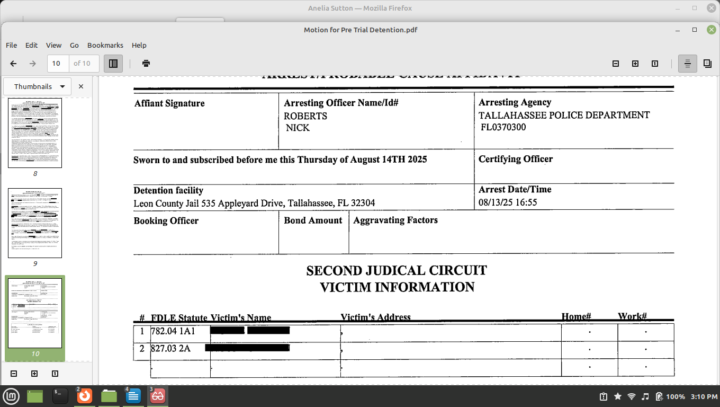
Okay, from the beginning of the "lure/entrapment/kidnapping," I saw Fraudulent intent. The ELEMENTS of Mens Rea & Actus Reus were apparent in the initial CONTACT the officer made with my daughter: "To DETAIN/ARREST/Kidnap and TRAFFIC her, (the 'alleged' defendant). The ARRESTING OFFICER: 1. Committed a Crime-he intentionally lured her to the Police Station with the promise of Benevolent Funds available for pickup. Knowing there were no funds, he thought (Mens Rea-guilty mind)up the scenario when she to comes into the precinct. Once there, he says "there is no victim Compensation" you're under arrest for the M of your Son. 2. Then he proceeds to Actus Reus, meaning he intended to cause my daughter harm by using the Reid Interrogation-that uses both Coercion and Deception as part of the Reid Technique. Maximization: Through the interview, the interrogator firmly asserts the suspect’s guilt and ignores any claims of innocence. Minimization: after making it clear that claims of innocence won’t be believed, the interrogator downplays the seriousness of the offense, offering opportunities for the suspect to explain why she committed the crime...I just want to hear your side of the story. - Everyone makes mistakes. But it’s important that you man up and tell the truth. - I’m trying to help you. - But I can’t help you if you don’t talk to me. It is my opinion the ARRESTING OFFICER was in the COMMISSION of a Crime from the first moment of contact using FRAUDULENT means. And more importantly the PC/Affidavit IS NOT A SWORN ONE! (I declare under penalty of perjury that the foregoing is true and correct. (28 U.S.C. 1746). Executed on (Date) (Signature) https://mande.net/media/2019/06/WYSU.13th.posters.jpg FRAUD vitiates everything it touches United States v Throckmorton 98 U.S. 61, 66, (1878)
1 like • Oct '25
Look up the The fraudulent concealment doctrine allows a plaintiff to toll, or pause, the statute of limitations for a claim when a defendant has actively and intentionally hidden facts that would have put the plaintiff on notice of the cause of action. To prove fraudulent concealment, a plaintiff must show the defendant had a duty to disclose, suppressed a material fact with the intent to defraud, and that the plaintiff was unaware of the fact and would have acted differently if they had known it, suffering damages as a result. This doctrine originated as an equitable remedy and has been applied in various legal contexts, including contract disputes and federal statutes like the Clayton Act. [1, 2, 3, 4, 5, 6, 7] Elements of Fraudulent Concealment To establish fraudulent concealment, a plaintiff generally must prove: [2, 4, 5] 1. Concealment of a Material Fact: The defendant hid a fact that was significant to the case. [5, 7, 8] 2. Duty to Disclose: The defendant had a legal obligation to disclose this fact. [5, 9] 3. Knowledge of the Fact: The defendant knew about the material fact they concealed. [2] 4. Intent to Defraud: The defendant concealed the fact with the deliberate purpose of misleading the plaintiff. [2, 9] 5. Lack of Plaintiff's Knowledge: The plaintiff was unaware of the fact and would have acted differently if it were known. [5, 9] 6. Resulting Damage: The plaintiff suffered harm or loss because of the concealment. [4, 5, 10] Application of the Doctrine • Tolling the Statute of Limitations: This is the most common application, where the statute of limitations for filing a lawsuit is extended until the plaintiff discovers, or reasonably should have discovered, the concealed facts. [1, 8] • Duty of Disclosure: The doctrine typically requires that the defendant had a duty to disclose the hidden fact, which can arise from a fiduciary relationship, a contract, or a relationship where one party has superior knowledge. [2, 4, 5, 11, 12, 13, 14]
Oct '25 •
Part 5: Justice Restored
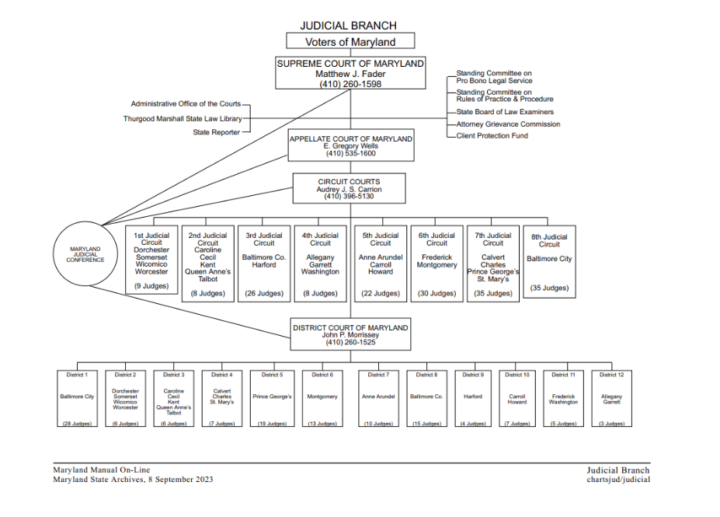
There is a hierarchy in the justice system—yet you are at the top. Look at the image. It's a typical organizational chart for the courts. I say typical because it varies from state to state. The point is for you to see with your own eyes that you are literally in charge of your court case. You sit at the top as one of “We the People.” Courts disguise this power using colorable titles. For example, Maryland’s chart says “Voters of Maryland.” Don’t focus on the title. Focus on the position. It’s the position that matters and you are at the very top. You are literally above the governor, the highest state public official! I used this exact truth to kill a warrant in traffic court. How? A single handwritten page torn from a spiral notebook, addressed to the judge. The header was “Legal Notice.” Remember: a notice doesn’t ask. It informs. On that paper, I wrote that I was tired of the matter being open and I wanted to close it now. I attached a copy of Maryland’s organizational chart. That moment broke my fear. Once I saw the truth and acted on it, it was over for them. Knowledge is power. But it only matters if you use it. Don’t just collect it like a bone collector of knowledge. I can tell who knows their power and who doesn’t. - Those who know show up ready to discuss, strategize, and share solutions. - Those who don’t show up only to complain, recite violations, or wait for a savior. I can only provide you with knowledge and tools. But in the end, you have to save yourself. Knowledge is power but applied knowledge is the way. Apply it to your case. Not as a beggar, but from the position of authority. HOMEWORK Part A: Search: [Your State] state organizational chart Part B: Add the name of the state, the title you see on the top of the chart, and the link to your state’s chart in the comments!!! If this post resonated, turn in the homework link. Next, hit the ❤️ LIKE button and comment justice restored as a new comment.
2 likes • Oct '25
https://www.leg.state.nv.us/Division/Research/Publications/Directory/StateOrgChart.pdf
2 likes • Oct '25
Justice restored!
Sep '25 •
Part 4: Justice Restored
You have to use quiet diplomacy to defeat the corrupt AND you have to prosecute judges. Quiet diplomacy DISARMS AND DISRUPTS all manners of corruption with claims. A claim is not a complaint. Complaints are for immature people who need to request assistance from big government. You are the highest authority of your court. Submit a claim. A claim is a lawful demand made by a private woman or man who has reached the age of legal competency of 18. You win by holding them accountable to their own "code" by enforcing your own jurisdiction. Once you are standing on holding them accountable, remain standing. No one is above the law so stick to it and don’t budge. It lets them know the jig is up. Speak with authority where the goal is to catch them by surprise because they’re not expecting you to be composed and unbothered. They believe they will get away with their violations forever. Show them that is no longer the case and their reign has ended. If you enjoy this post, hit the LIKE button and comment justice restored.

2 likes • Sep '25
Justice restored!
Sep '25 •
Part 3: Justice Restored
The public officials have sold us out to the highest bidder. They have partnered with Big Oil, Big Media, and Big Pharma. The sad state of government corruption goes all the way back to ancient days when the Pharisees walked the earth. The other sad part of our plight is that most people accepts the fraudulent system because the fraudulent system is all they know. The truth is extremely jarring so they reject it. The court officials use our ignorance of the law against us. It is a disturbing truth. Another disturbing truth about most attorneys is that they pass around paint-by-number defense briefs because clients are just numbers to them. The most experienced attorney with the longest practice is the worst offender because they have made even more connections with court officials. However, simply test them against the law and even the most egotistical attorney is no match for you. And when they harm you, the consequences must be fast and severe to discourage the offender. That's how you stop violators who violate. If you enjoy this post, hit the LIKE button and comment justice restored.

1 like • Sep '25
Justice restored!
1-10 of 11

@keyonnia-floyd-5184
Ready to win ! And flip the game legal education is the key.
Active 56d ago
Joined Sep 2, 2025
Powered by