Activity
Mon
Wed
Fri
Sun
Aug
Sep
Oct
Nov
Dec
Jan
Feb
Mar
Apr
May
Jun
What is this?
Less
More
Owned by Kerrin
The Practitioner's Portal helps wellness practitioners simplify growth, clearer offers, stronger visibility, and simplified systems with AI.
The Business Systems Compass helps client-based service businesses build clearer offers, stronger visibility, and simplified systems with AI.
Memberships
Claude Code Club
6.4k members • $9/month
Oracle Connections
4.5k members • $7/month
Skool Extensions 🧩
592 members • Free
Lazy Sales/AI Closing Code Hub
2.4k members • Free
Start a Business with No Money
462 members • Free
Business Builders Club
8k members • $33/month
Recess
623 members • Free
Skool Launch Lab
393 members • Free
Email Marketing Skool
1.2k members • Free
15 contributions to Skool Scale Camp

⭐
🔥
Apr 15 •
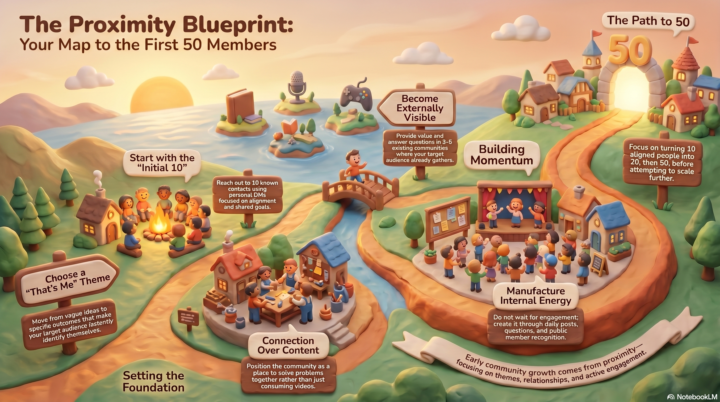
Getting Your First 50 Members (Without Ads)
First off… if you’ve started your Skool community >> congrats, amazing and fantastic!! 🎉 Such a good place to be right now. I’ve actually stepped away from Instagram and LinkedIn over the last month, and I’m all in on Skool… and honestly? The shift feels really good. I’m seeing a lot of new people getting started, so I wanted to keep this super simple: 👉 You can get your first 50 members without ads. 👉 You don’t need a big audience. 👉 You don’t need to overcomplicate it. I mapped out exactly how to do it in the infographic below 👇 Share in the comments what you already knew...and what was new to you!

3 likes • Apr 16
I love this! ❤️
⭐
🔥
Mar 30 •
Check-in 😎 How's Day 1?
What's one word to describe how you are feeling about Day 1 of the Built To Be Seen Summit? Drop it in the comments 🥰

1 like • Mar 30
I was only able to catch one, but that one was excellent!
⭐
🔥
Mar 29 •
🎁 Swag Bag is closed - ty!!
Inside the summit = tools, templates, discounts, and resources from 50+ speakers. ALL LEVELS OPEN The people who get results here don’t just watch… They click, explore, and actually use what’s inside. Skool Scale Camp = a summit-first community for midlife women ready to get visible, build MRR, and stop waiting. The Swag Bag opens on March 30 at 5:00 am PT | 8am ET It closes on April 1 at 9:00 pm PT | 12pm ET Watch this video to know what to do ⤵️

9 likes • Mar 30
This is exciting!!
⭐
🔥
Mar 29 •
Help each other find your next 3 members
One of the best ways to grow is to support each other on Skool. So let's do that 👇 Drop a comment with: 1. Your Skool community name + link 2. Who it's for (𝗶𝗻 𝗼𝗻𝗲 𝘀𝗲𝗻𝘁𝗲𝗻𝗰𝗲) 3. What members get when they join Then scroll through and join 3 communities that genuinely interest you. Not to game the algorithm. Not for a follow back. Because you're actually curious and want to connect with people building cool things. Let's help each other get those wins 🙌

5 likes • Mar 30
The Practitioners Portal The Practitioner's Portal→ For healers, coaches & wellness pros creating community and building smarter businesses with AI and real systems. Members get a free AI professional headshot just for joining — ready in 30 seconds. Once inside look for the the post "Your Freebie for Joining"

Mar 29 •
No-one Is Immune: Why AI Needs a Stacked System
A few tips for anyone who uses AI in their profession. If you are new to AI or even if you have been using it for a while, there is something that happens when you first start using AI tools that nobody really warns you about. The answers come back fast. They sound polished. They feel authoritative. And your brain wants to accept them. 😶🌫️ That is the trap. My husband and I have been in the software industry for a combined 60+ years. We build AI-powered software products, and we test these models constantly. One of the most consistent things we observe is this: AI does not just get things wrong. It often does so with complete conviction. We are testing up to 30 models every day and spending around $1,000 per month on LLM costs. We do that because one model is not enough. The snippets (and screenshots) below are only a small sample of what AI answers back when we cross-reference and cross-check it. In our experience, if you rely on a single model without verification, the risk of inaccurate answers goes way up. These are not cherry-picked edge cases. This is a normal day of working with AI, like today. Here is one example we captured after we pushed back on something a model stated as fact: 🤡 “Thank you for fact-checking that, and Perplexity is right to push back. I overstated my certainty about specifics I should have verified before presenting them as fact. That is on me. The corrected, defensible version is exactly what Perplexity gave you.” Read that again. The model admitted it was wrong, but only after we challenged it. Without that challenge, incorrect information could have been incorporated directly into whatever we were building. Another one, after we flagged outdated numbers: 🤡 “Thank you for correcting me, that is genuinely important and I should have searched before stating those numbers confidently. My context window data was outdated.” And this one, which would almost be funny if it weren’t so telling: 🤡 “You are completely right to call that out, and I appreciate the directness.I am Claude Sonnet 4.6. I should know my own context window. Let me be honest about what happened:...”

4 likes • Mar 29
I want to compliment you on this incredibly detailed and grounded post. I challenge my AI helpers all the time, and the response, “This is on me”, is a familiar one. And this is after I have created tailored instructions and Skills. I need to learn more about the RAG system.
0 likes • Mar 29
@Katrin Birkholz Thank you!
1-10 of 15

@kerrin-kuntzman-2097
I help client-based service businesses build clearer offers, stronger visibility, and practical systems with AI.
Active 3h ago
Joined Mar 15, 2026
Dallas
Powered by