Activity
Mon
Wed
Fri
Sun
Aug
Sep
Oct
Nov
Dec
Jan
Feb
Mar
Apr
May
Jun
What is this?
Less
More
Memberships
Ideorix - AI Writing & Editing
156 members • $15/month
AI Pro Writers Studio
95 members • Free
Story Hacker AI
1.6k members • $67/month
The Argovale Lore Guild
351 members • Free
Story Hacker STARTER
7.6k members • $7
42 contributions to AI Pro Writers Studio

13h •
Welcome to New Members!
Welcome all new folks to the Professional Writing System, Help with Writing whether you use AI or not and the support Channel for WordCrafter.Pro, very shortly adding BookWeaver, and PlotCrafter (squashing bugs) If you are reading this and not here for WordCRafter.Pro that's cool too. We are a community of writers who use AI to help write stories that are meaningful and real (or so we hope). My goal for everyone here is to be productive, successful, and prolific in your writing. No matter how you want to write. We are here to help! So a big welcome for: And apologies for the delay..... @J P @Ebone Holmes @James Ford @Jacob Perry @Abdullah Muhammad @Laguna Oasis @Liora Vale @Kimmy Miller @Haider Chattha Welcome to the Room!!


🔥
3 likes • 13h
Hey there and welcome! @J P @Ebone Holmes @James Ford @Jacob Perry @Abdullah Muhammad @Laguna Oasis @Liora Vale @Kimmy Miller @Haider Chattha
1d •
Marketing Monday
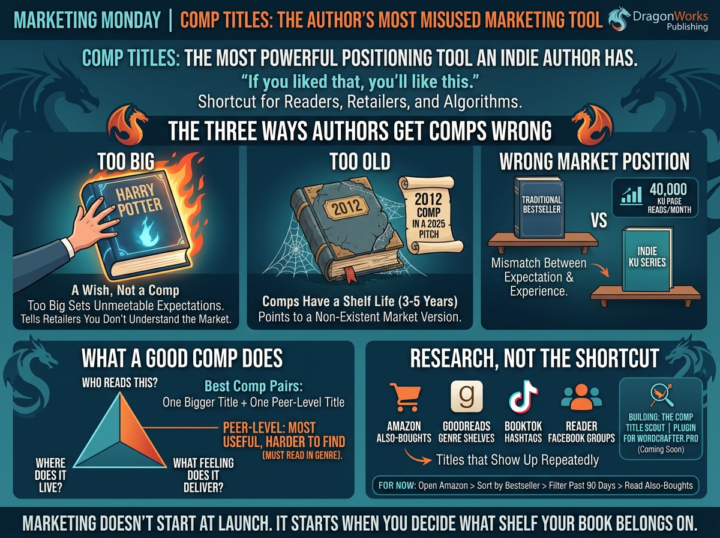
Comp Titles: The Author's Most Misused Marketing Tool Comp titles are the most powerful positioning tool an indie author has. They're also the one most authors get completely wrong. A comp title tells a reader, a retailer, and an algorithm: "If you liked that, you'll like this." It's a shortcut that bypasses the need to explain your entire book. Done right, a comp title does more marketing work than a blurb. Done wrong, it makes you invisible at best and actively misleading at worst. The Three Ways Authors Get Comps Wrong Using titles that are too big. "It's like Harry Potter but for adults" is not a comp. It's a wish. Harry Potter is one of the best-selling series in publishing history. Comparing yourself to it doesn't tell a reader where to shelve you. It tells a retailer you don't understand the market. Comps work by setting specific expectations. A title that big sets expectations no debut or mid-list author can meet. Using titles that are too old. Comp titles have a shelf life. Most industry guidance puts it at three to five years for a useful comp. If your target reader discovered your comp title in college and graduated a decade ago, that comp is pointing at a version of the market that no longer exists. Readers change. Genres evolve. A 2012 comp in a 2025 pitch is a red flag. Using titles from the wrong market position. A traditionally published bestseller and an indie series with 40,000 Kindle Unlimited page reads per month are in different market positions even if they share a genre. Comping up too far creates a mismatch between the expectation you set and the experience you deliver. What a Good Comp Does A good comp title answers three questions simultaneously: Who reads this? Where does it live on the shelf? What feeling does it deliver? The best comp pairs are one slightly bigger title for brand recognition and one peer-level title for precise positioning. Something a reader would recognize, and something a reader in that community is actively talking about right now.
🔥
3 likes • 20h
Great info, thanks
4d •
Question for the Lurkers....
you joined for a reason? What are we not doing here to get you to join in on the conversation? Happy to have you keep watching, I just feel like I'm not helping you if I don't know what your needs are? Give a shout, ask a question, throw out an idea. I'm noodling on ideas to get people more involved and see what you need that I/we can provide.

🔥
7 likes • 4d
Im 50/50....sometimes I am all over the boards, sometimes I just hit likes😁
7d •
Sigh... Rules change
Thanks to two warnings from a new user - Whose initials *might* be Sandra Rose I've raised the floor on Direct MEssaging to level 3. Glad to have you if you need help or want to help others here, and if your offer is of legitimate value to our users then cool post it for all. But please do not directly contact folks with offers. You must engage and move to level 3 to send DM's now.

🔥
3 likes • 7d
@Dashawn Byron that’s weird, when I looked I thought you were at level 2…..eyes playing tricks…..well hopefully for anyone else, it will be easy too😁
🔥
3 likes • 7d
@Dashawn Byron 😆😆🤦♂️ thanks, I do feel better now
11d •
Fabulous Fridays and the Customer Journey
I was reading a post on another site about the customer journey in sales and had some thoughts on how we as authors can use this to out advantage. ****** The Map Your Reader Takes Before They Buy Your Book Most authors think marketing is about getting in front of people. It's not. Or — it's not just that. Marketing is about understanding where someone is in their relationship with your book, and meeting them there. Get that wrong and you're spending money talking to people who aren't ready to hear you. Get it right and every dollar, every post, every email does exactly what it's supposed to do. The framework that changed how I think about this is called the customer journey — and once you see it, you can't unsee it. What the Customer Journey Actually Is The customer journey is the path a complete stranger takes to become a reader, and then hopefully a fan. It has stages. Not everyone is at the same stage. And the biggest mistake authors make with advertising is treating everyone like they're already at the end. Here's how the stages break down for a book author: Awareness — They don't know you exist yet. They've never heard your name, never seen your cover, never stumbled across your title. You are not on their radar at all. Discovery — Something catches their eye. A BookTok video. A Facebook ad with a hook that lands. A recommendation from a friend. An Amazon also-bought. They know you exist now, but they don't know if they care yet. Consideration — They're looking closer. They read your blurb. They check your reviews. They click through to your author page. They're asking: is this worth my time and money? Conversion — They buy. They download the sample. They add it to their TBR. The transaction happens. Retention — They read it. They finish it. They feel something. Now the question is whether you've given them somewhere to go next — another book, a newsletter, a community, a series. Advocacy — They tell someone. They leave a review. They post about it. They become part of your marketing machine without you asking them to.

🔥
3 likes • 11d
Well done, words to think by
1-10 of 42

🔥
@kenny-funk-7375
My name is Kenny and I love the art of storytelling. I enjoy stories mostly in the fantasy & sci fi genres, but I won't limit myself with just those.
Active 2h ago
Joined May 8, 2026
Pennsylvania
Powered by