Activity
Mon
Wed
Fri
Sun
Aug
Sep
Oct
Nov
Dec
Jan
Feb
Mar
Apr
May
Jun
What is this?
Less
More
Memberships
AI Automation Club
7.5k members • Free
Do Better Business
98 members • Free
Merkle Entrepreneurs
2.6k members • Free
Business Ownership Academy
1.3k members • Free
AI Automation Simplita.ai
77 members • Free
AI Workshop Lite
27.7k members • Free
AutomationForDays
300 members • Free
AI Automation Flow
570 members • Free
AI Automation Agency PH
2.9k members • Free
38 contributions to AutomationForDays

Apr 1 •
AI Automation & Chatbot Development for Smarter Businesses
More businesses today are looking for smarter ways to automate communication, improve customer experience, and streamline their daily operations. One of the most effective ways to do this is by combining AI with workflow automation. With tools like Make.com, Zapier, and n8n, it’s possible to build intelligent chatbot systems that can handle many tasks automatically. For example, these systems can: Automatically respond to customer inquiries Route messages to the correct department Trigger workflows across multiple apps Capture and organize leads Improve response time for customers When AI is added, the chatbot becomes much more capable. Instead of simple scripted replies, it can understand questions, generate helpful responses, and handle repetitive communication without human intervention. The real goal is simple. Reduce manual work while creating faster and smarter interactions for customers. AI automation is quickly becoming a core part of modern business operations rather than just an optional tool.
Mar 28 •
How AI and Automation Are Changing Business Operations
More businesses are beginning to realize that AI is not just about chatbots or content generation. The real value appears when AI is connected to automation and integrated directly into daily operations. Instead of teams spending hours searching for information or repeating the same tasks, AI systems can now handle large parts of that work automatically. Some of the most useful implementations I keep seeing include AI chat systems that handle customer conversations, internal knowledge assistants that allow teams to search company information instantly, and workflow automations that connect multiple business tools together. Another interesting development is the use of retrieval based knowledge systems where AI can access internal documents and provide accurate answers instead of generic responses. When these systems are connected to automation platforms the impact becomes much bigger. Tasks that used to require several manual steps can run automatically in the background. This combination of AI and automation is slowly changing how businesses operate. Teams spend less time on repetitive work and more time focusing on decisions growth and strategy. Companies that understand how to connect these technologies properly are building much more efficient systems than traditional manual processes.
4
0
Mar 28 •
Using n8n and AI for Real Estate Prospecting Automation
Today I was looking at an interesting use case for n8n in the real estate and construction space. Many companies in these industries rely heavily on manual research and prospecting. Teams spend hours searching for property data identifying potential projects and organizing information from different sources. This is exactly where automation can make a big difference. With n8n and AI integrations it becomes possible to build workflows that collect data analyze opportunities and organize prospects automatically. Instead of manually researching leads the system can gather information process it and send structured insights directly to the team. Another common task is cleaning up existing automations. As workflows grow over time they can become messy or inefficient. Rebuilding them with proper logic error handling and better structure can significantly improve reliability. The combination of workflow automation and AI makes it possible to turn repetitive research tasks into scalable systems that run in the background. For industries like real estate and construction where information gathering is constant this kind of automation can save a huge amount of time and improve how prospecting is done.
4
0
Mar 24 •
Launching a Story Driven Content Brand
Today I was reviewing a project focused on launching a storytelling based social media brand. The concept revolves around creating a strong narrative series centered on a female character whose life journey includes faith growth healing and personal transformation. The story naturally incorporates elements like prayer church and her relationship with the Heavenly Father Yahuah and his son Yahshua. What makes projects like this interesting is that success does not come from one viral video. It comes from consistency storytelling quality and emotional connection with the audience. The first phase of the project focuses on building the foundation. Locking in the storytelling style Refining the visual direction and pacing Testing how the audience responds to the early episodes Making adjustments based on engagement and feedback For brand new pages the early weeks are usually focused on consistency and building the content library. As the audience begins to connect with the story engagement starts growing and new opportunities appear. Over time this type of storytelling content can expand into multiple paths including collaborations affiliate partnerships digital products and extended story series. Another important part of the launch is creating a clear introduction to the brand so new viewers understand the purpose of the series and know where to follow the journey. When done well storytelling content like this can grow into a powerful long term brand rather than just a social media page.
Mar 23 •
AI-Powered WhatsApp Auto-Reply System (Automation Complete)
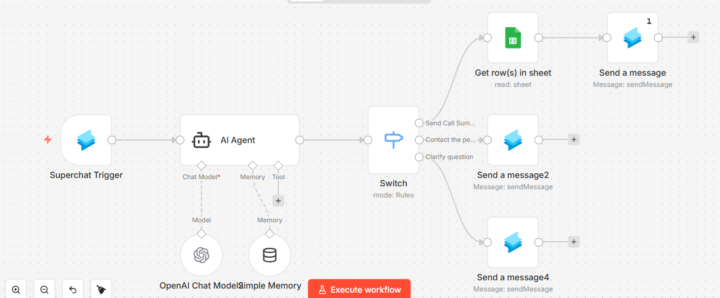
AI-Powered WhatsApp Auto-Reply System (Automation Complete) Just finished building an automation that turns WhatsApp into an intelligent AI assistant. Here’s how the system works: A new message comes in through WhatsApp → The automation instantly detects it → The message is analyzed using ChatGPT as the AI brain → The system decides the correct response → The reply is automatically sent back to the user through Superchat. No manual replies. No delayed responses. The system can respond instantly, 24/7. This type of automation is powerful for businesses that receive a lot of WhatsApp messages from customers and need fast, consistent responses without hiring extra support staff. It can be used for: • Customer support • Lead qualification • Sending call summaries • Answering frequently asked questions • Routing complex questions to a human agent Instead of businesses spending hours replying to the same messages, the AI handles the first layer of communication automatically. Another example of how AI + automation can turn simple messaging into a smart business system. #automation, #aiautomation, #whatsappautomation, #n8n, #chatgpt, #businessautomation, #workflowautomation, #automationexpert, #aiagents, #openai, #digitalautomation, #nocodeautomation, #automateyourbusiness, #automationworkflow, #techautomation, #aiintegration, #automationdeveloper, #smartworkflows, #futureofwork, #productivityautomation
2
0
1-10 of 38

@kenechukwu-johnplanus-9988
I am a freelancer. I am on a hunt to get all the necessary experience I need to take my business to the next leve
Active 3d ago
Joined Dec 10, 2025