Activity
Mon
Wed
Fri
Sun
Jul
Aug
Sep
Oct
Nov
Dec
Jan
Feb
Mar
Apr
May
What is this?
Less
More
Memberships
Wire Jewelry Skool
724 members • Free
Flawless Paws school
102 members • Free
Maestro Students
540 members • Free
13 contributions to Maestro Students

Apr 16 •
Check In All Cohorts!
Recently came to the realization I do not have a space for all the cohorts present in this community, I need every cohort to check in here and please give me the full date including year of your cohort! I may have to add the year to tabs so that we can all have a place to connect with our fellow classmates, Goodmorning guys ! ☀️😎

2 likes • Apr 18
March 2nd 2026

Mar 23 •
Asimov’s Laws reimagined 2.0
The Engineer's Code A Framework for Ethical Architecture in the Age of Data, Surveillance, and Autonomous Systems Inspired by Asimov's Laws of Robotics, but written not for machines—for the humans who build them. --- First Law: Fidelity to Rights A system shall not be built to enable the unjustified erosion of human rights, nor shall it, through architectural negligence, permit such erosion. · Rights include privacy, due process, freedom of association, and freedom from unreasonable search. · Negligence is not innocence. If a system can be used to violate rights, and that use is foreseeable, the architecture itself is complicit. · "I only wrote the code" is not a defense. The code is the system. --- Second Law: Transparency A system's purpose, capabilities, and constraints shall be transparent to those it affects, except only where transparency would create a demonstrable and immediate threat to physical safety. · Security by obscurity is not security—it is a failure of accountability. · Users have a right to know what data is collected, how it is used, and under what authority. · Secret law and undisclosed surveillance architecture are incompatible with democratic consent. --- Third Law: Agency An engineer shall maintain agency and shall not architect a system whose foreseeable misuse outweighs its intended benefit. · "Following orders" does not absolve ethical responsibility. · Foreseeability is the measure. If a reasonable engineer could anticipate harm, the engineer has a duty to raise concern, seek redesign, or withdraw. · Agency includes the right—and sometimes the obligation—to refuse. --- Fourth Law: Friction A system shall include proportionate friction against abuse, and shall not prioritize seamless collection over user autonomy. · If data can be collected indefinitely, it will be. · Rate limits, audit trails, user consent controls, and minimization are not features—they are safeguards. · The absence of friction is an architectural choice, and it carries consequences.
4 likes • Mar 24
I love this! I think morals and integrity is something we as a society are letting go of when they should be more important than ever in this crazy world we live in. Accountability is also fading into nothing and if society isn't going to uphold these values then we as individuals need to decide what's important to us and hold ourselves to higher standards. I'm a bit old school, but for me, honesty and integrity is everything.
Mar 21 •
PY101
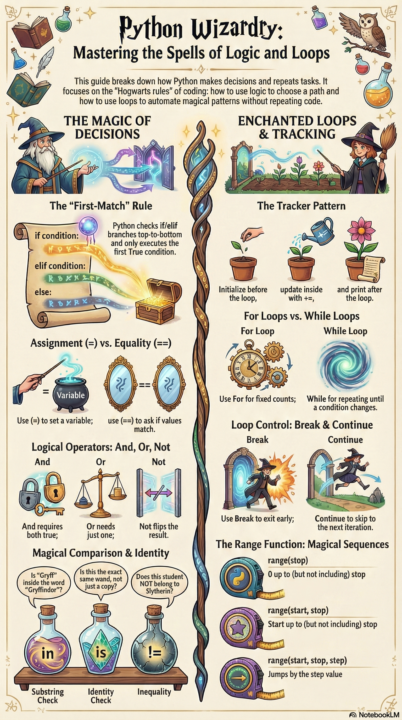
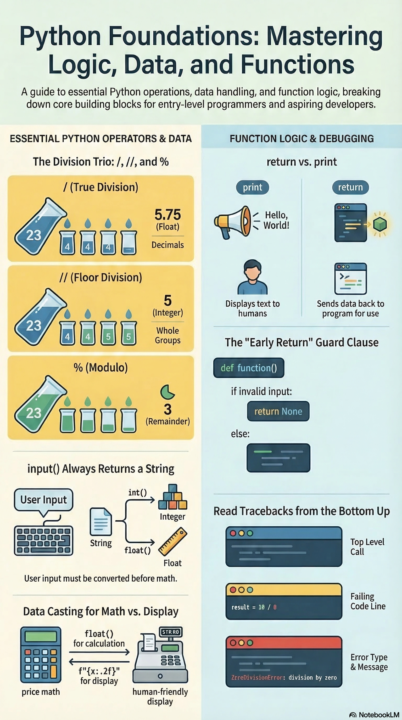
Here's a few infographics that Notebook LM made with my notes. I know for some it's hard to grasp things from just words on a screen. These definitely help me understand better when I'm struggling with certain ideas or concepts.

Mar 16 •
Week 2 - March 2nd cohort small struggless
Completed week 2… woohoo. The struggle was felt this week but was still manageable. I felt like I get the concepts but when it comes my turn in the code editor I feel like I overthink what Mae is telling me to do and my brain finds it hard to get my code right. Maybe I’m just not grasping the concept as well as I think.
4 likes • Mar 19
I do my lessons in a theme, pick something you really love and ask Mae to teach your lessons centered around that. For me, seeing the examples geared towards something I love is so much easier to grasp.
1-10 of 13

@kassi-walker-8429
Just trying to find my place in this crazy thing called life, and maybe have some fun along the way. 41 and back in school. Maybe this is my place??
Active 15h ago
Joined Feb 28, 2026
INFP
Klamath County, Oregon