Activity
Mon
Wed
Fri
Sun
Nov
Dec
Jan
Feb
Mar
Apr
May
Jun
Jul
Aug
Sep
Oct
What is this?
Less
More
13 contributions to Hungarian Global Folk Network

Mar 11 •
Hot Recommendations?
What’s everyone listening to now that’s new, good, hot - or maybe old but has captured your ear again? I’m really into Muhely Banda’s new CD, Vagjunk Bele. On Apple Music it’s https://music.apple.com/ca/artist/m%C5%B1hely-banda/1872092711, on Spotify at https://open.spotify.com/album/0VDks0fhVKtBGZSm7SBl6G?si=8HqlmU3eQfeWKjoyJ-pVBg . They are out of Marosvasarhely, one of the violinists is Kicsi (Bartis Zoltan) who’s been to Canada before. My favorite song is “FriciGeza fantazia”, about halfway through after the friss there is a halgato which is dynamite.
0 likes • Mar 20
@Lecsó Miklós Great recommendation, I will check it out - I saw King Ferus play about 25 years ago in Queens!
1 like • Jun 27
@Andrew Komaromy not lame at all, good music is good music!!!!
Mar 11 •
Tanchaz Dance Etiquette Revisited
In an April 2012 article in FolkMagazin which has recently been making its rounds on Facebook, there was a transcription of a Transylvanian villager from Korond talking about how dancing to live music happened in village dance halls. I think it’s a wonderful and important reminder of what I perceive to be somewhat of a lost art of dancing to live music (whether or not there are microphones involved). I would like to see Tanchaz dancers adopt “back” to these customs and traditions, because they make so much sense, including from the perspective of a musician, but also in terms of community and the development of dancers. The most important take-away points, I think, are that the dancers in the room should move/circulate; no one is “entitled” to be in front of the band the whole time; depending on where you are, who you’re in front of, and who you’re dancing with your style/approach should adjust; and the contact/relationship with the musicians is critical. THOUGHTS, COMMENTS? “In the dance hall, the dancing did not stay in one place — the dancer did not stand still and dance in a fixed spot — but rather the dancing community, that crowd, swirled from left to right. It was very crowded, yet everyone found their own place, and the dancers never knocked into one another, they were so careful…. Now, as the dance went around the room like this, the couples danced differently in different parts of the hall, because dancing in front of the band was quite different — there you had to show your musical ability in front of the musicians. And let me stop here! The musicians would actually call out to a truly fine dancing couple, to a good dancing lad: ‘Don’t move on, stay here, there’s a cup of wine for you!’ — because it was easier to play music after a good dancing lad, since his rhythm was sure, his musicality was sure; the musician watched him and then played very confidently and effortlessly. When the couple moved on from there, this section — the part near the musicians, moving to the left — was typically where the men stood, and here you had to dance seriously, in a manly way, you had to show that you were a lad, and not just any lad. So here the men expected to see that their son had good posture, was solidly built, and not someone who would fall on his backside for any reason….
1 like • Jun 27
@Andrew Komaromy yes great idea, maybe we can make announcements in the future, great idea!!!!
Jun 16 •
Important Reminder About Our Neighbors!!!
Here is a quote from Zoltan Kodaly re-posted a few hours ago by folkMAGazin, a reminder about how getting to know our neighbors’ music being an important step in knowing our own. This applies to dancing as well, and all cultural treasures of the Carpathian Basin and beyond. It’s something that I didn’t find that important when I was 18 years old but now at the age of 52 realize how crucial it truly is! Translation: “What is Hungarian in music cannot even be determined without a thorough knowledge of the music of the surrounding peoples; otherwise we may fall into the gravest errors… Therefore, first and foremost, we need to become acquainted with our neighbors so that we may see the boundaries of our Hungarianness as clearly as possible. But it is also worthwhile to know them for their own sake. Every people has created its own distinctive forms of beauty; in each we find something that does not exist in others. Thus we can only be enriched by it. Finally, nothing characterizes a people as much as its language and its music. No one can say that we have come to know our neighbors sufficiently so far. Only good can come from striving to see and understand them better through their music as well.” (Zoltán Kodály: “Neighboring Peoples” [after 1942]) – István Pávai: Zoltán Kodály, the Ethnomusicologist (folkMAGazin 2008/3)

Apr 28 •
RIP Ferenc “Feri” Sebo
Ferenc “Feri” Sebő has passed away. For those in the Tanchaz movement, we will know him as my mentor Bela Halmos’ first kontra player, and namesake of the Tanchaz Movement’s first-ever band. But more than that, he became a composer, a conveyor of the past and what is possible in the future, and a champion and mentor to many musicians, dancers, singers, and folklore lovers. His death comes as a sudden shock, as just 2 days ago he was on the stage at the Tanchaztalalkozo in Budapest giving some remarks about our Transylvanian music and song hero Zoltan Kallos. Many people have given very classy and loving remarks about Feri’s passing, but here is one from a surprising source, Budapest’s Mayor Gergely Karacsony (not a usual “folk-ky”), which I thought to share: “How will we “Sebő” from now on? Only the very greatest have their names turned into verbs: at first it was meant as a stigma, then it became a badge of pride, because the action derived from Ferenc Sebő’s name came to mean singing, dancing, poetry, tradition, and community-building. To “Sebő” is happiness, to “Sebő” is value, to “Sebő” is, in the noblest sense of the word, Hungarian. For as Ferenc Sebő said: “Our Hungarianness is a linguistic and cultural community, and that is what we must protect.” Few have protected it better than he did; today, that “revolution” he launched by creating the táncház movement has even become part of the world’s cultural heritage. “It wasn’t a big thing,” he said: “our method was really just that we loved it very much—and that drew many people to us.” It drew me in too, and many others; we owe him so much for having been able to live it through him. For we know from him—and his extraordinary life’s work proves it—that “tradition is not something to be preserved, for it is not sick; not something to be guarded, for it is not a prisoner; our traditions can only survive if we live them.” We do right if we never stop “Sebőing”—with him, with his voice, his music, his sung poems—but now without him. May Ferenc Sebő rest in peace.”
1
0
2 likes • Apr 27
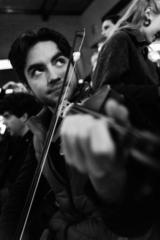
Very cool! My classical violin teacher is long deceased, but perhaps he is rolling in his grave reviewing this bow-hold technique! But for Csangalo and Szaszcsavas, it works!!! The first way he shows it, is the way he usually holds it, but when he does the grip with his index finger out, that’s what he does when he’s “tired”. Very interesting!!!!
1-10 of 13
