Activity
Mon
Wed
Fri
Sun
Nov
Dec
Jan
Feb
Mar
Apr
May
Jun
Jul
Aug
Sep
Oct
What is this?
Less
More
Closed to new members
29
Free
The Atelier Sewing Hub
66
Free
zaneteknits
2.3k
Free
Sound More French
529
Free
The Sound More French Café
120
5.0
$37/m
5 contributions to The Atelier Sewing Hub

Aug 18 •
We had a spammer in the group ..
Apologies, we had someone upselling to other member sin our wee sewing group. They've been removed, thank you for making me aware and if anything else like this happens again, please just drop me a comment/message, as I take this seriously. Happy Tuesday everyone, I'm about to go around a few charity shops looking for some sewing bits... I always get some great surprises I wasn't looking for, especially looking for old cotton/linen table clothes with super cute embroidery on them! Would make great blouse upcycle project. What are everyone else's sewing plans this week?


2 likes • Aug 18
Aah, I did wonder, I was going to report them but completely forgot 😅
Jul 24 •
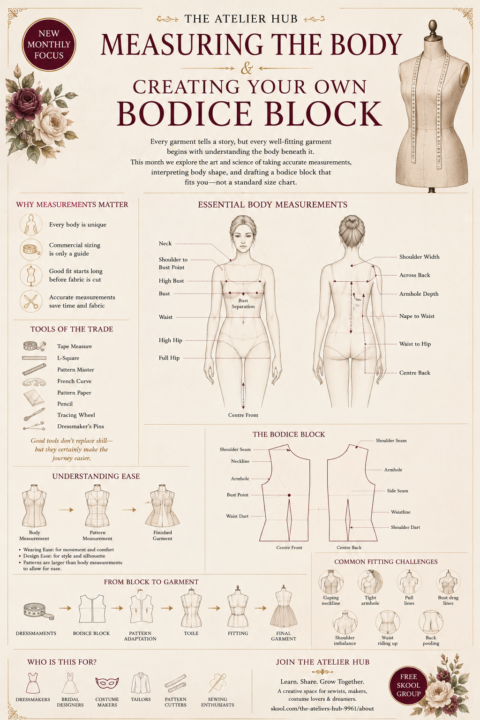
📏 Measuring the Female Body – The Foundation of Every Well-Fitting Garment
Before we draft a single pattern or cut into beautiful fabric, we need to start with the most important tool in dressmaking... Accurate body measurements. Whether you're making garments for yourself or for clients, every great fit begins with understanding the unique proportions of the body. Commercial patterns are drafted to standard measurements, but very few of us fit neatly into one size. Learning to measure correctly allows us to create garments that are comfortable, balanced and beautifully fitted. A few tips before you begin: 🪡 Wear close-fitting clothing or well-fitting underwear. 📏 Stand naturally, tall and straight. 🤝 If possible, ask someone to help with back measurements for greater accuracy. 🪞 Always measure in front of a mirror. 🎀 Tie a narrow piece of elastic around your natural waist. This creates a fixed reference point and makes vertical measurements much more consistent. 📐 Keep the tape measure level around the body and snug, but never tight. It should rest against the body without compressing it. 📝 Record your measurements immediately and always use the same units throughout your drafting. Remember... Our bodies change over time, and that's perfectly normal. Weight fluctuations, posture, muscle development and even different undergarments can all affect your measurements. It's good practice to measure again before starting a new project rather than relying on old notes. Most importantly, measure the body you have today, not the body you hope to have tomorrow. A well-fitting garment is made for the person standing in front of you, and that's where beautiful dressmaking begins. Let's chat! 📏 Have you ever taken your own body measurements before? 📏 Which measurement do you find the trickiest to take accurately? 📏 Do you measure yourself, or do you have someone who helps? 📏 Have you ever discovered that your commercial pattern size was completely different from your actual measurements? Share your experiences below, we all learn from one another, and your tips might help another member who's just beginning their measuring journey.

1 like • Jul 24
@Debra Verrall I never knew that! Learn something new every day...
Jul 18 •
Vintage Wedding Dress Turned Into Modern Bodice
We're discussing bodices this season, so here we are, a live project I'm working on for a customer. The customer asked for her mum's wedding dress to be made into a top for her to wear any time as sadly her mum has passed now, it's bringing a memory back to life 🫶 one of my favourite types of projects. The vintage wedding dress had to be washed 3 times before I took it apart, then I could start the lace manipulation onto the bodice. The fabric souring was the hardest part of this project, to match it to the yellow/gold tone of the lace, and for the client to feel comfortable as she was very sensory to fabrics. Wanting a tight fit but feel soft.. Take a watch and if you have any questions, please drop them in the comments!

1 like • Jul 18
Wow, that's looking really lovely - you are talented 🙂
Jul 14 •
What's On - Measuring The Female Body & Making A Body Block
We're stepping into one of the most valuable skills any dressmaker, pattern cutter or garment maker can learn: understanding the body and creating a bodice block that truly fits. No matter what you love to sew—everyday clothing, bridal wear, historical costume, tailoring or couture—it all begins with a solid foundation. And that foundation isn't fabric or thread... it's understanding the person you're creating for. Throughout these sessions, we'll explore how to take accurate body measurements, interpret those measurements, and use them to draft a personalised bodice block. A bodice block (sometimes called a sloper) is a simple, close-fitting pattern that represents the unique proportions of the body. It isn't a finished design, but it is the starting point for countless garments. Once you have a well-fitting block, you can adapt it into dresses, blouses, jackets, bodices and so much more. Along the way, we'll be discussing topics such as: 📏 How to take accurate body measurements 📐 Understanding balance, posture and body shape 🪡 Drafting a personalised bodice block ✏️ Common fitting challenges and how to identify them 👗 Turning a basic block into your own garment designs ✨ Why commercial patterns don't fit everyone—and how to make them work for you One of the most rewarding parts of learning pattern cutting is that it changes the way you see clothing. Instead of simply following instructions, you begin to understand why a garment fits, how seams create shape, and where adjustments make the biggest difference. Whether you've been sewing for decades or you're just beginning your dressmaking journey, these skills will help you build confidence and create garments that fit better, feel better and reflect your own creativity. We'd love to hear from you! 📏 Have you ever drafted your own bodice block? 📏 Do you usually rely on commercial patterns, or have you experimented with pattern drafting? 📏 What's the biggest fitting challenge you've experienced when making clothes?
2 likes • Jul 14
I have always used a commercial pattern - I have a pattern somewhere I bought 2 years ago to make a blouse. I have the thread, the buttons and the material. It will be the first item I have made for at least 30 years, but it has been packed away somewhere and I can't find it! 😥😥
Jun 25 •
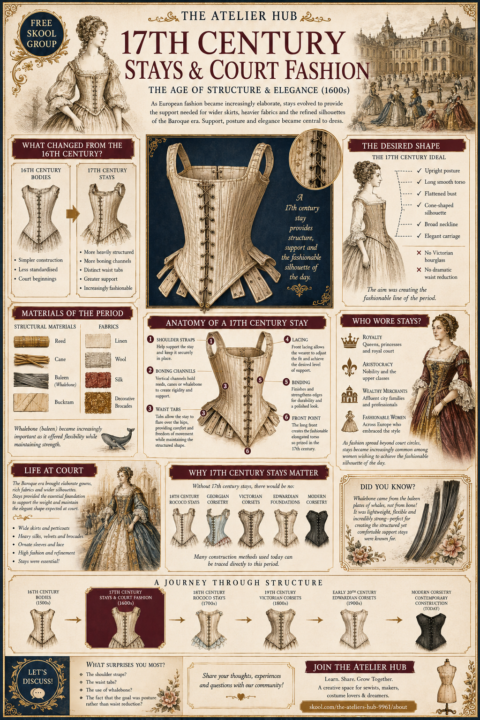
🪡 17th Century Stays, Corsets & Court Fashion 🪡
As we continue our journey through the history of corsetry, we arrive at a fascinating period where structure, elegance and craftsmanship became increasingly intertwined. By the 17th century, the earlier "pair of bodies" had evolved into what we now recognise as stays. These garments were becoming more refined, more structured and increasingly important to fashionable dress throughout Europe. One of the most common misconceptions about historical corsetry is that it was always about creating a tiny waist. In reality, the fashionable silhouette of the 1600s was very different. The goal was a long, smooth torso, upright posture and a cone-shaped silhouette that supported the elaborate gowns of the Baroque period. Rather than emphasising curves, stays helped create a controlled and elegant line beneath clothing. The construction itself was becoming increasingly sophisticated. Makers used materials such as: 🌿 Reed 🌿 Cane 🌿 Buckram 🐋 Baleen (commonly known as whalebone) 🪡 Linen 🪡 Wool 🪡 Silk and decorative brocades One particularly important development was the growing use of baleen. Despite its name, whalebone wasn't actually bone at all. It was a flexible material taken from the baleen plates of whales, offering the perfect balance between strength and movement. This made it ideal for creating the support required by increasingly elaborate garments. The 17th century also saw the widespread use of features we still associate with corsetry today: ✨ Boning channels ✨ Lacing systems ✨ Structured shaping ✨ Waist tabs for movement ✨ Reinforced construction techniques For anyone interested in historical costume, dressmaking, tailoring or couture, studying stays offers valuable insight into how garments achieve shape and support. Many techniques used in modern corsetry can trace their origins directly back to this period. As makers, it's easy to focus on the outer garment, but these hidden foundations are often where the real engineering takes place. I'd love to hear from you:
1 like • Jun 25
Yes, I always thought corsets were for tiny waists too... Lol 😂 You learn something new every day 🌞
1-5 of 5
@joy-green-3817
Living in France with hubby for 4 years & have 2 Jack Russell pups
I hand knit, machine knit, crochet & cross stitch. Trying to improve my French 🙂
Active 3h ago
Joined Jun 14, 2026
Prissac