Activity
Mon
Wed
Fri
Sun
Nov
Dec
Jan
Feb
Mar
Apr
May
Jun
Jul
Aug
Sep
Oct
What is this?
Less
More
How to Spot a Liar
11
$5/m
The Black Archive
12
$3/m
23 contributions to The Black Archive
Jul 15 •
Murder at Heath House
The mystery begins long before Simon Dale’s death. In his mind, Heath House was never merely a sprawling country mansion. He believed it concealed something older and stranger beneath its Georgian skin. As an architect, he became convinced the building preserved fragments of a medieval hall, perhaps even a site with connections to the Arthurian world that had increasingly consumed his imagination. Friends regarded the theories with varying degrees of affection and scepticism, but for Dale the house was a puzzle whose answers lay beneath floorboards, behind panelling and inside forgotten archives. Heath House was not simply where he lived; it had become his life’s unfinished argument. Against that romantic backdrop unfolded a family dispute of astonishing bitterness. Dale’s marriage to Baroness Susan de Stempel had ended, but the house remained the battleground. Ownership was contested, correspondence grew increasingly hostile and neighbours became accustomed to stories of arguments, accusations and legal manoeuvres. It was the sort of domestic conflict that seems peculiarly English: outwardly civil, inwardly corrosive, capable of lasting for years. When Dale was murdered in September 1987, the investigation naturally focused on those closest to that dispute. The subsequent trial brought moments that seemed almost too theatrical for fiction. Susan de Stempel cultivated an air of impatience towards the police investigation, often appearing openly dismissive of detectives’ conclusions. Her evidence from the witness box was equally striking, punctuated at one point by the exclamation, “Bollocks,” a moment that briefly cut through the solemnity of the proceedings. She also remarked that, at the time Simon Dale was killed, she had been at home watching an episode of Miss Marple. Yet, for all courtroom drama, the prosecution ultimately failed to persuade the jury beyond reasonable doubt, and Susan de Stempel was acquitted. Simon Dale’s murder remains officially unsolved.


1 like • Jul 15
Suede used to live on a street named for Susan's great-great grandfather. That's my hot take. She seems like a bit of a bad egg.
Jul 9 •
Noseybonk
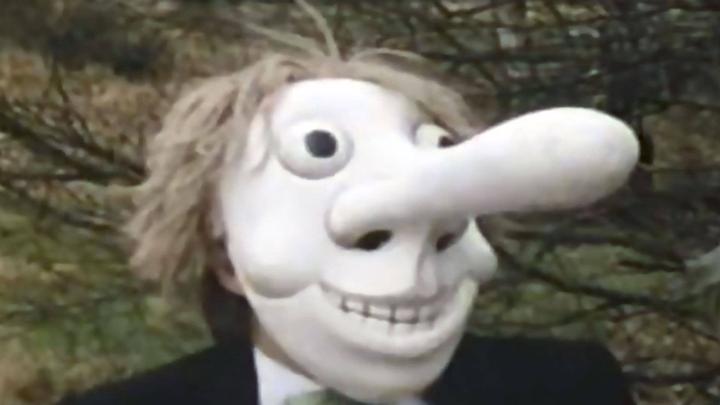
Mr Noseybonk belongs to that peculiarly British cabinet of televised horrors: not monsters designed to frighten, but those perfectly well-meaning creations that somehow slipped through a crack in the national psyche. He arrived courtesy of Jigsaw, a programme devoted to games, puzzles and gentle education, yet moved through it with the unnerving confidence of something that had wandered in from an altogether darker production. His costume was simplicity itself: dinner jacket, white gloves, an alabaster mask fixed in a grotesque rictus, and that extraordinary nose, jutting forward like a baleful compass needle. He never spoke. He never needed to. Silence can be infinitely more eloquent than menace. There is something profoundly unsettling about a figure whose only apparent motivation is boundless, wordless delight. He materialised in parks, shopping precincts and village greens with the inevitability of bad weather, observing the world through expressionless eyes while that impossible grin remained forever unchanged. Janet Ellis seemed unconcerned, but then she’s made of sterner stuff than most. What lingers is not terror in the conventional sense, but the uncanny. British children’s television once possessed an enviable confidence that young audiences could withstand oddness, melancholy and the occasional brush with the macabre. Nobody convened focus groups to determine whether Noseybonk might haunt impressionable minds. He was simply accepted as another eccentric visitor, as much a fixture of the landscape as milk floats, red telephone boxes or the Shipping Forecast. Perhaps that explains his remarkable afterlife. He endures not because he was overtly horrific, but because he resisted explanation. Like some smiling relic unearthed from the back room of a forgotten museum, he occupies that delicious territory where nostalgia shades imperceptibly into dread. We remember him with laughter, certainly—but there remains the faint, irrational temptation to glance over one’s shoulder, just in case that white face and grotesque smile are waiting patiently beyond the hedge, while he assembles an improvised nosegay.
2 likes • Jul 12
Has Henry met Noseybonk? I'd like his hot take.
1 like • Jul 14
@Edward Higgins Jesus Christie! *blesses self*
Jul 2 •
And Called It Macaroni…
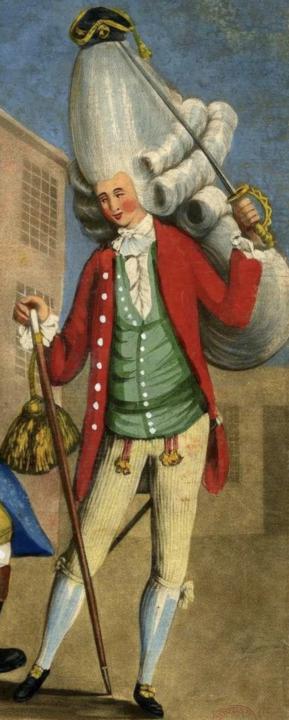
There are few spectacles more delightfully absurd than the Macaroni. In the bustling streets of Georgian London, where powdered wigs already strained the limits of good judgement, these fashionable gentlemen somehow contrived to go further. Their hair rose skyward in elaborate constructions, their coats shimmered with embroidery, and their tiny hats appeared to have landed by accident upon mountains of carefully arranged curls. And the duelling swords that they routinely wore were delicate to point of uselessness—and used only for removing their hats. Evidently, these were ponces, not fighters. The name itself hinted at foreign adventures. Having returned from the Grand Tour, these young men embraced continental tastes with evangelical enthusiasm, adopting Italian refinements that struck many of their countrymen as hopelessly extravagant. To admirers, they represented sophistication; to satirists, they were irresistible prey. Their reputation travelled far beyond Britain. During the American Revolutionary War, British officers are thought to have mocked colonial militiamen by singing Yankee Doodle. One verse jeers that a man ‘stuck a feather in his cap and called it macaroni’—the implication being that simply adding a feather was a laughably poor attempt at achieving the dazzling, over-the-top elegance of a true Macaroni. In one of history’s neat reversals, the American troops embraced the song instead, turning the joke into a badge of pride. Back in piss-taking London, caricaturists sharpened their pens, playwrights rolled their eyes, and pamphleteers wondered aloud whether Britain had exchanged sturdy common sense for silk stockings and scented powder. Yet beneath the towering wigs and embroidered coats lurked deeper questions about masculinity, wealth, patriotism and the unsettling influence of foreign ideas. Every age invents its own peacocks. The Georgians simply did it with more lace, more powder and considerably greater theatrical flair. Mind you, the little hats were clearly excellent. (Pretty much how all hats look on me!)
1 like • Jul 3
The Black Archive has a broad scope. A lot of this was taken from MY quarterly pamphlet, "Little Hat Review". I drew all the hats myself, with NO help.
Jun 28 •
The Bad Service Man
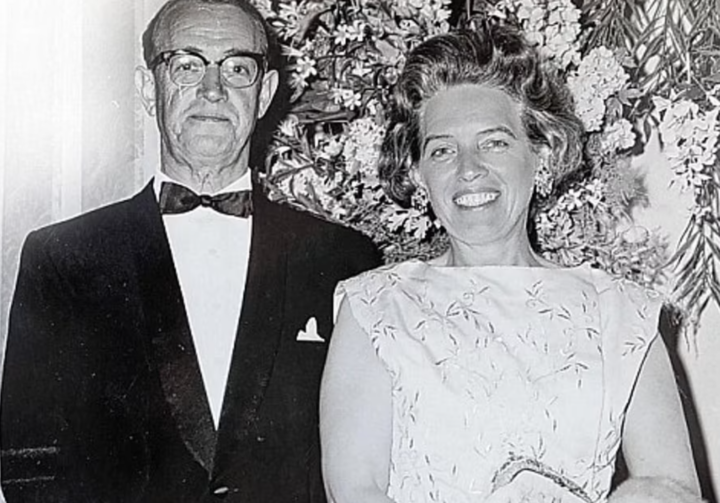
Donald Sinclair, former proprietor of the Hotel Gleneagles in Torquay, was the unwitting inspiration for Basil Fawlty – the irascible protagonist of the hugely-successful BBC comedy series Fawlty Towers. Before the Second World War rolled around, Sinclair was an officer in the Royal Naval Reserve – and, consequently, in 1939, he was called up for military service. His naval career was dramatic. Sinclair was first assigned to the HMS Salopian, a converted cargo liner that had been armed and converted into a warship. On the 13th of May 1941, the ship was attacked by a German U-boat and torpedoed four times. Despite the Salopian’s engines being knocked out, Sinclair and his shipmates fought on – engaging the enemy in a gun battle when the submarine surfaced. When the German submariners finally gave up the fight and retreated back to the depths, a fifth torpedo ripped through the Salopian, breaking her in half. Sinclair, clinging to the wreckage, was picked up by the HMS Impulsive the next morning. Two months later, Sinclair joined the crew of the infantry landing ship HMS Karanja – to take part in the impossibly butch-sounding military mission ‘Operation Ironclad’ – the British invasion of Vichy French-controlled Madagascar. Once again, Sinclair’s boat was taken out with him still on it – this time the engine room was hit by two bombs from a German Fokker, which caused it to blow up and sink. Finally, Sinclair served on the escort carrier HMS Trumpeter, assigned to take part in the slightly less cool-sounding ‘Operation Zipper’ – a mission to assist in the recapture of British Malaya. However, by the time they reached the Far East in July 1945, the war had all-but ended, and the mission was abandoned. During a period of extended leave in 1940, Sinclair had travelled back to the UK to marry Beatrice Ritchie – the daughter of an Aberdeenshire policeman, who worked as a fashion consultant and designer at a department store. To avoid the constant bombing of Glasgow, whose factories and shipyards made it a major enemy target, Beatrice came south to the more tranquil environs of Torquay, a popular tourist resort on the Devonshire coast, where she initially resided with an aunt.
2 likes • Jun 29
Well, that's excellent.
Jun 25 •
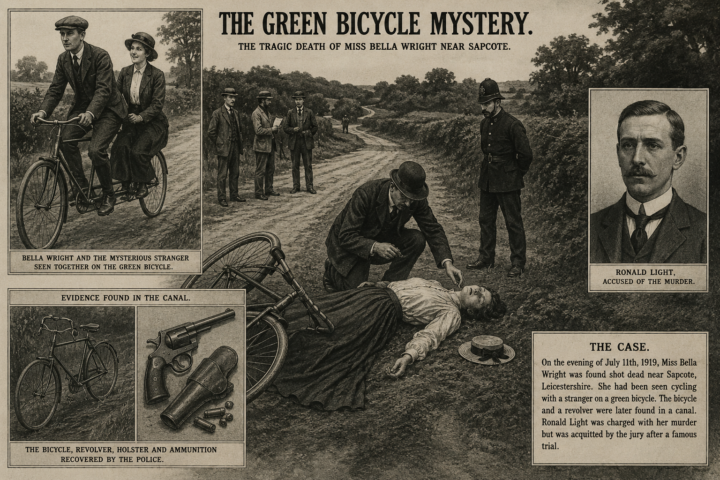
The Green Bicycle Case
The only thing anyone could agree upon was the bicycle. It was green. On a warm July evening in 1919, twenty-one-year-old Bella Wright set off along the quiet lanes of rural Leicestershire. She was seen smiling as she cycled beside a well-dressed stranger on an unusually coloured green bicycle. They chatted as they rode through the villages, attracting just enough attention for several witnesses to remember them. It was the last time Bella was seen alive. A farmer discovered her lying beside the ancient Roman road known as the Via Devana. At first glance, it appeared she had simply fallen from her bicycle. Then somebody noticed the tiny wound beneath her eye. Bella had been shot through the face with a revolver. One neat, devastating bullet. No weapon. No obvious motive. No witnesses to the moment she died. The stranger had vanished. For weeks, newspapers appealed for the mysterious cyclist to come forward. Nothing. Until police dredged a canal. There, beneath the murky water, they found a dismantled green bicycle. Nearby lay a revolver holster and ammunition. The bicycle belonged to Ronald Light, a former army officer and mathematics teacher who had quietly filed away its identifying numbers before throwing it into the canal. When questioned, Light lied. Then he changed his story. Finally, confronted with witness after witness, he admitted he had indeed spent the evening cycling with Bella. But he insisted he had left her alive. He denied pulling the trigger and, remarkably, no one could prove otherwise. His defence was conducted by the legendary barrister Sir Edward Marshall Hall, who performed what many still regard as one of the greatest courtroom defences in British history. Hall did not have to prove his client innocent. He merely had to point to the holes in the prosecution’s case. Where was the motive? Why would a man murder a complete stranger in broad daylight? Could the shot have been an accident? A stray bullet? A tragic misadventure? The jury acquitted Ronald Light after little more than three hours.
1 like • Jun 26
Ronald got off "Light"ly. Chortle. I've got tears in my eyes...
1-10 of 23

Active 91d ago
Joined May 11, 2026