Activity
Mon
Wed
Fri
Sun
Sep
Oct
Nov
Dec
Jan
Feb
Mar
Apr
May
Jun
Jul
What is this?
Less
More
Owned by John
Independent peptide research, education, and discussion. Built with Stack Tracker and supported by n1 Aminos for verified research supply.
Memberships
n1 Wellness
12 members • Free
The Peptide Tactical Playbook
926 members • Free
P
PeptideproPH
149 members • Free
Longevity and Biohacking Labs
217 members • Free
Biohacking Elite
319 members • Free
Peptide Association Community
1.1k members • Free
Longevity Lab
800 members • Free
BIOHACKING | TONY HUGE
4.3k members • Free
Biohackers Buyers Club
376 members • Free
6 contributions to KRISTINA’S PEPTIDE JUNKIES 24
5d •
Anaphylaxis to a Compound I've Used Before. Here's the Breakdown.
What an acute reaction actually looks like, and why "I've used this before" doesn't protect you *PSA: The dog GIF is actually funny because I was literally home alone with my 2 dogs.. who would not have properly executed CPR 🙄* I want to write this one up properly, because I had an experience this week that I've spent years telling other people to watch for, and it still caught me off guard when it happened to me. If you inject anything, peptides or otherwise, this is worth ten minutes of your time. WHAT HAPPENED 25mg of NAD+, subcutaneous. That is a low dose by any standard. I pushed it fast, which I now think was a contributing factor but not the whole story. Seven to ten minutes later, in this order: my mouth started watering in that specific way that comes right before you get sick, and I went clammy. Then nausea, indigestion, and hiccups. Then abdominal cramping that was, by a wide margin, the worst part of the whole thing. Somewhere in there my ears started itching. The detail that made me take it seriously was that it came in waves. Not one peak that built and faded, which is what a flush reaction does. It would ease off, then roll back in, minutes apart. That cycling means mediator release is still active rather than resolving, and it is a very different animal from a niacin-style flush. I took nothing for it. It settled on its own over a couple of hours, and I thought I was through it. Then hives appeared after I had already improved. That is a biphasic reaction, and it is the single most important thing in this entire post, so I am going to come back to it. The hives have since resolved. I gathered my thoughts for this post sitting at Labcorp getting an acute tryptase level drawn, with an order for a baseline draw on a symptom-free day, and I have a prescription for epinephrine in hand. I do not have answers yet. I have a plan, which is more than I had this morning. WHAT IS ACTUALLY HAPPENING IN AN ACUTE REACTION Mast cells are immune cells that live in the tissues where your body meets the outside world. Skin, gut lining, and airways are packed densely around blood vessels and nerves. What makes them different from most immune cells is that they are preloaded. They hold granules full of ready-made inflammatory mediators, so when they fire, there is no synthesis delay. It is not a response being built. It is a warehouse being emptied.

Feb 28 •
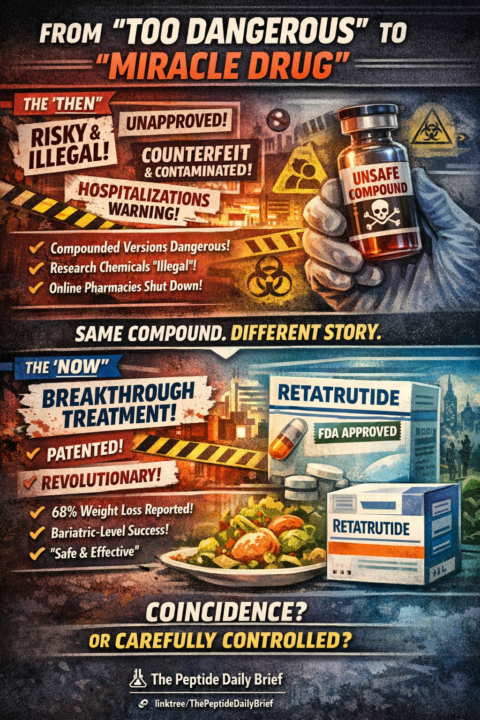
🚨 BREAKING: The “Too Dangerous” Molecule Is About to Become a Miracle 🚨
They said it was risky. They said it was illegal. They said it was counterfeit, contaminated, reckless, life-threatening. Now? They’re preparing to patent it, brand it, and call it revolutionary. 🧬 The Data They’re Celebrating Eli Lilly’s Phase 3 TRIUMPH-4 data on retatrutide shows: 📉 28.7% average body-weight reduction at 68 weeks (12 mg dose) 🦵 Significant reduction in knee pain (WOMAC improvements) ❤️ Improvements in triglycerides, non-HDL cholesterol, hs-CRP, and systolic BP 🔥 ~23–24% of participants lost ≥35% body weight (bariatric-range outcomes) That’s not incremental. That’s surgical territory. And yes, tolerability issues were there: Nausea ~38–43% Diarrhea ~33–35% Vomiting ~20% Discontinuation rates up to ~18% New signal: dysesthesia Some participants reportedly stopped because they lost too much weight. Let that sink in. ⚖️ Now Remember the Messaging From Not Long Ago… Before commercial approval was realistic, the narrative was very different. The tone was: “Unapproved GLP-1 products are dangerous.” “Compounded versions cause hospitalizations.” “Research-use ingredients are illegal and harmful.” “Online sales = counterfeit, contamination, overdoses.” Regulators and corporate PR leaned heavily into: Counterfeit scare language Hospitalization statistics Cease-and-desist campaigns Litigation against telehealth and compounders Anything outside the branded channel? Framed as reckless. Even retatrutide as an API was explicitly warned against in FDA communications. The emotional positioning was clear: If it’s not ours, it’s unsafe. 🔄 And Now? Now the same molecule is being positioned as: Historic Breakthrough Bariatric-level Cardiometabolically transformative Soon it will likely be: Patented Exclusively distributed Marketed as the future of obesity treatment “Well tolerated and effective when used appropriately” Same compound. Different control. 🧠 The Pattern This isn’t about denying safety concerns. Large-scale human data matters.
3
0

0 likes • Aug '25
If your AOD-9604 turned into gel, it’s likely because of the pH of the reconstitution solution. AOD is super pH-sensitive — it’s usually stabilized in a slightly acidic environment (around pH 4–5). If you reconstitute it with something more neutral, like sterile water, or mix it with another peptide that has a different pH, it can crash out and turn into that thick, unusable gel. ✅ Best practice: use bacteriostatic water only, reconstitute gently, and never mix AOD in the same syringe or vial with other peptides. ❌ Once it’s gelled, don’t try to use it — the structure may be compromised. Best to discard and start fresh.

Jul '25 •
Newbie
Hi I’m new here and I look forward to meeting new friends and learning! Pleasure to meet you all!
0 likes • Jul '25
Hey, welcome to the group! 🙌 If you’re just getting started, Stack Tracker has been super helpful for a lot of us, especially when figuring out dosing early on. The calculator is free to use, and the other features really take the guesswork out of reconstitution and daily tracking. Check it out if you haven’t already! 🧬📊

1 like • Jul '25
For an 80mg vial, general educational protocols often fall in the range of 1–2mg per day, usually administered subQ. Many follow a cycle like 4–6 weeks on, 2–3 weeks off. 💡 Tips/Tricks (for educational purposes only): - Reconstitute with 2–4mL of BAC water for clean math. - Rotate injection sites to avoid irritation. - Keep it refrigerated after reconstitution. - Let the powder dissolve naturally — don’t shake it hard. Anecdotally, people report improved joint mobility, faster recovery, less inflammation, and better soft tissue healing. But as always, results vary, and this is strictly for research and educational purposes only. If you want help calculating dose-to-unit conversions, Stack Tracker has a free calculator to guide you.
1-6 of 6
@john-bastiat-1751
John | The Peptide Daily Brief — Powered by Stack Tracker - research peptide insights, protocol vault & exclusive deals. No hype, just research.
Active 8h ago
Joined Jul 19, 2025
Powered by