Activity
Mon
Wed
Fri
Sun
Oct
Nov
Dec
Jan
Feb
Mar
Apr
May
Jun
Jul
Aug
What is this?
Less
More
Powerhouse Fitness for Women
24.6k members • Free
Orion Peptides
371 members • Free
Peptide of The Week Community
15.7k members • Free
5 contributions to Orion Peptides

Jun 2 •
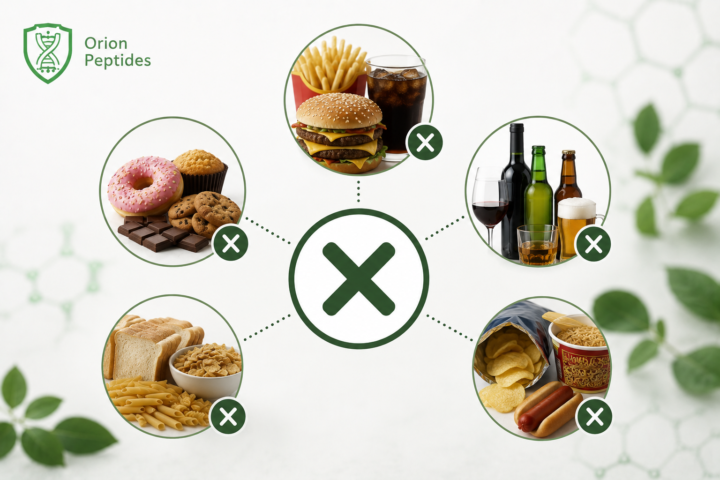
5 Types of Food to Avoid on R3TA & Other GLPs (For Better Results & Less Issues)
I cannot do what I do without the support of Orion Peptides, whose continued backing helps make this educational content possible. Use code Parker15 for 15% off. GLP-based compounds such as SEMA, TIRZE, and R3TA significantly change how the digestive system functions. One of the most important effects is delayed gastric emptying, meaning food remains in the stomach for longer periods of time. This is one of the key reasons these compounds can improve appetite control and support fat loss outcomes. However, it also explains why certain foods suddenly become much harder to tolerate. If someone is experiencing nausea, bloating, reflux, sulfur burps, or general stomach discomfort, diet is often a major contributing factor. Below are five food categories that commonly worsen side effects and reduce overall comfort and consistency. 1. High-Fat Greasy Foods This is one of the most commonly reported triggers of discomfort. Examples include: • fried foods • burgers • pizza • creamy sauces • fatty cuts of meat • fast food meals The issue is mechanical. Fat naturally slows digestion. GLPs also slow digestion. When combined, gastric emptying becomes significantly delayed. This can lead to: • nausea • bloating • reflux • stomach heaviness • prolonged fullness While fats are essential for health, intake may need to be more moderate and distributed throughout the day for better tolerance. 2. Fermented Foods Fermented foods are often considered healthy in a normal diet, but they may not always be well tolerated in this context. Examples include: • kimchi • sauerkraut • kombucha • kefir • fermented pickled foods • certain aged cheeses These foods increase fermentation activity in the gut. Since GLPs slow digestion, fermentation processes have more time to develop gas and pressure inside the digestive system. This may contribute to: • bloating • sulfur burps • abdominal pressure • nausea Tolerance varies significantly between individuals.

1 like • Jun 4
Great article
Jun 1 •
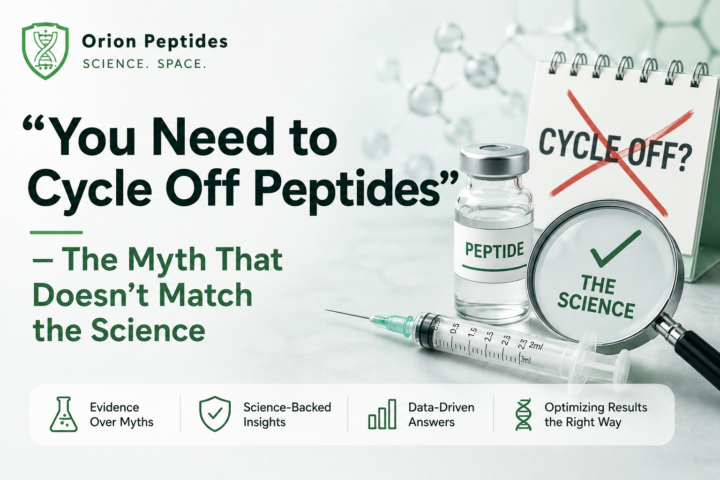
“You Need to Cycle Off Peptides” — The Myth That Doesn’t Match the Science
I cannot do what I do without the support of Orion Peptides and the educational content they help make possible. Use code Parker15 for 15% off. One of the most repeated claims in the peptide space is this: “You need to cycle off peptides.” It gets said so often that most people assume it’s established science. But when you actually look at the research, the idea doesn’t come from peptide biology at all. It comes from steroid biology. And those are two completely different systems. Where the Cycling Idea Actually Comes From Cycling makes sense in the context of anabolic steroids. When exogenous testosterone is introduced, the body detects elevated hormone levels. The pituitary reduces or shuts down natural production. That’s why steroid users cycle: • to allow endogenous hormone production to recover• to reduce long-term suppression• to manage hormonal balance So the idea of “cycling” is rooted in hormone suppression physiology. The key point: That mechanism applies to steroids, not peptides. Why Peptides Work Differently Peptides generally do not replace hormones in the body. Instead, they act as signalling molecules. They communicate with existing systems and encourage biological activity. They do not typically override endocrine production in the same way exogenous hormones do. That difference matters. GH Secretagogues: A Different Mechanism Entirely Compounds like: • CJC-1295 • Ipamorelin work by stimulating the pituitary gland to release growth hormone. They do not supply growth hormone externally. They signal your body to produce its own. Research on GH secretagogues has not shown the same type of shutdown pattern seen with exogenous hormone use. That is a fundamental distinction. Repair Peptides and Signalling Molecules Other commonly discussed peptides such as: • BPC-157 • TB-500 are studied primarily as signalling and repair-related molecules. Current research does not describe classic endocrine suppression pathways for these compounds.
1 like • Jun 1
Very informative
May 25 •
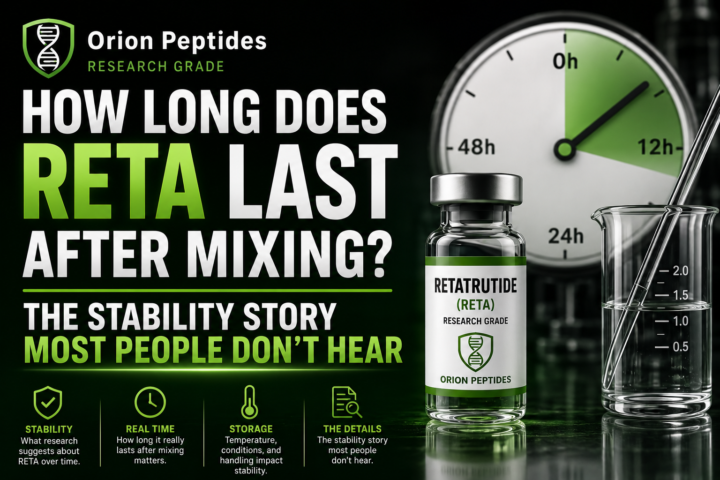
How Long Does RETA Last After Mixing? The Stability Story Most People Don’t Hear
There’s a common claim circulating in research and peptide communities that RETA should be discarded 28–30 days after reconstitution. But that number is often treated as a default safety guideline, not a strict biochemical expiration point. When you look at peptide stability data more closely, the picture becomes more nuanced. The 30-Day Rule: Where It Comes From The “30-day discard” recommendation is typically based on: - sterility risk over time - general pharmacy compounding guidelines - conservative safety assumptions - bacterial contamination potential In other words: it’s primarily a microbiological safety guideline, not a direct measure of molecular degradation What Stability Data Suggests In peptide stability research, certain compounds stored under controlled conditions have shown extended structural integrity. When stored properly (refrigerated, protected from light, and maintained in sterile conditions), some peptides have demonstrated: - minimal degradation over extended periods - retained structural integrity beyond typical discard windows - high remaining purity over time under ideal conditions In some observed stability analyses, peptides remained near baseline purity levels (around 99%) over extended refrigerated storage periods. Important note: this refers to controlled laboratory conditions, not uncontrolled or contaminated environments Why Storage Conditions Matter More Than Time Alone Peptide degradation is influenced less by time alone and more by environmental exposure. Key factors include: 1. Temperature Stability - consistent refrigeration slows degradation - temperature fluctuations accelerate instability 2. Light Exposure - UV and direct light can accelerate breakdown - opaque or dark storage conditions are preferred in research handling 3. Sterility (Most Important Factor) The most significant risk is not molecular decay — it is contamination. bacterial contamination is the fastest way to render a solution unusable
0 likes • May 26
Where do you store the unreconstituted bottles? I have done dark cupboard and also a fridge.
May 25 •
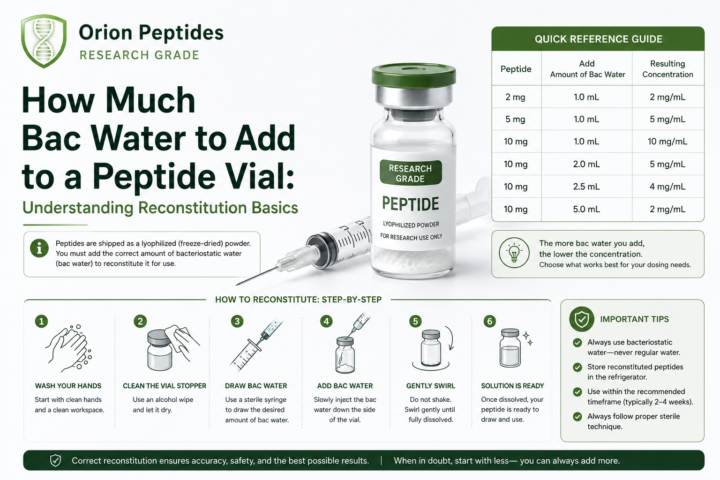
How Much Bac Water to Add to a Peptide Vial: Understanding Reconstitution Basics
One of the most common points of confusion in peptide preparation is how much bacteriostatic water (“bac water”) to add to a vial. While it looks complicated at first, the system becomes very simple once you understand the relationship between mass (mg) and volume (mL). This is strictly an educational breakdown of reconstitution principles used in research discussions. The Core Concept: It’s All About Concentration Reconstitution is not about a universal fixed amount of water — it’s about creating a usable concentration. Two key variables define everything: - Peptide amount (mg) = total compound in the vial - Bacteriostatic water (mL) = dilution volume Together, they create: mg per mL (concentration) This is what determines how syringe units translate into actual compound amounts. Example 1: 10 mg Vial A simple, commonly used educational ratio: - 10 mg peptide - 1 mL bac water This produces: 10 mg / 1 mL = 10 mg per mL concentration On a standard insulin syringe: - 100 units = 1 mL - 10 units = 0.1 mL So in this setup: - 10 units = 1 mg - 20 units = 2 mg - 40 units = 4 mg Example 2: 30 mg Vial Scaling the same logic: - 30 mg peptide - 3 mL bac water This also produces: 10 mg per mL concentration Meaning the syringe conversions remain identical: - 10 units = 1 mg - 20 units = 2 mg - 40 units = 4 mg The key benefit here is consistency — once the ratio is understood, the math stays linear. Why This Confuses So Many People Most confusion comes from mixing up three separate ideas: - Volume (mL or syringe units) - Total compound amount (mg) - Concentration (mg/mL) A syringe only measures: liquid volume It does not indicate how much active compound is present unless the concentration is known. Why Standard Ratios Are Used Using proportional reconstitution methods (like 1 mL per 10 mg or 3 mL per 30 mg) helps because: - calculations remain consistent - syringe measurements become predictable - interpretation is easier across different vial sizes - errors from mental math are reduced in theoretical discussions
1 like • May 25
This is a confusing factor and love this thanks
May 8 •
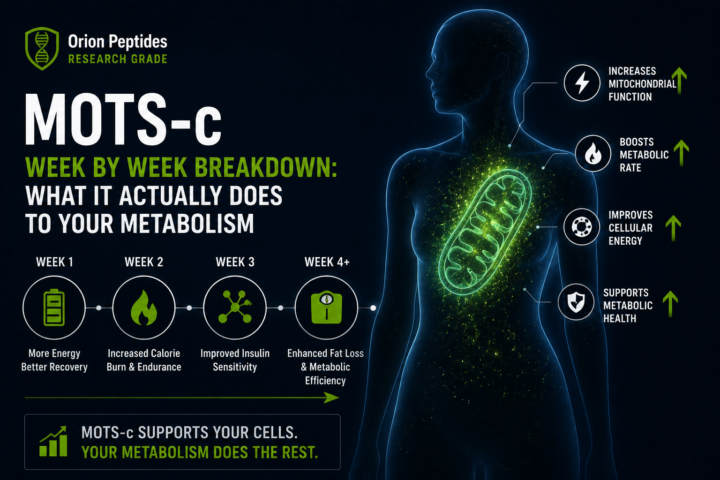
MOTS-c Week By Week Breakdown: What It Actually Does To Your Metabolism
Most people hear “fat loss” and think calories, cardio, or appetite suppression. MOTS-c doesn’t really fit that category. It’s better understood as a mitochondrial signal — one that influences how your cells communicate energy demand, stress, and adaptation. This isn’t about forcing change. It’s about shifting how your body responds to change. WEEK 1: SOMETHING FEELS DIFFERENT You may notice: - slightly more stable energy - fewer post-meal crashes - reduced cravings What’s happening: MOTS-c is associated with activation of AMPK pathways, which are central to cellular energy sensing. Your body starts becoming more efficient at recognizing energy availability and glucose handling begins to improve. WEEK 2: YOUR BODY STARTS SWITCHING FUEL You may notice: - more consistent energy through the day - less reliance on sugar - feeling lighter after eating What’s happening: Insulin sensitivity begins improving and glucose spikes may reduce. At this stage, the body starts shifting toward more flexible fuel utilization — including increased fat oxidation signaling. WEEK 3: FAT LOSS STARTS FEELING “AUTOMATIC” You may notice: - reduced appetite - less bloating - a “leaner” feeling without trying What’s happening: Mitochondrial efficiency improves and fat oxidation pathways become more active. Low-grade inflammation signaling may also begin to reduce, improving overall metabolic output. WEEK 4: YOUR METABOLISM STOPS FIGHTING YOU You may notice: - steady energy without crashes - improved training output or easier movement - clearer mental focus What’s happening: Mitochondrial function becomes more efficient at producing ATP (cellular energy), improving energy output per unit of fuel. Muscle tissue begins using energy more effectively. WEEK 5: BODY RECOMPOSITION SIGNALS You may notice: - gradual leanness without major effort - faster recovery - better physical definition What’s happening: Metabolic flexibility improves — meaning your body becomes better at switching between fuel sources (fat and glucose).
0 likes • May 11
How often should one cycle?
1-5 of 5

@jody-santoni-8306
46 year old fit female looking to age well and stay fit
Active 39d ago
Joined May 7, 2026