Activity
Mon
Wed
Fri
Sun
Oct
Nov
Dec
Jan
Feb
Mar
Apr
May
Jun
Jul
Aug
Sep
What is this?
Less
More
GTC
241 members • Free
30 contributions to GTC

Apr 27 •
SPEAKING PART 3
IELTS Speaking Part 3 Topic: Family Q. 1: Is family important in your country? Answer: Yes, in my view family is extremely important in my country. People have strong emotional ties with their family members, and they consider their family as the foundation of support, love, and guidance. Most individuals prioritise their family’s well-being over personal ambitions, and it is common for family members to help each other in difficult times. Even though modern life has made people busier, family gatherings and traditions are still valued and celebrated widely in my country and many parts of the world. Alternative Answer: Thank you for this question. Well, people in my country believe that family comes first and they put their family ahead of anything else. They would do anything for the family, and I am proud that family bonding in my country is quite strong. Q. 2: How has the size of the family changed in the last few decades in your country? Answer: Over the past few decades, the size of families in my country has significantly decreased. In the past, joint families, where multiple generations lived together under one roof, were the norm. However, with urbanisation, changing lifestyles, and economic pressures, nuclear families have become more common. People are moving to cities for jobs, and the cost of living has made it difficult to maintain large families. As a result, families today typically consist of just parents and their children, rather than extended relatives. Single-parent families - comprising of only a mom or dad and children have also increased. Alternative Answer: From my experience, I can say that my grandfather had an extended family and people at that time used to live together with close relatives. As far as I have heard, their forefathers also lived in a joint family and the number of family members was sometimes more than twenty! However, the trend of living in an extended family has changed remarkably in cities where most of the families are nuclear in nature. The villages in my country still have large families who live together but the number is shrinking day by day.
8
0
Apr 19 •
SPEAKING PART 2
Describe a major decision you have taken in your life. You should say: – What the decision was – What other choices were available to you – Why you made the decision you did And explain if you think the decision was a good one. SAMPLE RESPONSE : A really important decision I’ve made recently is to study abroad, which is the reason I’m here talking to you now. No-one from my family has ever had the chance to study abroad before. My parents were actually hoping I’d start working for our family textile business as soon as I graduate. I think it’s too soon to join the family business though. I really want to study marketing – especially fashion marketing – and English so I can sell our company products to buyers all over the world. If I study fashion marketing in the UK, I can learn how to do business in the fashion industry, which is of course very competitive and fast-moving. As for whether it was the right decision, I’m pretty confident it was and I can’t change my mind now anyway because I borrowed money from my parents to pay for my tuition. I’m going to do my best to finish my course and I will go back to my country with new ideas that will help expand our business. All I need now is to get a good score in IELTS. So, anyway, that’s an important decision in my life. Like many questions in IELTS Speaking Part 2, this one deals with an event or action in the past. There is, however, a switch to the present when the candidate is required to reflect on the decision. This IELTS candidate scores highly by: Getting straight to the point and saying what the decision was in the very first sentence Paraphrasing the topic: A really important decision Using a range of tenses – past simple, present simple and present perfect – with great accuracy Using a wide range of grammatical forms such as a conditional sentence (If I…) and a cleft sentence (All I need now is…) Signalling parts of the question: As for whether it was the right decision… Avoiding over-formality and using expressions such as actually and pretty that are appropriate to conversational style
6
0
Apr 5 •
SPEAKING PART 1
IELTS Speaking Part 1 answers should be short, natural, and direct (typically 2-4 sentences or 15-25 seconds). Use the A.R.E. method (Answer the question, Reason, Example/Details) to provide a complete response without rambling. Focus on fluency and extending answers slightly, rather than giving one-word answers or over-explaining. Where is your hometown? Answer: I’m originally from Kochi, but I’ve been living in Bangalore for the past few years. I love Bangalore, but I still miss my hometown sometimes. There’s just something about the small-town feel that I really appreciate. Analysis: This answer is clear and conversational. It establishes the speaker's background while expressing personal feelings about their hometown. The mix of contrast (Bangalore vs. Kochi) and emotional attachment adds depth. Is your hometown a big city or a small place? Answer: Kochi is a medium-sized city with a cozy atmosphere and a population of somewhere between 80,000 and 1 lakh people. Analysis: The response provides specific details about the city’s size and atmosphere, showing a balanced understanding. The use of "cozy atmosphere" adds descriptive depth. Please tell me about your hometown./ What’s your hometown like? Answer: My hometown, Kochi, is a lively and diverse city with a wonderful mix of culture, picturesque backwaters, and delectable cuisine. It’s a captivating place to live, work, and raise a family, offering both modern amenities and traditional charm. Analysis: This answer is vivid and engaging, incorporating sensory details like "picturesque backwaters" and "delectable cuisine." It highlights both cultural richness and practicality, making it well-rounded. How often do you visit your hometown? Answer: I visit my hometown occasionally, at least once or twice a year, during festivals to spend time with family and friends. I try to make it a point to return whenever possible. Analysis: The response shows personal connection and cultural significance, with specific mentions of festivals and family bonding. The phrase "try to make it a point" emphasizes effort.
9
0
Mar 30 •
SPEAKING PART 3
PART 2 Use linking words and phrases We use words and phrases to connect ideas and to express how we feel about what we are saying. We also use them to organise and manage what we are saying and to help us think about what to say next using fillers correctly to sound natural in our delivery. Try to avoid meaningless fillers [um, er, ah, eh] as they show that you cannot find the words or language needed to discuss the topic. Also, avoid repetitive use of fillers that we generally overuse [yeah, like, you know]. Depending on what you are asked, the following linking words and phrases can be used: - Sequencing - ordering information [to begin with, moving on to the next reason, secondly, thirdly, subsequently, on top of that, later, after this, finally] - Adding information [Another thing that comes to mind, also, and, besides, additionally, another good example of this is, another reason for this, and one more thing] - Indicating opinion & attitude [Unfortunately, however, actually, to be honest, definitely, essentially, frankly, basically, clearly, I'm afraid, if you ask me, sadly, thankfully, in fact, seriously, as a matter of fact] - Comparing and contrasting [Similarly, in the same way, equally, likewise, in a similar fashion, if I compare it to my country | However, although, instead of, despite, on one hand, on the other hand, in the opposite way, in contrast, whereas] - Giving examples [A great example of this is, for example, for instance, a personal example is, in other words, a striking example of this, a classic example is, a clear example of this can be seen, such as, illustrated by] - Stalling - thinking about what to say next [Let me think about that..., that's a difficult/interesting question, I haven't thought of that before, well..., actually, basically] - Generalising [Generally, broadly speaking, as a rule, on the whole, it is often said that..., in most cases, the vast majority of, a small minority of] - Result [As a result, because of this, therefore, consequently, so, then]
6
0
Mar 20 •
SPEAKING PART 3
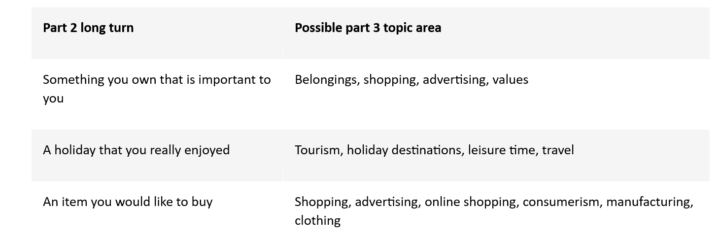
PART 1 : INTRODUCTION In part 3, you have the opportunity to discuss topic areas, related to part 2, in much more depth. This part of the test, focuses on your ability to express and justify opinions and to analyze, discuss and speculate about issues. The examiner will help you do this by asking you questions that explore the topic area in more depth. In our part 2 article, we looked at three topic areas. The long turn topic is always related to the part 3 topic area. For example, if your long turn is about your teacher, part 3 will be a general discussion about education. Look at the possible part 3 discussion areas related to the long turns you practiced in the part 2 article. ** Picture 1 SPEAK ABOUT TOPICS IN GENERAL In part 3, you are expected to discuss all topics in a general manner. If you try and talk about yourself and your family, the examiner will steer you away from these familiar topics and will encourage you to speak in a general way. Remember that you have already talked about familiar topics in part 1 and part 2. PART 3 is your chance to show the examiner that you can discuss general topics, giving your opinion and ideas on what is being discussed. Rather than talking about yourself, you can use the following phrases to extend the discussion in a more general way: - In my country most people believe that... - If I compare my country to Australia, the way we [farm/travel/work/eat/celebrate] is quite different - The local communities in my country... - Thinking about this in general, the main reason why most people... - From my perspective, if I take my country as an example... - I have seen this happen in my city and it's a major issue. To deal with this problem, we should... - There are a lot of examples of this in my country.
7
0
1-10 of 30