Activity
Mon
Wed
Fri
Sun
Aug
Sep
Oct
Nov
Dec
Jan
Feb
Mar
Apr
May
Jun
What is this?
Less
More
Memberships
3 contributions to Learn Tarot with Grant Isaac

Mar 18 •
Finally Understand These 2 Tricky Tarot Cards
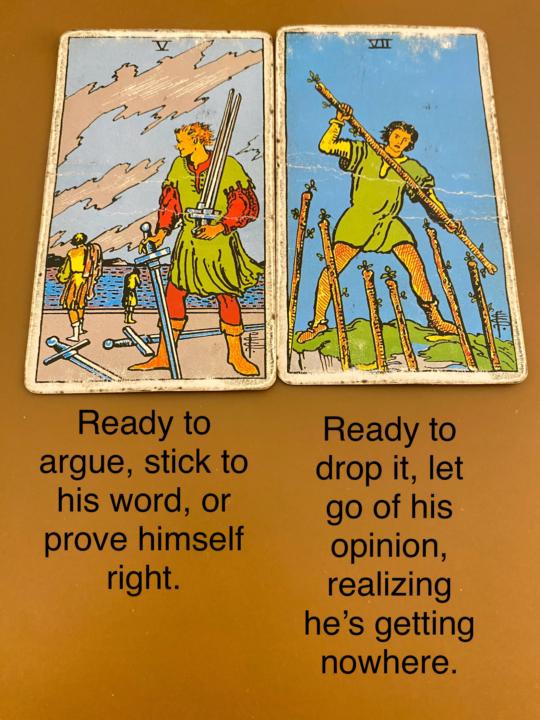
These two cards can be confusing. I will explain the difference between the two. They are basically opposites of each other. The 5 of Swords: Swords represent thoughts, ideas, and how we communicate with the spirit. This card depicts a man who has received a brilliant and exciting idea that he vows to manifest. He feels it is wise and true. And no one can talk him out of it, not with rational or reason. The two swords in the man's left hand point up to the right corner of the card. Because every card is drawn over an invisible Tree of Life, these 2 swords point to and correspond with the 2nd sefirah called Chokmah, which means wisdom. The left arm or left side of each human being aligns with the 'receiving' polarity. Therefore, this man is receiving a wise idea. He then channels this idea down to earth with his right hand, and sticks it into the ground (firm foundation/cement). He sticks to his point. Sticks to his promises or words. Others give up arguing or reasoning with him, so they drop their swords (ideas) and walk away to sulk in the sea of emotions. The 5 of Swords depicts a man who has a brilliant idea and sticks to it. He keeps his promises to himself that he will see the idea through. And he will set out to prove everyone wrong - everyone that said he was crazy or who didn't believe in him. The 7 of Wands has the opposite vibe. 7 of Wands: Wands represent opinions, beliefs, things we feel rooted in, things we have spent a lot of time learning and gaining knowledge about. The man stands over the group of wands with his large wand. This shows how he feels his opinion is better, bigger, more correct, rooted in fact and experience. Although, his words go right over their heads, and it's as if he is talking to a wall. He is growing frustrated trying to pursued and or convince the others that his way of doing things is better, and could actually end up making their lives easier. But they don't understand, no matter how hard this man tries to get them to stand under him (or understand him). He will come to the realization that it is best to simply drop it and walk away. This concept is portrayed in the card's symbolism. You see, there are 20 branches on the 7 wands. 20 is the value of the Hebrew letter Kaf, which means grip or open palm. [We see this 20/Kaf connection in the Ace of Cups and also the Ace of Swords.] The man depicted here will soon release his grip and drop his wand (opinion) and stop trying to prove himself right.
1 like • Apr 9
Can you explain the Kaf connection with the ace of cups and the ace of swords? I have been looking at this, and I just cannot figure it out. 🧐
0 likes • Apr 29
@Grant Isaac Asay thank you
Apr 11 •
Tarot Tips of the Day
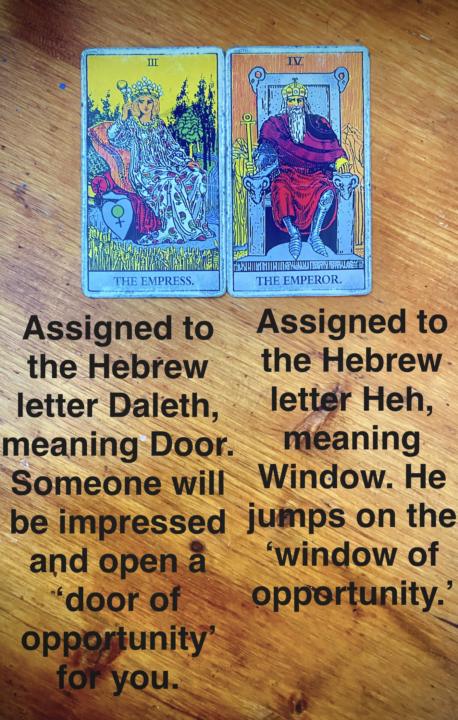
I don’t read reversals because a lot of cards have opposing energy vibes. Here’s two examples of that here:
1 like • Apr 13
@Grant Isaac Asay thank you for the explanation, and that makes more sense to me than reading reversals. If there was a different meaning, or message, the cards would show you. Simple and sensible. 📚🙏
1 like • Apr 13
@Grant Isaac Asay thank you for the further explanation. Generally, I get a full message from just three cards also and have been wondering if that really is enough or should I be pulling more. If I do need clarification, I will pull another card or two but usually 3 to 5 is also enough for me. I have tried doing large spreads, but they felt overwhelming and the message wasn’t coming together as clearly for me. But that could also be due to how new this is for me.
1 like • Apr 9
That was very interesting. I’m interested in knowing what the rest of the cards lineup to the tree of life was. Also, how do you select your cards? It would be great if the video showed you handling the cards as well. Would be great if this was written up for the spread with a little more detail. I do appreciate your different take on the cards. Do you go more in depth with your card meanings in your book?
1-3 of 3
@jiana-evans-9363
Learning tarot and building AI automations. Here for the weird overlap between the two. Colorado. Orange cat obligatory.
Active 20d ago
Joined Mar 23, 2026
Colorado Springs, Colorado