Activity
Mon
Wed
Fri
Sun
Dec
Jan
Feb
Mar
Apr
May
Jun
Jul
Aug
Sep
Oct
Nov
What is this?
Less
More
Dakoda Herbals Academy
222
Free
5 contributions to Dakoda Herbals Academy

Jul 20 •
Herbal Preparations 101: What Is an Oxymel?
Sweet, sour, and wonderfully versatile, an oxymel is a traditional preparation made by combining honey and vinegar, often with herbs infused into the mixture. The name comes from the Greek words oxys, meaning “acid” or “sharp,” and meli, meaning “honey.” Honey and vinegar preparations have appeared in Greek, Roman, and Persian medical traditions for centuries. Historical oxymels were not one standardized recipe, however. Their ingredients, proportions, and intended uses varied considerably. Why combine honey and vinegar? Each ingredient contributes something different: 🍎 Vinegar is especially useful for extracting minerals and certain water-soluble plant constituents. It is not a universal solvent, so it will not extract every constituent that alcohol, oil, or water can extract. 🍯 Honey adds sweetness, improves the flavor of bitter or pungent herbs, and has a naturally soothing quality. 🌿 Herbs allow the preparation to be tailored according to its purpose. Aromatic herbs are particularly lovely in oxymels. Depending on the herbs selected, an oxymel may be traditionally used as a soothing seasonal preparation, a digestive tonic, or simply a flavorful herbal food. Modern research on oxymels is still limited, so their traditional uses should not automatically be interpreted as clinically proven treatments. A simple herbal oxymel You will need: • A clean, dry glass jar • Dried herbs of your choice • Vinegar with at least 5% acidity • Honey • A nonreactive lid or parchment placed beneath a metal lid Basic method: 1. Fill the jar approximately one-quarter to one-third full with dried herbs. 2. Mix roughly equal parts honey and vinegar. This ratio is flexible. Add more honey for a sweeter preparation or more vinegar for something sharper. 3. Pour the mixture over the herbs until they are completely covered, leaving a little room at the top. 4. Stir well, seal, and label the jar with the ingredients and date. 5. Allow it to infuse in a cool, dark place for approximately two to four weeks, gently shaking or stirring it regularly. Keep the plant material submerged. 6. Strain through a fine mesh strainer or cheesecloth, transfer it to a clean bottle, label it, and refrigerate it.

1 like • Jul 21
I haven't tried to make an oxymel yet! I would love to make a digestive support one
Jul 21 •
Plant Lore and the Stars, Part One: The Zodiac Man!
Have you ever seen an old illustration of a human figure surrounded by the twelve signs of the zodiac? This mysterious figure is known as the Zodiac Man, or Homo Signorum, meaning “Man of Signs.” It became one of the most recognizable images associated with medieval European medicine. But it was more than decorative artwork! Attached, you will see my own artwork and examples of others! The Zodiac Man illustrated the traditional belief that each zodiac sign corresponded with a particular region of the human body: ♈ Aries, the head and face ♉ Taurus, the neck and throat ♊ Gemini, the shoulders, arms, and hands ♋ Cancer, the chest and breasts ♌ Leo, the heart and upper back ♍ Virgo, the abdomen and digestive region ♎ Libra, the kidneys and lower back ♏ Scorpio, the reproductive organs ♐ Sagittarius, the hips and thighs ♑ Capricorn, the knees ♒ Aquarius, the lower legs and ankles ♓ Pisces, the feet This arrangement begins with Aries at the head and travels downward through the body until it reaches Pisces at the feet. This head-to-foot sequence is sometimes called melothesia, the assignment of zodiacal signs to parts of the human body. ✨ How was the Zodiac Man used? Versions of the Zodiac Man appeared in medical manuscripts, calendars, almanacs, Books of Hours, and early printed medical works. Its use became especially widespread in Europe during the later Middle Ages and continued into the early modern period. Physicians, surgeons, barber-surgeons, and other practitioners could consult astrological information when deciding when to perform procedures such as bloodletting. One commonly repeated rule advised against bleeding or operating upon a body part when the Moon was passing through the sign traditionally associated with that area. For example, if the Moon were in Aries, some practitioners would have avoided procedures involving the head. However, the image was not a complete diagnostic system by itself. It served as one component within a much larger medical worldview that could also include humoral theory, examination of urine, observation of symptoms, seasonal considerations, diet, and the perceived astrological conditions surrounding an illness.

2 likes • Jul 21
Love this! I am JUST now getting into medical astrology ❤️
Jul 15 •
Weekly Materia Medica Series: Therapeutic Terms A-Z
Happy Wednesday! I hope everyone has had a wonderful week so far and if not, I hope it gets better! 💙 One of my favorite parts of learning herbalism has been discovering that many of the old therapeutic terms sound mysterious...until you realize they're describing something we've all heard before. This week's term is Depurative. The word comes from the Latin depurare, meaning "to cleanse" or "to purify." Historically, herbalists used the term depurative for herbs believed to help the body's natural cleansing processes. You'll often see older texts refer to these as "blood purifiers." Today, we understand this a bit differently. Rather than literally "cleaning the blood," modern herbalists generally use the term to describe herbs that support the body's normal elimination and detoxification pathways, including the: + Liver + Kidneys + Lymphatic system + Skin + Digestive tract In other words, these herbs support the organs that are already doing the incredible work of processing and eliminating metabolic waste. Some classic examples include: 🌱 Burdock root – traditionally used to support the skin, liver, and lymphatic system. 🌼 Dandelion root – valued for supporting healthy liver function and digestion. 🍀 Red clover – traditionally used as a gentle lymphatic and skin suppo.rtive herb. 🌿 Nettle leaf – a mineral rich nutritive herb that also supports healthy kidney function. One thing I love about herbalism is how language evolves. Older books often use terms like alterative, depurative, tonic, or vulnerary that can feel intimidating at first, but once you learn them, they become a wonderful shorthand for understanding what an herb has traditionally been used for. 💬 Question for the group: Have you worked with any of these herbs before? Which depurative is your favorite, or is there another one you reach for that wasn't on the list? Next week, we will keep it going!

1 like • Jul 17
I really love Burdock ❤️
May 14 •
Happy Thursday, everyone!
One of the most beautiful parts of herbalism is realizing that plants don’t always work in loud or dramatic ways. Sometimes the most powerful herbs are the ones that work slowly, gently, and consistently over time. Think about herbs like nettles, oatstraw, lemon balm, or raspberry leaf. They often aren’t “quick fix” herbs. Instead, they nourish, strengthen, and support the body little by little, almost like building a foundation brick by brick. Modern culture often teaches us to look for immediate results, but traditional herbalism reminds us that healing and nourishment can also come through rhythm, consistency, and relationship with the plants themselves. Even something as simple as: drinking a daily mineral rich infusion, growing one medicinal plant at home, earning one new herb each week, can slowly reconnect us to both nature and ourselves. Herbalism is not just about symptoms. It’s also about observation, patience, nourishment, and learning the language of the natural world around us. 💙 🍀 Question for everyone! What’s one herb you feel personally connected to lately, and why? And what topics would you want to learn about, specifically?
2 likes • Jun 2
Lately I feel really connected to motherwort. Her unique appearance and her beautiful medicine with an edge. ❤️
May 26 •
Happy Tuesday everyone!!
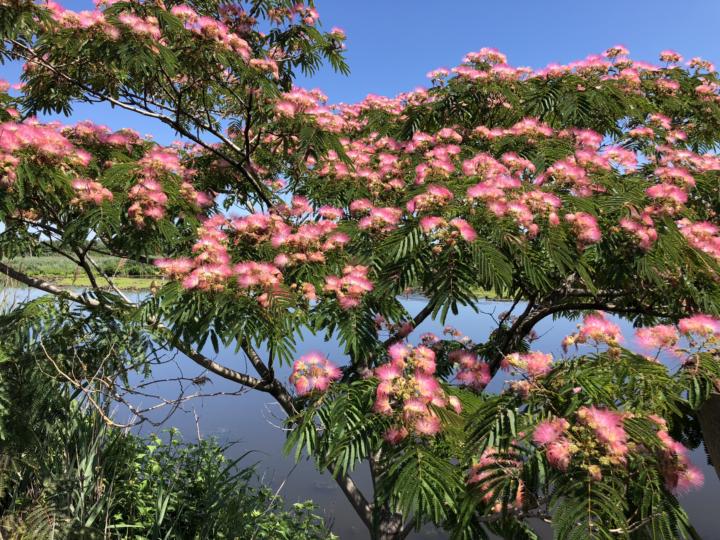
Welcome new members!! I hope those of you in the United States had a wonderful Memorial Day weekend. Over Memorial Day weekend I went out of town on a little girls trip, and one thing that caught my attention the entire drive were the Persian silk trees blooming everywhere along the highways and roadsides! Those fluffy pink flowers almost look dreamlike when they are in full bloom this time of year. Seeing them everywhere reminded me how badly I have wanted to talk about Albizia julibrissin again, commonly called the mimosa tree, Persian silk tree, or silk tree. I did a video last year on Albizia julibrissin. If you want to check it out, I'll link the video in the post! I completely sold out of 5 ounces of harvested mimosa flower from that video and am eager to harvest more to dry, as there are very little to no trustworthy sellers online. One thing that can get confusing in herbalism is the word “mimosa,” because multiple plants share that common name. When people talk about “mimosa flowers” in herbal preparations, they are often referring to the flowers of Albizia julibrissin, not necessarily the sensitive plant Mimosa pudica that folds its leaves when touched. Common names can overlap a lot in the plant world, which is why botanical names matter so much. Although she's beautiful, Albizia julibrissin is not native to the US. It originally comes from parts of Asia and the Middle East and was introduced here as an ornamental tree because of its beautiful flowers and fast growth. Over time it naturalized in many areas across the South and eastern United States, which is why so many of us see it lining roadsides every summer. Traditionally, the flowers and bark have been used in Chinese herbal traditions, where the tree is sometimes called the “Tree of Happiness.” Historically it has been associated with emotional support, calming the spirit, easing grief, supporting sleep, and helping with melancholy or emotional heaviness. The flowers in particular are often viewed as uplifting and heart soothing. I honestly love the flowers so much and a tincure of it tastes like heaven.
2 likes • Jun 2
I love learning about new plants 😍 now a new friend to keep my eyes peeled to spot in the world lol
1-5 of 5

@jessica-c-7675
My name is Jessica and I am a year and half into my herbal studies.
Active 95d ago
Joined Jun 1, 2026