Activity
Mon
Wed
Fri
Sun
Nov
Dec
Jan
Feb
Mar
Apr
May
Jun
Jul
Aug
Sep
Oct
What is this?
Less
More
Exploring Peptides Community
23.2k
5.0
Free
The Spiritual Tribunal
47
Free
Powerhouse Fitness for Women
27.7k
5.0
Free
Orion Peptides
407
Free
Peptides Calculator
1.4k
Free
5 contributions to Orion Peptides

30d •
China Peptide Shipping Disruptions: Why September Could Create Supply Chain Pressure for Research Peptides
For researchers and businesses working with research peptides, supply chains can be just as important as peptide quality. A disruption at the manufacturing or shipping level can quickly create longer lead times, reduced availability, and pressure on inventory. That is why reports of potential shipping interruptions from China beginning around September 22, 2026, have attracted attention across the research peptide market. However, there is an important distinction to make. There is currently no clear evidence of a universal Chinese government rule stating that all peptide or other sensitive products will be unable to ship internationally for two to four months beginning September 22. Instead, the situation appears to be related to a combination of holiday periods, international events, manufacturing schedules, logistics capacity, and the additional restrictions that can sometimes affect sensitive or regulated shipments. Why September and October Matter The timing is significant. China's 2026 calendar includes the Mid-Autumn Festival on September 25, followed shortly afterward by the National Day holiday period from October 1 through October 7. These periods can create temporary changes to factory operations, staffing, courier schedules, customs processing, and international freight capacity. That does not mean every manufacturer shuts down or every shipment stops. It does mean that businesses relying heavily on Chinese manufacturing or export logistics should not assume that September and October will operate exactly like a normal shipping period. For companies operating with relatively tight inventory, even a relatively short interruption can become significant. This Is a Supply Chain Issue, Not an Eli Lilly Issue Another claim circulating around this situation is that potential Chinese shipping disruptions are somehow connected to Eli Lilly. There is no good reason to automatically make that connection. Supply-chain interruptions can happen for many reasons, including national holidays, factory schedules, customs requirements, carrier capacity, international conferences, regulatory controls, and changes in export procedures.


0 likes • 28d
No way that Lilly has lobbyists pushing for the recent 30% increase in customs seizure of peptides imported to the U.S. and specific Chinese factories added to a list flagged for automatic seizure of all imports. There is Noooooo proof of that …. except it’s happening.
Jul 16 •
Do You Have to Stay on Retatrutide Forever? What the Research Says About Weight Regain and Coming Off
One of the biggest questions surrounding Retatrutide isn't how much weight people lose. It's what happens after they stop. Spend five minutes browsing peptide forums or social media and you'll see the same concern repeated over and over: "If I stop Retatrutide, will I gain all the weight back?" Some people even suggest you'll need to stay on it for life. Others recommend complicated "exit protocols" involving multiple compounds. So what's actually supported by current research? The answer is far more nuanced than many headlines suggest. Before we dive into the science, I'd like to thank Orion Peptides for supporting our educational content. If you're looking for premium research compounds, you can save 15% using my code Parker15. Let's separate physiology from internet speculation. Why Weight Regain Happens After Any Diet The first thing to understand is this: Weight regain is not unique to Retatrutide. Researchers have been studying weight loss for decades, and the pattern is remarkably consistent. Whether someone loses weight through: - calorie restriction - bariatric surgery - ketogenic diets - intermittent fasting - GLP-1 medications - intensive exercise …the body begins adapting. Scientists refer to this as adaptive thermogenesis. Your body simply becomes more efficient. Your Body Doesn't Want to Lose Weight From an evolutionary perspective, losing body fat was dangerous. Thousands of years ago, significant weight loss usually meant famine. So the body developed several protective mechanisms. As weight decreases: - Resting metabolic rate falls - Hunger hormones increase - Appetite rises - Energy expenditure decreases - Food becomes more rewarding - The brain encourages calorie intake These responses are normal human biology—not a failure of willpower. Retatrutide Doesn't Create an "Addiction" One misconception that's becoming increasingly common is the idea that people become "addicted" to Retatrutide.
0 likes • Jul 16
I’m down with the maintenance dose group. I’m loving the reduced cholesterol, reduced portions, reduced cravings for food, alcohol, or retail therapy.
Jul 10 •
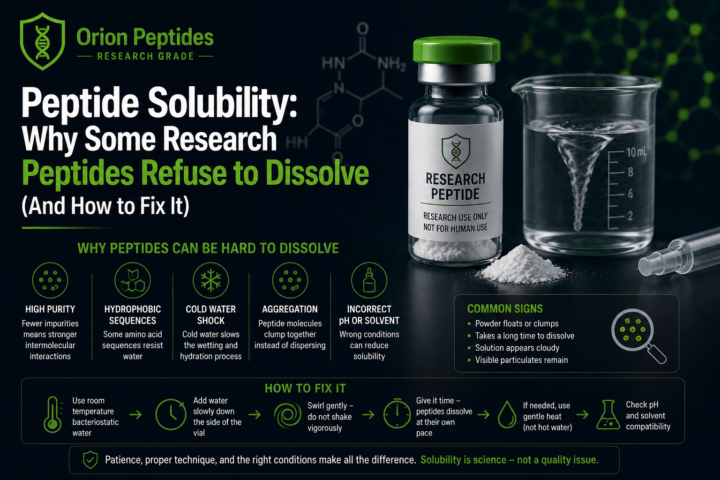
Peptide Solubility: Why Some Research Peptides Refuse to Dissolve (And How to Fix It)
One of the most common questions in peptide research isn't about dosing or storage—it's about reconstitution. A researcher adds bacteriostatic water to a vial, waits a few minutes, gives it a gentle swirl... and nothing happens. The peptide remains cloudy, forms small particles, or appears to stick stubbornly to the bottom of the vial. The first assumption is usually that something is wrong with the peptide. In reality, that's often not the case. Peptide solubility is influenced by chemistry, molecular structure, purity, salt form, and even the way the peptide was freeze-dried. Some compounds dissolve almost instantly, while others require considerably more patience and a slightly different approach. Understanding why this happens can prevent unnecessary frustration and help preserve valuable research materials. Why Some Peptides Dissolve Instantly While Others Don't Every peptide has its own unique chemical personality. Some are naturally hydrophilic (water-loving), while others contain long stretches of hydrophobic (water-repelling) amino acids. When water is introduced, hydrophilic peptides readily interact with the solvent. Hydrophobic peptides, however, prefer interacting with each other instead of the surrounding water molecules. This causes aggregation, cloudiness, or slow dissolution. The longer and more complex the peptide becomes, the greater the likelihood of this occurring. This is why compounds like: - Tesamorelin - Kisspeptin-10 - IGF-1 LR3 - Certain lipidated GLP-1 analogues often require additional care during reconstitution compared to smaller peptides like BPC-157 or TB-500. Tesamorelin: Why It Can Take Time Tesamorelin contains 44 amino acids. For comparison, many popular research peptides contain fewer than 15. That additional length creates several challenges. Longer peptide chains can begin folding into secondary structures such as alpha helices, exposing hydrophobic regions that naturally stick together. Tesamorelin also contains an N-terminal lipid modification which further reduces water solubility.
0 likes • Jul 10
Excellent. I like it when we get info that is not often explored by others. Thanks!!
Jul 6 •
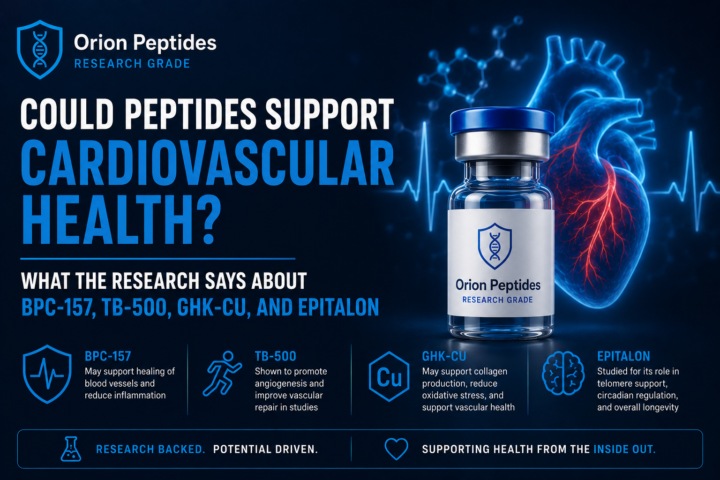
Could Peptides Support Cardiovascular Health? What the Research Says About BPC-157, TB-500, GHK-Cu, and Epitalon
Heart disease remains the leading cause of death worldwide, which is why researchers continue searching for new ways to support cardiovascular health beyond traditional medications and lifestyle interventions. In recent years, peptides have entered that conversation—not because they replace exercise, nutrition, blood pressure management, or cholesterol-lowering therapies, but because some are being investigated for their potential roles in vascular repair, inflammation, oxidative stress, and tissue regeneration. You'll sometimes hear bold claims online that peptides can "replace heart medications." That isn't supported by current evidence. What is supported is growing scientific interest in how certain naturally occurring signaling molecules may influence biological processes involved in cardiovascular aging. Before we dive in, thank you to Orion Peptides for supporting our educational content. If you're purchasing research compounds, you can save 15% with code Parker15 at checkout. Why Heart Health Is About More Than Cholesterol For decades, cardiovascular health has focused largely on: - Cholesterol - Blood pressure - Blood sugar - Smoking - Exercise Those remain incredibly important. But researchers now recognize several additional biological processes that contribute to cardiovascular aging. These include: - Chronic inflammation - Endothelial dysfunction - Oxidative stress - Fibrosis - Impaired blood vessel repair - Cellular aging Many investigational peptides are being studied because they interact with one or more of these systems. The Endothelium: Your Blood Vessels' Hidden Organ Every artery, vein, and capillary is lined with a thin layer of specialized cells called the endothelium. Although only one cell thick, this lining controls many vital functions. Healthy endothelial cells help regulate: - Blood vessel dilation - Blood flow - Oxygen delivery - Inflammation - Blood clotting - Communication between tissues
0 likes • Jul 6
Excellent article!! I’d love to print this for a friend that’s not on here. Absolutely excellent! If I have one thing to add it would be that vesugen a well researched Russian peptide out performed epitalion for telomere lengthening, boosts stem cell proliferation by 200%, and repairs endothelial and cardiac muscle. It also is neuroprotective.
Jan 6 •
🛑 Community Rules: Read Before Posting 🛑
Welcome to the team! To keep this space free, educational, and safe for everyone, please read and respect the following guidelines. We are here to research and learn, not to spam or endanger others. 1. NO Selling or Solicitation (Zero Tolerance)🚫 : - Do not use this group to sell your own products, promote your own affiliate links, or push "Underground Lab" (UGL) items. - Any member caught sliding into DMs to sell substances or unverified services will be banned immediately. 2. This is NOT Medical Advice ⚠️ - While I am a professional Biohacking Coach and Trainer, I am not a doctor, and neither are most members here. - Everything shared here is for informational, educational, and research purposes only. - Do not prescribe protocols to others as absolute medical fact. - Always consult with a qualified medical professional (like our partners at Optimal Clinic) before starting any new therapy. 3. Research & "Bro-Science" 🧪 - We love new experiments, but please distinguish between anecdotal experience (what worked for you) and scientific fact. - If you make a bold claim, try to back it up with a source or clearly state that it is just your personal experience. - Help us fight misinformation by calling out bad data respectfully. 4. Respect & Professionalism 🤝 - We are navigating a complex industry together. Treat fellow researchers with respect. - No flaming, harassment, or bullying. - Disagreements are fine; disrespect is not. 5. Privacy Matters 🔒 - Do not post private personal information (addresses, phone numbers, etc.) or sensitive payment details regarding vendors publicly. Keep the feed clean and safe. 🔒
0 likes • Jul 3
Agree
1-5 of 5

Active 49m ago
Joined Jul 3, 2026